Applying for Social Security disability benefits can be a stressful process, especially if you’re unable to work because of a serious medical condition. While no one can guarantee approval, there are several signs that you will be approved for disability that may indicate your application is stronger than average.
The Social Security Administration (SSA) reviews every claim carefully. Approval depends on medical evidence, work history, income, and how your condition affects your ability to perform substantial work. Many applicants are denied simply because they don’t provide enough documentation—not necessarily because they don’t qualify.
In this guide, you’ll learn the most common signs that can improve your chances of approval, the reasons some claims are denied, and what you can do to strengthen your disability application.
Quick Answer
There is no guaranteed sign that you’ll be approved for Social Security disability benefits. However, your chances are generally higher if:
- Your medical condition meets the SSA’s definition of disability.
- Your condition is expected to last at least 12 months or result in death.
- You have strong medical records supporting your limitations.
- Your doctors document that you cannot work.
- Your condition matches an impairment listed by the SSA or is equally severe.
- You have enough work credits for Social Security Disability Insurance (SSDI), or you meet the financial requirements for Supplemental Security Income (SSI), if applicable.
Official Source: Social Security Administration – Disability Benefits
How the SSA Decides Disability Claims
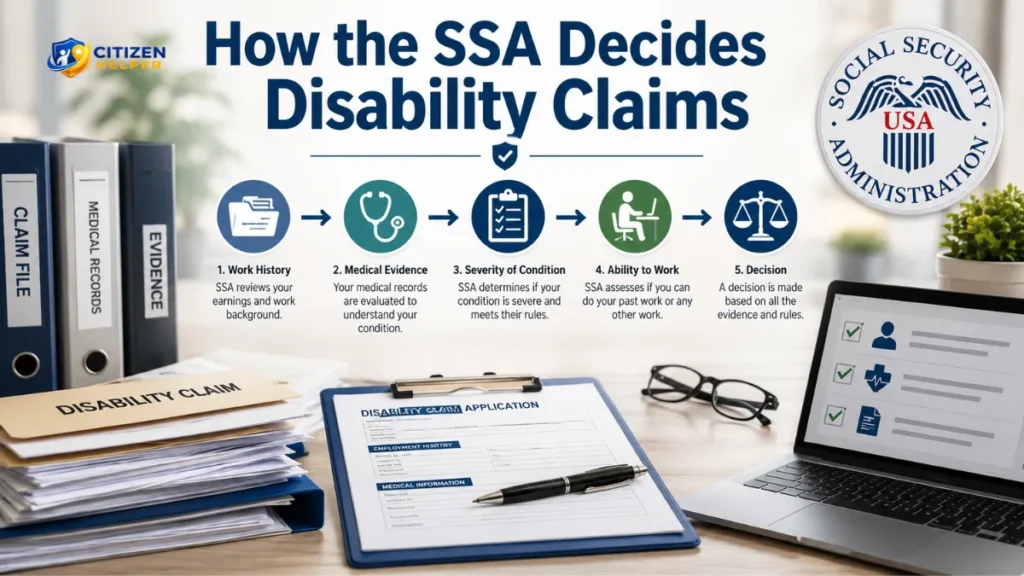
Before looking at the signs that you will be approved for disability, it’s important to understand how the SSA evaluates every application.
The SSA follows a five-step evaluation process to determine whether an applicant qualifies for disability benefits.
The agency considers:
- Whether you’re currently working above the allowed earnings limit.
- Whether your medical condition is severe.
- Whether your condition meets or equals one of the SSA’s listed impairments.
- Whether you can still perform your previous work.
- Whether you can adjust to another type of work based on your age, education, and work experience.
Even if your illness isn’t specifically listed, you may still qualify if your limitations prevent you from working full-time.
Official Source: Social Security Administration – Disability Evaluation Under Social Security
Signs That You Will Be Approved for Disability
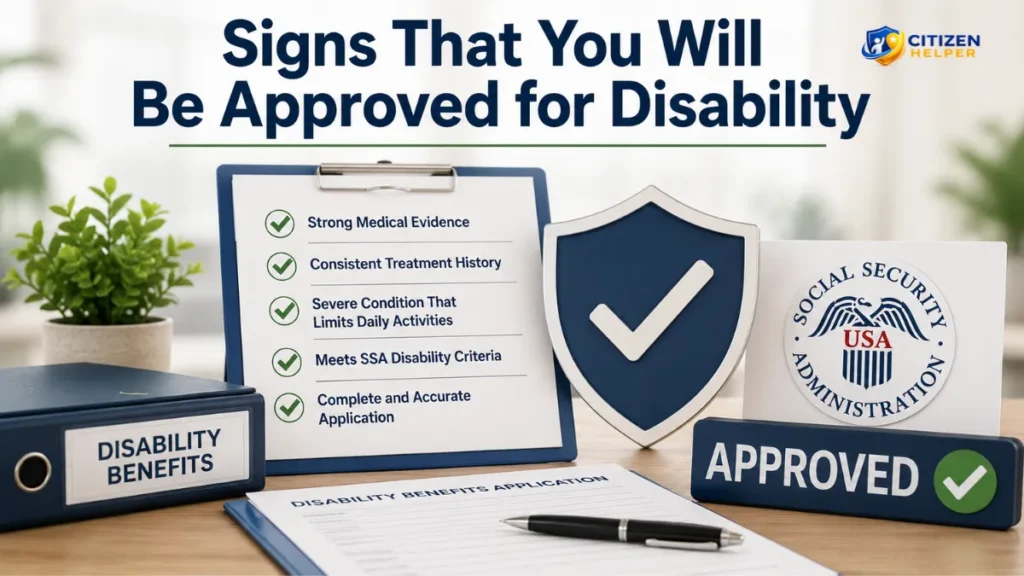
While every case is unique, the following factors often strengthen a disability claim.
1. Your Medical Condition Matches the SSA Blue Book
One of the strongest signs is that your condition appears in the SSA’s Blue Book, officially called the Listing of Impairments.
The Blue Book contains medical conditions that are considered severe enough to qualify for disability if specific requirements are met.
Examples include:
- Certain cancers
- Advanced heart disease
- Chronic kidney disease
- Multiple sclerosis
- Parkinson’s disease
- Severe spinal disorders
- Blindness
- Intellectual disorders
- Serious mental health conditions
Meeting a Blue Book listing doesn’t automatically guarantee approval, but it can significantly improve your chances when supported by complete medical evidence.
Official Source: Social Security Administration – Listing of Impairments
2. You Have Strong Medical Evidence
Medical documentation is one of the biggest factors in any disability claim.
Strong evidence may include:
- Physician treatment records
- Hospital records
- MRI, CT scan, or X-ray results
- Blood test results
- Mental health evaluations
- Surgical reports
- Physical therapy records
- Specialist reports
- Medication history
The SSA looks for objective medical evidence that confirms your diagnosis and explains how your condition limits your ability to work.
Applicants who regularly receive treatment generally have stronger cases than those with limited medical records.
3. Your Doctor Clearly States You Cannot Work
Although the SSA makes the final decision—not your doctor—a detailed opinion from your treating physician can strengthen your claim.
Helpful medical opinions often explain:
- Why you cannot work full-time
- Physical limitations
- Mental limitations
- Need for frequent breaks
- Difficulty standing, walking, lifting, sitting, or concentrating
- Expected duration of your condition
A doctor’s statement is most persuasive when it’s supported by treatment records and objective medical findings.
4. Your Condition Has Lasted or Is Expected to Last at Least 12 Months
The SSA generally requires that your disability:
- Has lasted at least 12 months,
- Is expected to last at least 12 months, or
- Is expected to result in death.
Short-term injuries usually don’t qualify for disability benefits.
For example:
- A broken arm expected to heal within several months usually won’t qualify.
- Advanced heart failure that prevents ongoing employment may qualify if it meets SSA requirements.
Official Source: Social Security Administration – Disability Benefits
5. You Can No Longer Perform Your Previous Job
The SSA evaluates whether you’re capable of doing the work you’ve performed in the past.
If your condition prevents you from performing your previous job duties, the agency then considers whether you could reasonably adjust to another type of work.
This evaluation considers factors such as:
- Physical ability
- Mental functioning
- Education
- Age
- Job skills
- Previous work experience
Older applicants with limited transferable skills may sometimes have a stronger case because adjusting to new work may be more difficult.
6. Your Functional Limitations Are Well Documented
Examples of functional limitations include:
- Difficulty standing longer than 15 minutes
- Inability to lift more than a few pounds
- Chronic fatigue
- Severe pain
- Memory problems
- Difficulty concentrating
- Panic attacks
- Frequent medical appointments
- Need to lie down during the day
These limitations should be consistently documented in your medical records.
7. You Follow Your Treatment Plan
Another positive sign is that you consistently follow the treatment recommended by your healthcare providers.
The SSA may review whether you:
- Attend medical appointments regularly.
- Take prescribed medications.
- Participate in physical therapy or rehabilitation, if recommended.
- Follow specialist referrals.
- Continue treatment for ongoing conditions.
If you stop treatment without a valid reason, the SSA may question whether your condition is as limiting as claimed. However, there can be acceptable reasons for not following treatment, such as severe side effects or an inability to afford care.
8. Your Medical Records Are Consistent
Consistency matters throughout the disability review process.
For example, if your medical records repeatedly document chronic pain, limited mobility, or severe depression over many months, your claim may appear more credible than one with conflicting or incomplete records.
The SSA compares information from multiple sources, including:
- Doctors
- Specialists
- Hospitals
- Therapists
- Imaging reports
- Laboratory tests
When these records tell the same story about your condition and limitations, they can strengthen your application.
9. You Have Frequent Medical Visits
Regular treatment shows that your condition is ongoing and requires continued medical attention.
Applicants who see healthcare providers consistently often have:
- More complete medical documentation.
- Updated test results.
- Detailed progress notes.
- Records showing how symptoms have changed over time.
Long gaps in treatment may require additional explanation, particularly if they leave questions about the severity of your condition.
10. Your Work History Supports Your Claim
For SSDI, your work history can also play an important role.
A steady employment history before becoming disabled may support your claim by showing that you worked until your medical condition prevented you from continuing.
The SSA will also verify whether you have earned enough work credits to qualify for SSDI.
Official Source: Social Security Administration – SSDI Benefits
Medical Conditions That Commonly Qualify for Disability
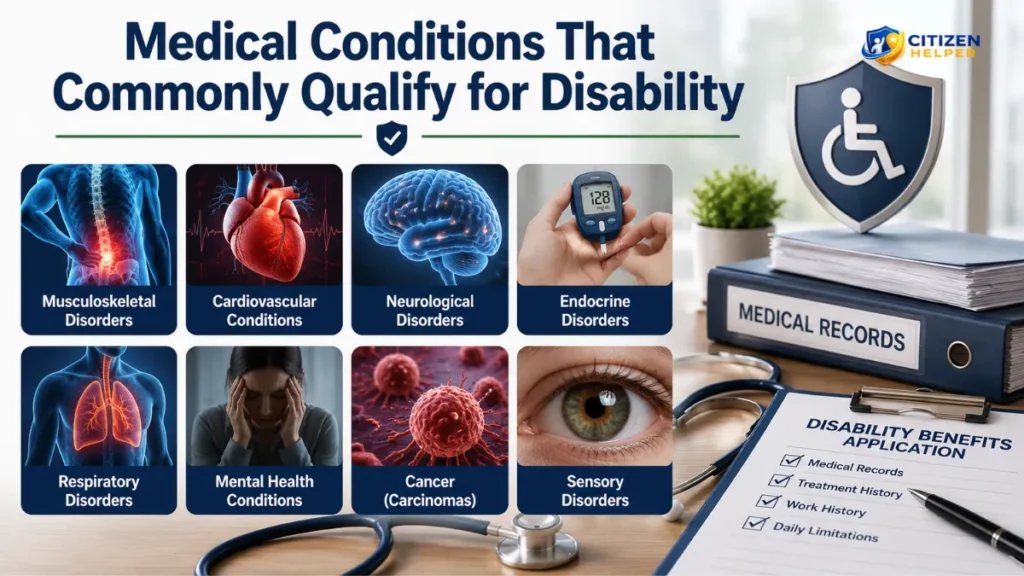
Many different medical conditions can qualify for disability benefits if they prevent substantial work and meet SSA requirements.
Some examples include:
Physical Conditions
- Severe arthritis
- Chronic heart failure
- Chronic kidney disease
- Chronic obstructive pulmonary disease (COPD)
- Multiple sclerosis
- Parkinson’s disease
- Stroke
- Spinal cord injuries
- Degenerative disc disease
- Certain cancers
Mental Health Conditions
- Major depressive disorder
- Bipolar disorder
- Schizophrenia
- Autism spectrum disorder
- Anxiety disorders
- Obsessive-compulsive disorder (OCD)
- Post-traumatic stress disorder (PTSD)
- Intellectual disorders
Having one of these conditions does not automatically qualify you for disability. The SSA considers the severity of your symptoms and how they affect your ability to work.
Common Reasons Disability Claims Are Denied
Many applicants are surprised when their first application is denied. In many cases, the denial is based on missing evidence rather than the medical condition itself.
Common reasons include:
- Insufficient medical evidence.
- Failure to follow prescribed treatment.
- Earning more than the SSA’s allowed income limit.
- The condition is not expected to last at least 12 months.
- Missing medical records.
- Incomplete application forms.
- Failure to attend a consultative examination requested by the SSA.
- The SSA determines you can still perform your past work or adjust to another job.
Understanding these common issues can help you avoid preventable mistakes.
How to Improve Your Chances of Disability Approval
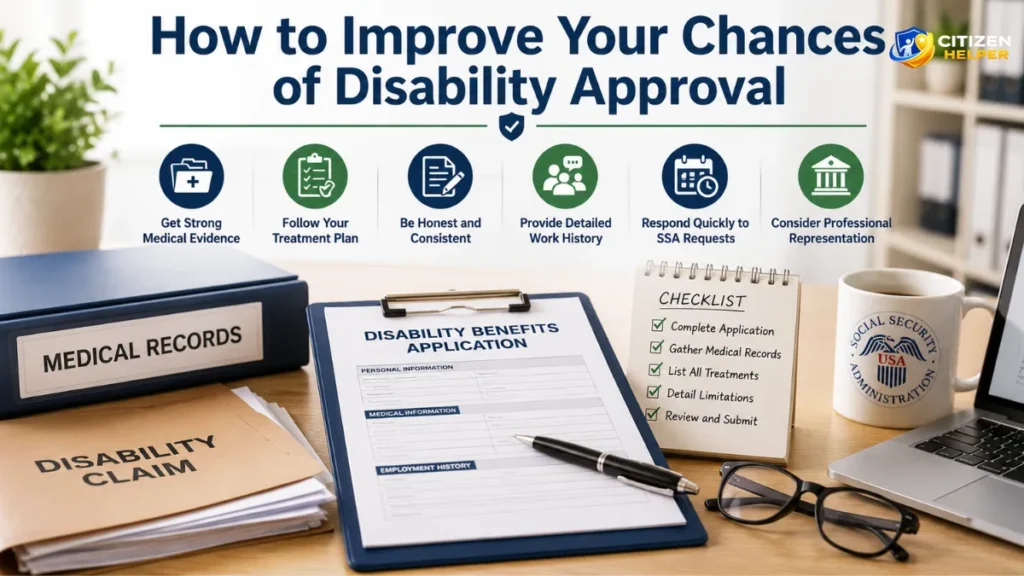
While no strategy guarantees approval, these steps may strengthen your application:
Keep Detailed Medical Records
Maintain copies of:
- Test results
- Imaging reports
- Medication lists
- Treatment plans
- Hospital records
- Specialist evaluations
Continue Medical Treatment
Regular treatment creates an ongoing record of your condition and helps demonstrate that your symptoms are persistent.
Be Honest About Your Symptoms
Describe your limitations accurately. Avoid minimizing or exaggerating your symptoms, as inconsistencies can create questions during the review process.
Complete Every Form Carefully
Review your application before submitting it to ensure all sections are complete and accurate.
Respond Quickly to SSA Requests
If the SSA asks for additional information, medical records, or schedules a consultative examination, respond promptly to help avoid delays.
Does Age Affect Disability Approval?
Age can influence how the SSA evaluates whether someone can adjust to other work.
In general, older applicants may receive more favorable consideration under certain SSA vocational rules because changing careers can become more difficult with age.
However, age alone does not qualify someone for disability benefits. Every applicant must still meet the SSA’s medical and non-medical requirements.
What Happens After You Apply?
After submitting your application, the SSA may:
- Review your non-medical eligibility.
- Request your medical records.
- Ask you to complete additional questionnaires.
- Schedule a consultative examination if more information is needed.
- Issue an approval or denial decision.
Processing times vary depending on the complexity of the case and how quickly medical evidence is received.
Official Source: Social Security Administration – Disability Benefits
Conclusion:
Recognizing the signs that you will be approved for disability can help you better understand how the Social Security Administration evaluates claims. Strong medical evidence, consistent treatment, well-documented functional limitations, and meeting the SSA’s disability requirements can all improve your chances of approval.
Even if your condition is serious, approval is never automatic. The SSA reviews each application individually, considering both medical and non-medical eligibility requirements. Taking time to gather complete medical records, follow your treatment plan, and provide accurate information can make your application stronger.
Because disability rules and income limits may change, always verify the latest requirements through the Social Security Administration before applying.
Frequently Asked Questions (FAQ)
What is the biggest sign that you will be approved for disability?
There is no single guarantee of approval. However, having strong medical evidence, documented functional limitations, and a condition that meets or equals an SSA impairment listing are among the strongest indicators.
Does my doctor’s opinion guarantee disability approval?
No. While your doctor’s opinion can be important, the SSA reviews all available medical and vocational evidence before making a decision.
Can I be approved if my condition is not in the SSA Blue Book?
Yes. Even if your condition is not specifically listed, you may still qualify if the SSA determines that your limitations prevent you from performing substantial gainful work.
Is it easier to get disability if I’m older?
Age may be one factor the SSA considers when determining whether you can adjust to other work. However, you must still meet all medical and eligibility requirements.
Can I work while applying for disability?
Possibly. However, earning more than the SSA’s substantial gainful activity (SGA) limit may affect your eligibility. The income limits can change each year, so check the latest SSA guidance.