If you receive Social Security Disability Insurance (SSDI), you may wonder whether you need to pay taxes on your monthly benefits. The good news is that most SSDI recipients do not pay federal income tax on their benefits. However, some people with higher overall incomes may owe taxes on a portion of their SSDI payments.
In this guide, you’ll learn when SSDI is taxable, how the IRS determines whether your benefits are taxed, how to estimate if you may owe taxes, and what steps you can take to avoid surprises at tax time.
Quick Answer
Yes, SSDI can be taxable—but not for everyone.
Whether your SSDI benefits are taxed depends on your combined income for the year. If your income exceeds certain IRS thresholds, up to 50% or 85% of your SSDI benefits may be taxable.
Most people who rely mainly on SSDI and have little or no additional income do not owe federal income tax on their disability benefits.
Official Source: IRS – Publication 915: Social Security and Equivalent Railroad Retirement Benefits
What Is SSDI?

Social Security Disability Insurance (SSDI) is a federal program that provides monthly benefits to people who cannot work because of a qualifying disability and who have earned enough work credits through payroll taxes.
Unlike Supplemental Security Income (SSI), SSDI is based on your work history rather than financial need.
Many people assume SSDI is always tax-free, but the IRS treats disability benefits similarly to Social Security retirement benefits for tax purposes.
Official Source: Social Security Administration – Disability Benefits
Is SSDI Taxable?
Yes—but only in certain situations.
The IRS looks at your combined income to determine whether part of your SSDI benefits is taxable.
If your combined income stays below the IRS limits, your SSDI benefits generally are not taxable. If your income exceeds the applicable thresholds, up to 50% or 85% of your SSDI benefits may be included in your taxable income.
It is important to remember that these percentages refer to the portion of your benefits that may be subject to income tax, not the tax rate you pay.
IRS Income Thresholds for SSDI Taxation
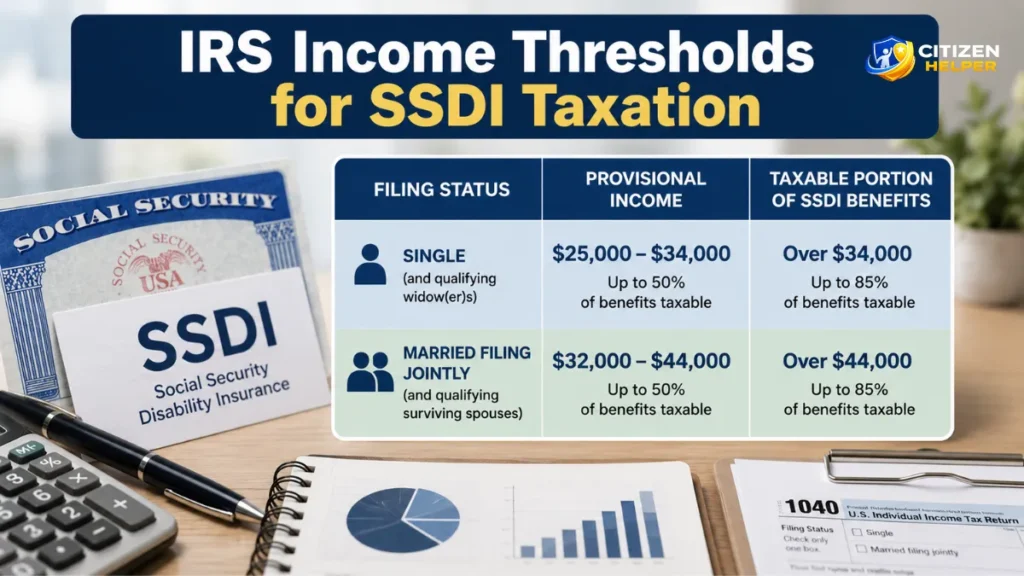
The IRS uses different income thresholds depending on your tax filing status.
| Filing Status | Combined Income | Taxable Benefits |
| Single | Under $25,000 | Usually not taxable |
| Single | $25,000–$34,000 | Up to 50% may be taxable |
| Single | Over $34,000 | Up to 85% may be taxable |
| Married Filing Jointly | Under $32,000 | Usually not taxable |
| Married Filing Jointly | $32,000–$44,000 | Up to 50% may be taxable |
| Married Filing Jointly | Over $44,000 | Up to 85% may be taxable |
These percentages refer to the portion of your benefits that may be taxable, not the percentage of tax you owe.
Official Source: IRS – Publication 915
What Is Combined Income?
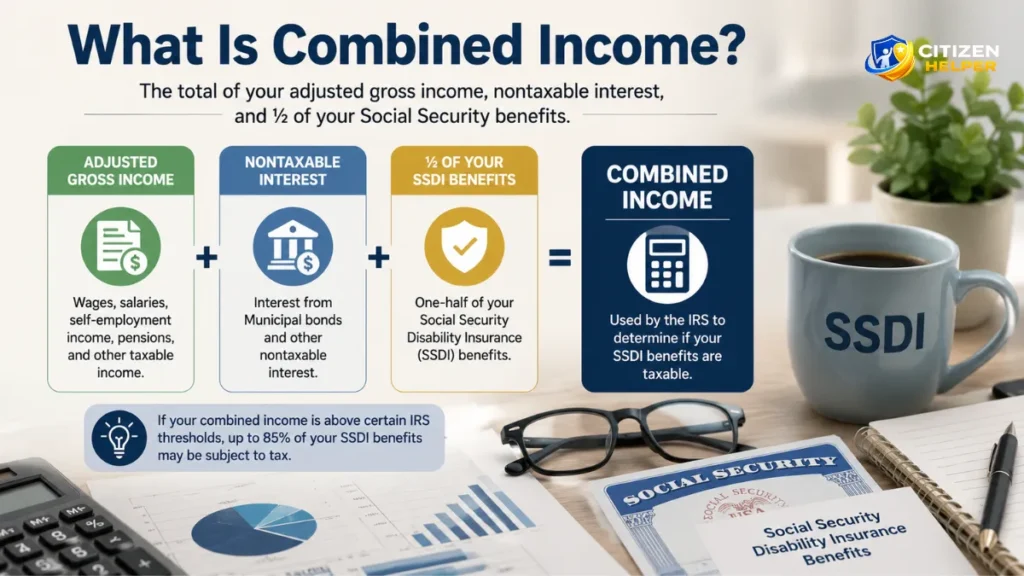
The IRS uses a figure called combined income (sometimes referred to as provisional income) to determine whether any portion of your Social Security benefits, including SSDI, is taxable.
For most taxpayers, combined income is calculated as:
- Your Adjusted Gross Income (AGI)
- + Any nontaxable interest (such as certain municipal bond interest)
- + One-half (50%) of your annual SSDI benefits
The IRS compares this combined income to its income thresholds to determine whether none, up to 50%, or up to 85% of your SSDI benefits may be taxable.
Example
Suppose you have:
- SSDI benefits: $24,000 per year
- Part-time wages: $18,000
- No nontaxable interest
Your combined income would be:
- $18,000 (Adjusted Gross Income)
- $0 (Nontaxable interest)
- $12,000 (Half of your annual SSDI benefits)
- = $30,000
Since this exceeds the IRS threshold for a single filer, part of your SSDI benefits could become taxable.
When Is SSDI Usually Not Taxable?
Many SSDI recipients pay no federal income tax because they have little additional income.
You may not owe taxes if:
- SSDI is your primary source of income.
- You have little or no employment income.
- You receive minimal retirement income.
- You have limited investment income.
This is why many disability beneficiaries never pay taxes on their monthly benefits.
Income That Can Make SSDI Taxable
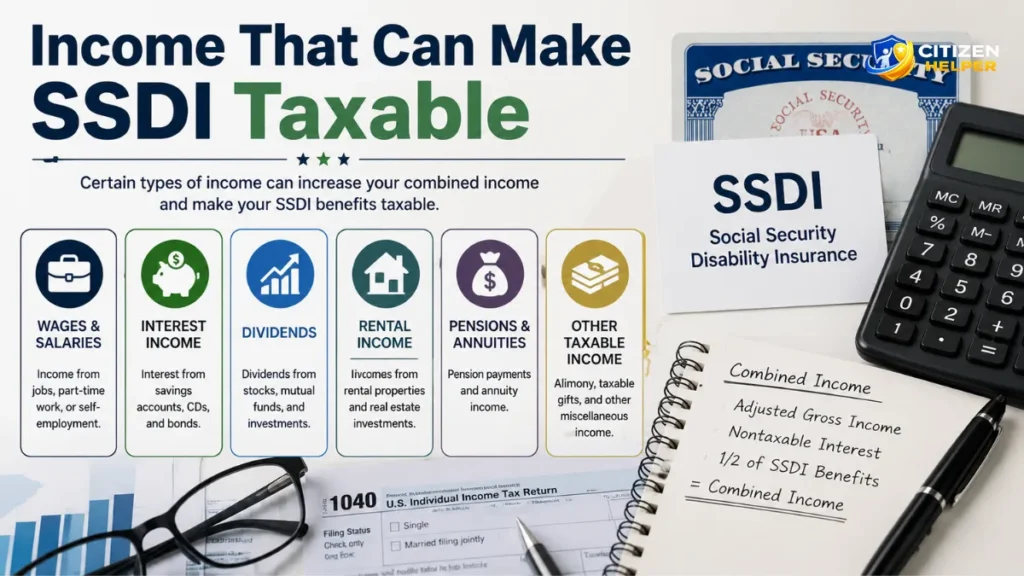
Your SSDI benefits may become taxable if you also receive income from:
- Employment
- Self-employment
- Retirement pensions
- IRA withdrawals
- 401(k) distributions
- Investment income
- Rental income
- Interest and dividends
The more taxable income you receive, the greater the chance that part of your SSDI benefits will also become taxable.
Does SSI Affect SSDI Taxes?
No.
Supplemental Security Income (SSI) is different from SSDI.
SSI benefits are not taxable under federal law.
If you receive both SSI and SSDI, only the SSDI portion may be taxable if your total income exceeds IRS limits.
Official Source: Social Security Administration – Supplemental Security Income (SSI)
Are State Taxes Different?
Yes, they can be.
While many states do not tax Social Security benefits, state tax treatment of Social Security benefits varies by state. Some states may tax certain Social Security benefits, while others exempt them entirely or apply income-based rules.
Because state tax laws can change, you should not assume that your state’s rules are the same as the federal rules.
Check your state’s department of revenue or official tax agency for the most current rules.
How Can You Find Out if Your SSDI Is Taxable?
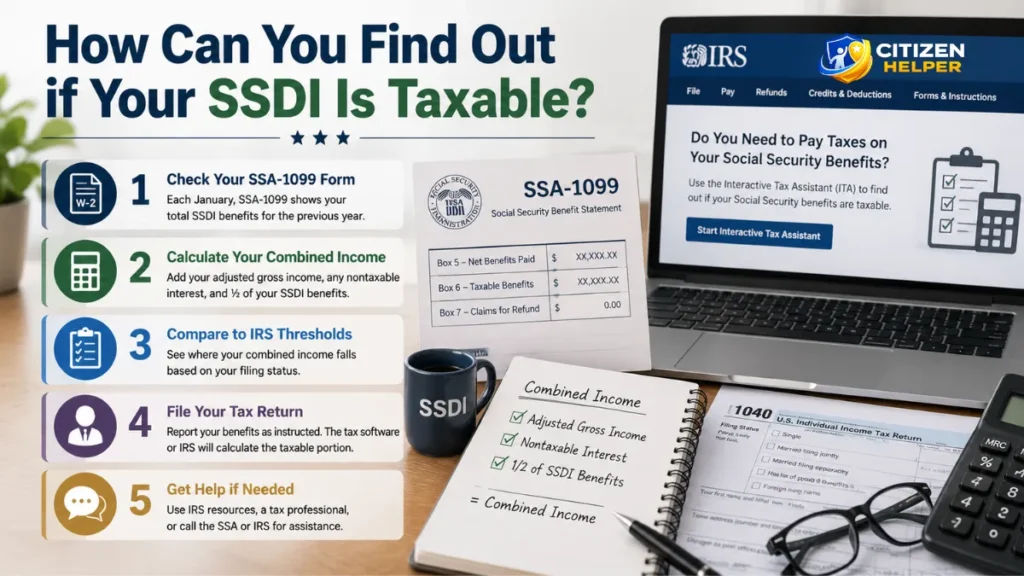
The easiest way is to review your annual income before filing your tax return.
You can also:
- Use the IRS Interactive Tax Assistant.
- Review IRS Publication 915.
- Consult a qualified tax professional.
- Use reputable tax preparation software.
Your annual Social Security Benefit Statement (Form SSA-1099) shows the total SSDI benefits you received during the year.
Official Source: Social Security Administration – Form SSA-1099
Can You Have Taxes Withheld From SSDI?
Yes.
If you expect to owe taxes on your SSDI benefits, you can choose voluntary federal income tax withholding.
This may help prevent a large tax bill when you file your annual return.
You can request withholding by completing the appropriate IRS form through the Social Security Administration.
Voluntary tax withholding may not be necessary for every SSDI recipient. Consider your overall income or consult a qualified tax professional before making a decision.
Official Source: IRS – Form W-4V
Common Misconceptions About SSDI Taxes
Myth: SSDI Is Always Tax-Free
Not necessarily. Higher-income recipients may owe taxes on part of their benefits.
Myth: If Benefits Are Taxable, All of Them Are Taxed
False. At most, up to 85% of your benefits may be taxable, depending on your income.
Myth: Everyone Receiving SSDI Must File Taxes
Not always. Whether you need to file a federal tax return depends on your overall income and IRS filing requirements.
Tips to Reduce Tax Surprises

If you receive SSDI and have other income:
- Keep records of all income sources.
- Review your annual SSA-1099 form.
- Estimate your combined income before tax season.
- Consider voluntary tax withholding if appropriate.
- Consult a tax professional if your income changes significantly.
Planning ahead can make filing your taxes much easier.
Conclusion
So, is SSDI taxable? The answer depends on your total income. Most people whose primary source of income is SSDI do not owe federal income tax on their benefits. However, if you earn wages, receive retirement income, or have significant investment earnings, part of your SSDI benefits may become taxable under IRS rules.
Before filing your taxes each year, review your combined income, check the latest IRS guidance, and consider speaking with a qualified tax professional if your financial situation has changed. Staying informed can help you avoid unexpected tax bills and ensure you meet your filing obligations.
Keep in mind that IRS tax rules, income thresholds, and filing guidance may change over time. Before making tax-related decisions, verify the latest information on the official IRS website.
Frequently Asked Questions (FAQ)
Is SSDI considered taxable income?
It can be. Whether SSDI is taxable depends on your combined income and IRS filing thresholds.
How much of SSDI can be taxed?
Depending on your income, up to 50% or up to 85% of your SSDI benefits may be taxable.
Do I have to pay taxes if SSDI is my only income?
In most cases, no. People whose only significant income is SSDI generally do not owe federal income tax on their benefits.
Is SSI taxable like SSDI?
No. SSI benefits are generally not taxable.
Will receiving retirement benefits affect SSDI taxes?
Yes. Additional retirement income may increase your combined income and make part of your SSDI benefits taxable.