If you’re unable to work because of a medical condition and you’re 50 years old or older, the Social Security disability rules after age 50 may make it easier to qualify for benefits than they do for younger applicants. The Social Security Administration (SSA) recognizes that changing careers or learning new work skills becomes more difficult as people age. Because of this, the SSA uses special medical-vocational guidelines—often called the Grid Rules—when evaluating disability claims for older workers.
Understanding these rules can improve your chances of receiving Social Security Disability Insurance (SSDI) benefits if your condition prevents you from maintaining substantial work. In this guide, you’ll learn how disability rules change after age 50, who qualifies, how work history and education affect your claim, and what to expect during the application process.
Quick Answer
Yes. The Social Security disability rules after age 50 are generally more favorable than those for younger applicants. Once you turn 50, the SSA begins considering your age as an important vocational factor. If your medical condition prevents you from performing your previous work and adjusting to new work is considered difficult because of your age, education, and work experience, you may qualify for disability benefits under the SSA’s Medical-Vocational Guidelines (Grid Rules).
Official Source: Social Security Administration – Medical-Vocational Guidelines
How Social Security Evaluates Disability Claims

Before considering your age, the SSA follows a five-step evaluation process for every disability application.
The SSA asks:
- Are you currently working above the Substantial Gainful Activity (SGA) limit?
- Do you have a severe medical condition?
- Does your condition meet or equal a listed impairment?
- Can you perform your previous work?
- Can you adjust to any other work?
If the answer to the fifth question is no, you may qualify for disability benefits.
For applicants over age 50, this final step often becomes much more favorable because the SSA recognizes that transitioning into a completely different type of job becomes increasingly difficult with age.
Official Source: Social Security Administration – Disability Evaluation Under Social Security
Why Age 50 Is an Important Milestone
Turning 50 does not automatically qualify someone for disability benefits.
Instead, age becomes one of several vocational factors the SSA considers when deciding whether you can adjust to other work.
The SSA divides applicants into several age categories:
| Age | SSA Category |
| Under 50 | Younger Individual |
| 50–54 | Closely Approaching Advanced Age |
| 55–59 | Advanced Age |
| 60 and older | Closely Approaching Retirement Age |
Each higher age category generally makes it easier to qualify when combined with limited work skills and significant medical limitations.
What Are the SSA Grid Rules?
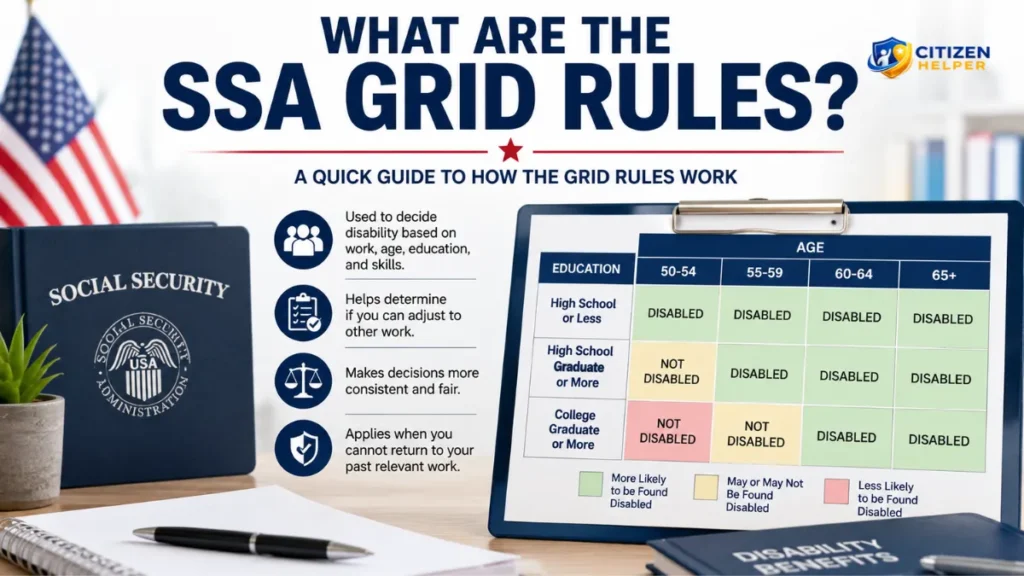
The Medical-Vocational Guidelines, commonly called the Grid Rules, help the SSA determine whether someone can reasonably transition to another type of work.
Instead of looking only at your medical condition, the SSA also considers:
- Your age
- Your education
- Your previous work experience
- Whether your job skills transfer to other work
- Your physical ability to perform work
These factors are evaluated together.
For example, a 52-year-old construction worker with severe arthritis may have a much stronger disability claim than a healthy office worker of the same age because construction skills may not easily transfer to less physically demanding jobs.
Official Source: Social Security Administration – Medical-Vocational Rules
How the Rules Change After Age 50
The biggest difference after age 50 is that the SSA becomes more realistic about your ability to switch careers.
If your medical condition limits you to sedentary or light work and your previous job required medium or heavy labor, the SSA may determine that finding suitable employment is unlikely.
This is especially true if:
- You spent many years in physically demanding work.
- Your skills do not transfer easily to office jobs.
- You have limited education.
- Your medical condition significantly limits your ability to work.
These factors can increase the likelihood of approval under the Medical-Vocational Guidelines.
Age Categories Explained
Ages 50–54: Closely Approaching Advanced Age
Applicants between 50 and 54 receive the first significant advantage under SSA rules.
The SSA recognizes that workers in this age group may struggle to adapt to entirely new occupations, particularly after years in physically demanding jobs.
You may have a stronger claim if:
- You cannot perform your previous work.
- Your medical condition limits you to sedentary or light work.
- Your work skills are not transferable.
- You have limited formal education.
However, the SSA still evaluates every claim individually.
Ages 55–59: Advanced Age
Applicants between ages 55 and 59 often benefit from even more favorable Grid Rules.
The SSA generally assumes that changing careers becomes increasingly difficult at this stage of life.
If your previous work required physical labor and your medical condition prevents you from continuing that work, your chances of qualifying may improve.
Transferable job skills become especially important during this age group.
Age 60 and Older
Workers age 60 and older receive the greatest consideration before reaching retirement age.
The SSA recognizes that learning entirely new occupations shortly before retirement may not be realistic.
Applicants with severe medical limitations and non-transferable work skills may qualify more easily under the Grid Rules than younger workers with similar medical conditions.
Medical Conditions That May Qualify After Age 50
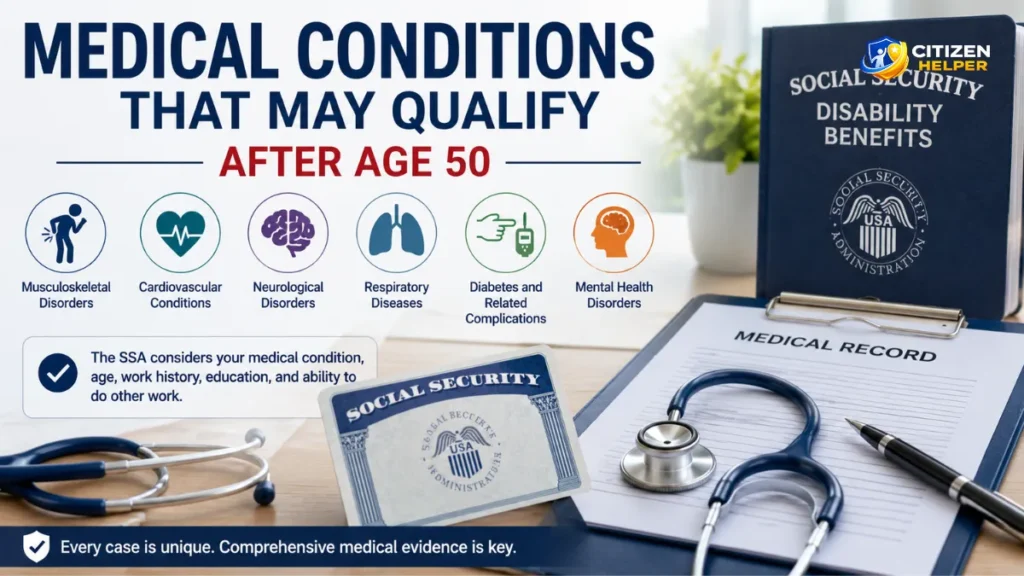
The SSA does not maintain a separate list of medical conditions for people over age 50.
Instead, eligibility depends on how your condition affects your ability to work.
Common conditions include:
- Arthritis
- Degenerative disc disease
- Chronic back pain
- Heart disease
- Stroke complications
- Diabetes with serious complications
- Chronic obstructive pulmonary disease (COPD)
- Multiple sclerosis
- Parkinson’s disease
- Cancer
- Kidney disease
- Severe vision impairment
- Mental health disorders such as depression or anxiety when they significantly limit work ability
Even if your condition is not specifically listed in the SSA’s Blue Book, you may still qualify if the combined evidence shows you cannot perform substantial work.
Official Source: Social Security Administration – Listing of Impairments
Does Your Work History Matter?
Yes. Your work history plays a major role in disability decisions after age 50.
The SSA evaluates:
- The type of work you’ve performed.
- How physically demanding those jobs were.
- Whether your skills can transfer to different occupations.
- How long you performed those jobs.
Someone who spent 30 years in construction, manufacturing, farming, or warehouse work may face greater challenges adapting to sedentary office work than someone who has always worked in administrative roles.
As a result, applicants with long careers in physically demanding occupations may have stronger claims under the Medical-Vocational Guidelines when supported by medical evidence.
Residual Functional Capacity (RFC) Is Critical
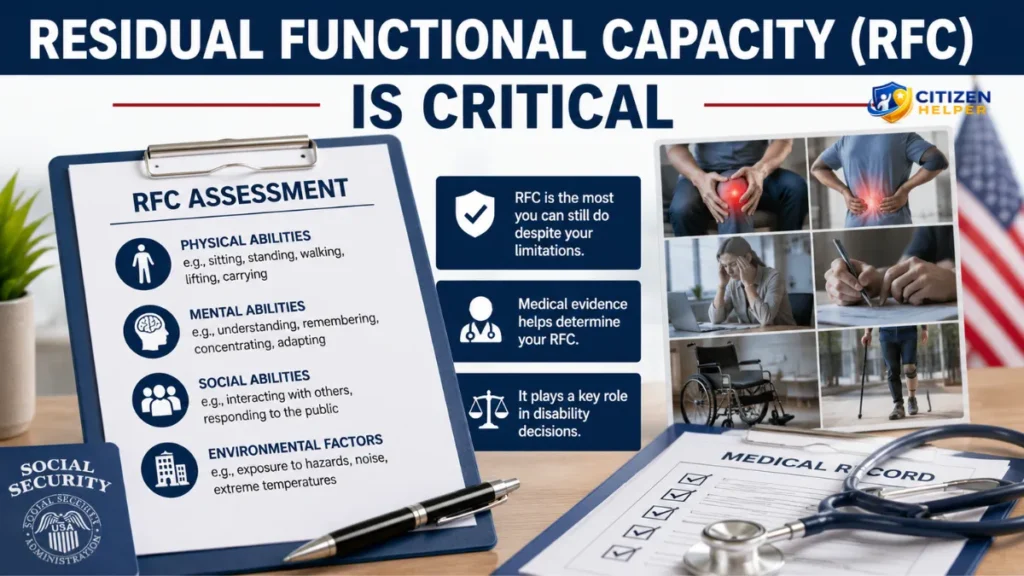
One of the most important factors in any disability claim is your Residual Functional Capacity (RFC). An RFC is the SSA’s assessment of the most you can still do despite your medical condition.
Your RFC is based on medical evidence, including:
- Medical records
- Doctor’s treatment notes
- Imaging results (such as X-rays or MRIs)
- Laboratory tests
- Hospital records
- Statements from your healthcare providers
The SSA uses your RFC to determine whether you can:
- Return to your previous job.
- Perform a different type of work.
- Sustain full-time work on a regular basis.
For example, if your RFC shows that you can only perform sedentary work, your age, education, and work history become especially important under the Medical-Vocational Guidelines.
Official Source: Social Security Administration – Residual Functional Capacity
How Education Affects Disability Claims After Age 50
Education is another vocational factor the SSA considers when applying the Grid Rules.
Generally, workers with less formal education may have a stronger case if their medical condition prevents them from returning to their previous occupation.
The SSA evaluates whether your education provides skills that would make it easier to adapt to other work.
For example:
| Education Level | Possible Impact |
| Limited education | May support a disability finding if other Grid Rule factors are met. |
| High school diploma | Evaluated along with work history and transferable skills. |
| College or specialized training | May make it easier for the SSA to conclude you can adjust to other work, depending on your experience and limitations. |
Education alone does not determine eligibility. It is considered alongside your age, medical limitations, and work experience.
Transferable Job Skills Can Affect Your Claim
The SSA also looks at whether the skills you gained from previous jobs can transfer to other occupations.
Transferable skills may include:
- Computer proficiency
- Bookkeeping
- Supervisory experience
- Customer service
- Administrative tasks
- Technical or specialized knowledge
In contrast, many physically demanding jobs involve skills that are not easily transferable to sedentary work.
For example:
- A roofer with severe knee problems may have limited transferable skills for office-based employment.
- A payroll specialist with the same medical condition may have skills that could transfer to less physically demanding work.
Because of this, transferable skills can significantly influence the outcome of a disability claim after age 50.
SSDI vs. SSI After Age 50
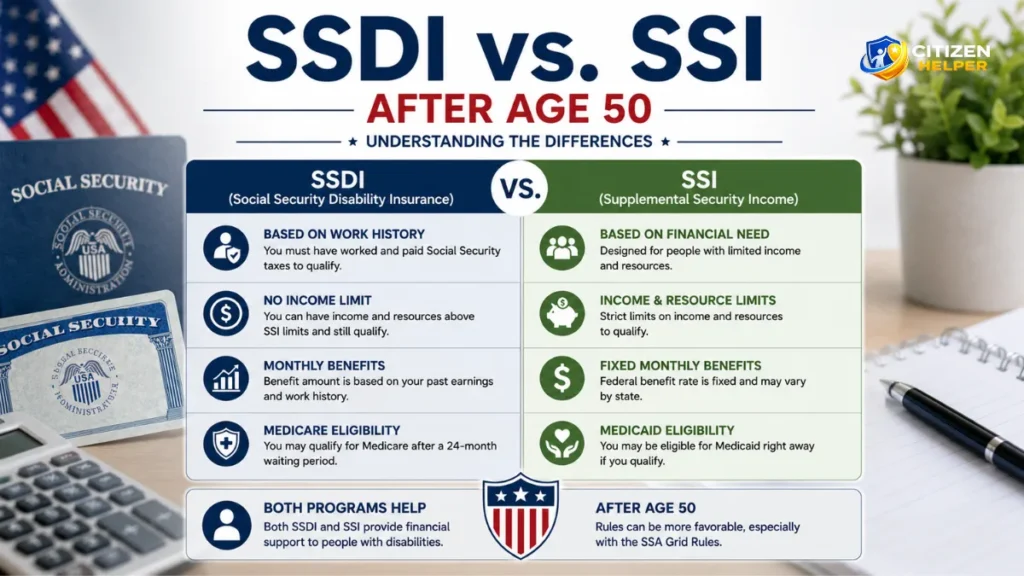
Turning 50 does not change the eligibility rules for Social Security Disability Insurance (SSDI) or Supplemental Security Income (SSI). However, the same Medical-Vocational Guidelines may be used when evaluating disability.
Here’s a quick comparison:
| Feature | SSDI | SSI |
| Based on work credits | Yes | No |
| Income and resource limits | No | Yes |
| Disability requirement | Yes | Yes |
| Age 50 Grid Rules | May apply | May apply |
| Monthly benefit amount | Based on earnings history | Federal benefit rate, with possible state supplements |
SSDI is designed for workers who have paid Social Security taxes and earned enough work credits. SSI is a needs-based program for individuals with limited income and resources.
Official Source: Social Security Administration – Disability Benefits
Common Reasons Disability Claims Are Denied
Even after age 50, many disability applications are denied. Common reasons include:
- Insufficient medical evidence.
- The condition is not expected to last at least 12 months or result in death.
- Missing medical records.
- Failure to follow prescribed treatment without a valid reason.
- The SSA determines you can still perform your past work.
- The SSA believes you can adjust to other work based on your RFC, education, and transferable skills.
- Incomplete or inconsistent information on the application.
A denial does not necessarily mean you are ineligible. Many applicants are approved after requesting reconsideration or appealing before an administrative law judge.
How to Improve Your Chances of Approval
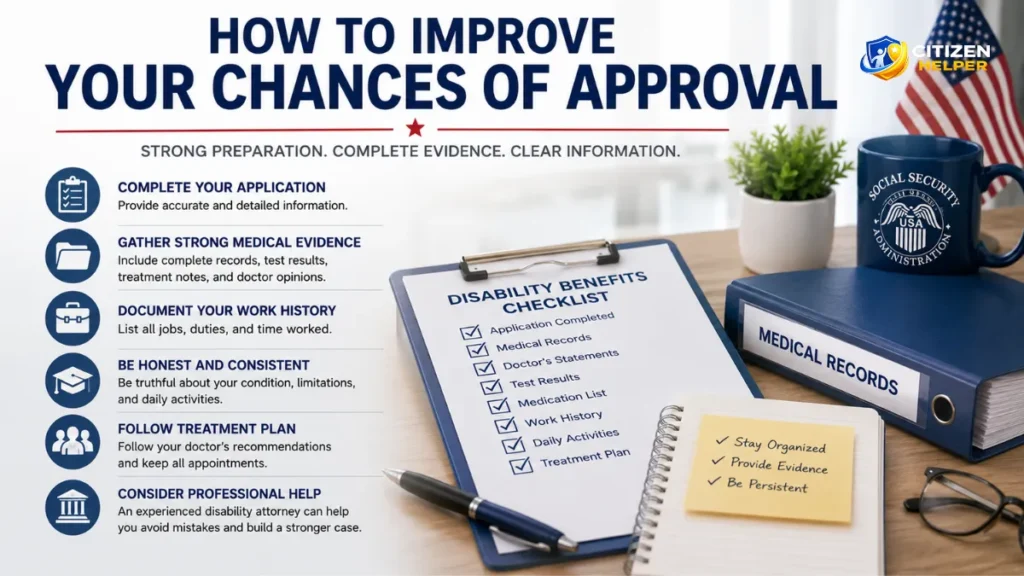
While there is no guaranteed way to receive disability benefits, you can strengthen your application by:
- Seeking regular medical treatment and following your healthcare provider’s recommendations.
- Keeping detailed records of your symptoms and limitations.
- Providing complete medical documentation from all treating providers.
- Clearly explaining why you can no longer perform your previous work.
- Including information about how your condition affects daily activities.
- Responding promptly to requests from the SSA.
- Considering professional assistance if your claim is denied.
Strong medical evidence remains one of the most important factors in every disability determination.
What Happens If Your Claim Is Denied?
If the SSA denies your application, you have the right to appeal.
The disability appeals process generally includes:
- Reconsideration: A different examiner reviews your claim.
- Hearing before an Administrative Law Judge (ALJ): You can present evidence and testify.
- Appeals Council Review: The Council reviews the ALJ’s decision if requested.
- Federal Court Review: You may file a civil action in federal court if appropriate.
Many successful disability claims are approved during the appeals process rather than at the initial application stage.
Official Source: Social Security Administration – Appeal a Decision
Conclusion:
Understanding the social security disability rules after age 50 can help you better prepare for the disability application process. While turning 50 does not automatically qualify you for benefits, the SSA’s Medical-Vocational Guidelines recognize that changing careers becomes more difficult with age. Your medical condition, Residual Functional Capacity, education, work history, and transferable skills are all considered together when determining whether you can adjust to other work.
If you believe a medical condition prevents you from maintaining full-time employment, provide complete medical documentation and carefully answer every question on your application. Because SSA policies and benefit rules can change, always verify the latest information through the official Social Security Administration website before filing your claim.
Frequently Asked Questions (FAQ)
Does turning 50 automatically qualify me for disability?
No. Simply reaching age 50 does not automatically make you eligible. You must still meet the SSA’s medical definition of disability and satisfy the applicable eligibility requirements.
Is it easier to get SSDI after age 50?
For many applicants, yes. The SSA’s Medical-Vocational Guidelines may make it easier to qualify if your age, medical limitations, work history, and education indicate that adjusting to other work is unlikely.
What is the Social Security Grid Rule?
The Grid Rules are Medical-Vocational Guidelines the SSA uses to determine whether a person can adjust to other work based on factors such as age, education, work experience, and residual functional capacity.
Can I work while applying for disability benefits?
Possibly. However, if your earnings exceed the SSA’s Substantial Gainful Activity (SGA) limit, you generally will not be considered disabled for SSDI or SSI purposes. The SGA amount changes periodically, so always check the current limit before relying on a specific figure.
Does every medical condition qualify after age 50?
No. The diagnosis itself is not enough. The SSA evaluates how severely the condition limits your ability to perform substantial work and whether those limitations are expected to last at least 12 months or result in death.