Paying taxes is a normal part of earning income in the United States, but not every dollar you receive is subject to federal income tax. Many people are surprised to learn that certain payments, benefits, and financial gifts are considered non-taxable income under IRS rules.
Understanding what is and isn’t taxable can help you file your tax return correctly, avoid unnecessary taxes, and reduce the risk of mistakes that could lead to IRS notices or penalties. It can also help you make better financial decisions when receiving government benefits, insurance payments, retirement income, or money from family members.
In this guide, you’ll learn what non-taxable income is, common examples, how it differs from taxable income, when you may still need to report it, and the situations where tax rules become more complicated. While this article focuses on federal income tax, keep in mind that some states have different tax laws.
Quick Answer
Non-taxable income is money or benefits that the Internal Revenue Service (IRS) does not require you to pay federal income tax on. Examples include qualifying workers’ compensation benefits, most gifts, inheritances, child support payments, certain life insurance proceeds, and many forms of public assistance.
However, non-taxable doesn’t always mean “ignore it.” Some types of tax-free income may still need to be reported on your tax return or considered when applying for certain government programs or financial aid.
Always review the latest IRS guidance if you’re unsure how a specific payment should be treated.
What Is Non-Taxable Income?

Non-taxable income is any payment or benefit that federal tax law excludes from taxable income. Unlike wages, salaries, business profits, or most investment earnings, these payments generally are not subject to federal income tax.
The IRS defines many different categories of non-taxable income. Some are always tax-free, while others are tax-free only if certain conditions are met.
For example:
- A birthday gift from a family member is usually non-taxable.
- Workers’ compensation benefits for a job-related injury are generally non-taxable.
- Child support payments received by a parent are usually not taxable.
- Most inheritances are not considered taxable income.
On the other hand, interest earned after receiving inherited money or insurance proceeds may still be taxable.
Because every type of income has its own rules, it’s important not to assume that all payments are treated the same way.
Official Source: IRS – Taxable and Nontaxable Income
Why It Matters to Know Whether Income Is Taxable
Knowing whether your income is taxable can help you:
- File an accurate federal tax return.
- Avoid paying tax on money that isn’t taxable.
- Prevent IRS errors or notices.
- Better estimate your annual tax bill.
- Understand how different payments affect your finances.
- Plan for retirement or disability income.
- Make informed financial decisions throughout the year.
Many taxpayers accidentally overreport income because they believe every payment they receive must be taxed. Others make the opposite mistake and fail to report income that is actually taxable.
Learning the difference can save both time and money.
What Counts as Income for Federal Tax Purposes?

Before discussing non-taxable income, it’s helpful to understand what the IRS generally considers income.
In simple terms, income includes money, property, goods, or services you receive unless the law specifically excludes them from taxation.
Common examples of taxable income include:
- Wages and salaries
- Self-employment income
- Business profits
- Bonuses and commissions
- Tips
- Rental income
- Interest earned from bank accounts
- Most dividends
- Capital gains
- Taxable pension income
- Certain retirement account withdrawals
If a payment doesn’t qualify for an exclusion under federal tax law, it is generally considered taxable.
Official Source: IRS – Publication 525, Taxable and Nontaxable Income
Taxable Income vs. Non-Taxable Income
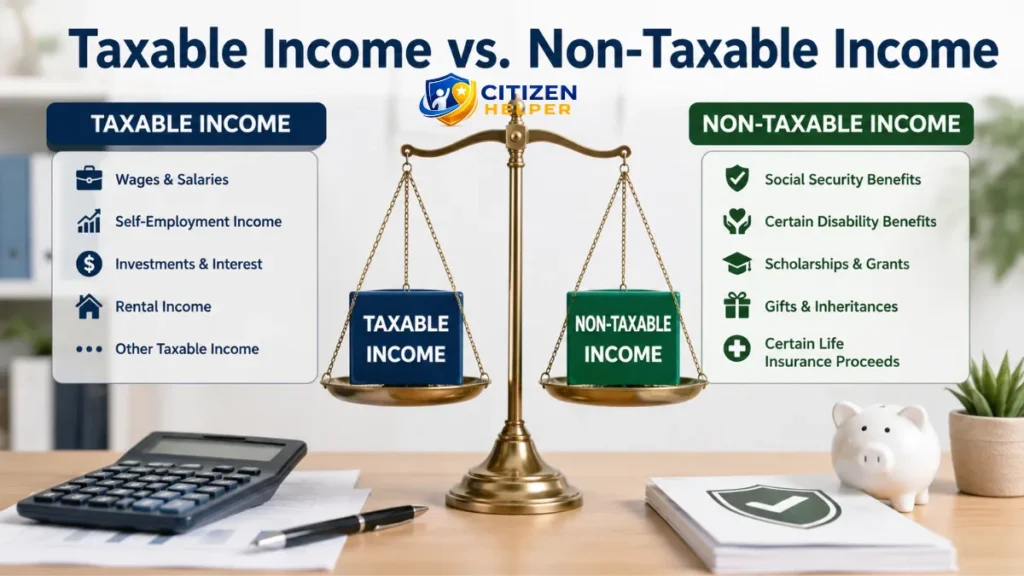
Understanding the difference between taxable and non-taxable income can make tax filing much easier.
| Usually Taxable Income | Usually Non-Taxable Income |
| Wages and salaries | Gifts received |
| Business income | Most inheritances |
| Self-employment income | Qualified workers’ compensation |
| Interest income | Child support received |
| Rental income | Certain life insurance proceeds |
| Taxable pensions | Certain welfare benefits |
| Capital gains | Qualified foster care payments |
| Bonuses | Certain disaster relief payments |
Remember that this table provides general guidance. Some payments have exceptions or special rules that may apply depending on your circumstances.
Common Types of Non-Taxable Income
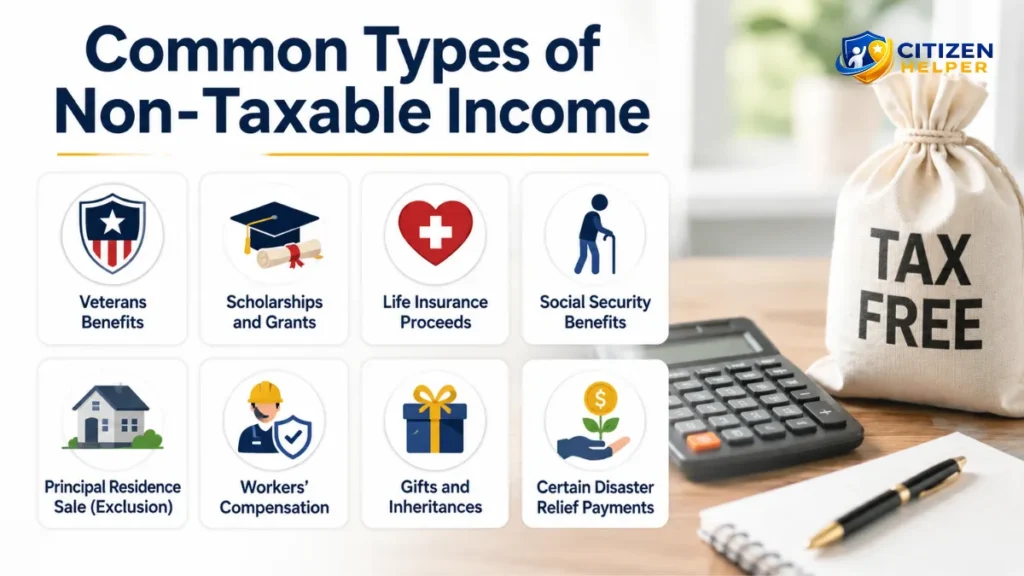
The IRS recognizes many forms of income that are generally excluded from federal income tax. Below are some of the most common examples.
1. Gifts
If someone gives you money or property as a genuine gift, you generally do not pay federal income tax on what you receive.
Examples include:
- Birthday gifts
- Wedding gifts
- Graduation gifts
- Holiday gifts
- Financial gifts from parents or grandparents
In most cases, the recipient owes no federal income tax. If gift tax reporting is required, it is generally the responsibility of the person giving the gift—not the person receiving it.
Official Source: IRS – Frequently Asked Questions on Gift Taxes
2. Inheritances
Money or property you inherit is generally not taxable income for federal income tax purposes.
Common inherited assets include:
- Cash
- Homes
- Vehicles
- Stocks
- Retirement assets
- Personal belongings
However, any income generated by those inherited assets after you receive them—such as interest, dividends, rental income, or investment gains—may be taxable.
For example, if you inherit a savings account, the money you inherit is generally tax-free. But the interest the account earns after it becomes yours may be taxable.
Official Source: IRS – Publication 559, Survivors, Executors, and Administrators
3. Workers’ Compensation Benefits
Workers’ compensation benefits are generally not taxable if they are paid under a workers’ compensation law because of a work-related injury or occupational illness.
These benefits may cover:
- Medical treatment
- Wage replacement
- Permanent disability benefits
- Rehabilitation services
There are limited exceptions, particularly if workers’ compensation benefits affect certain Social Security disability benefits.
Official Source: IRS – Publication 525More Common Types of Non-Taxable Income
While gifts, inheritances, and workers’ compensation are among the best-known examples, the IRS recognizes several other types of income that may not be subject to federal income tax. Understanding these categories can help you avoid confusion when preparing your tax return.
4. Child Support Payments
If you receive child support from a former spouse or another parent, those payments are generally not taxable income.
Likewise, the parent making child support payments cannot deduct them on a federal tax return.
It’s important not to confuse child support with alimony. Depending on when a divorce or separation agreement was finalized, alimony may have different tax rules.
Official Source: IRS – Publication 504, Divorced or Separated Individuals
5. Certain Life Insurance Death Benefits
Life insurance proceeds paid to a beneficiary because of the insured person’s death are generally not subject to federal income tax.
For example, if a family member names you as the beneficiary of a life insurance policy, the death benefit you receive is usually tax-free.
However, there are exceptions. If the insurance company pays interest on the proceeds before they are distributed, the interest portion is generally taxable.
Official Source: IRS – Publication 525
6. Welfare and Certain Public Assistance Benefits
Many need-based government assistance programs provide benefits that are not taxable under federal law.
Examples may include:
- Temporary cash assistance
- Certain state welfare payments
- Emergency financial assistance
- Need-based public assistance programs
These benefits are generally intended to help individuals and families meet basic living expenses and are usually excluded from taxable income.
However, each program has its own eligibility and reporting rules.
Official Source: IRS – Publication 525
7. Qualified Disaster Relief Payments
If you receive qualified disaster relief payments after a federally declared disaster, those payments may not be taxable.
Examples include payments used for:
- Temporary housing
- Medical expenses
- Funeral expenses
- Home repairs
- Personal property replacement
Not every disaster-related payment qualifies, so always review the specific IRS guidance.
Official Source: IRS – Publication 525
8. Qualified Foster Care Payments
Payments received for caring for qualified foster children placed by a state or qualified placement agency are generally excluded from taxable income.
This tax treatment applies only when IRS requirements are met.
Official Source: IRS – Publication 525
9. Certain Scholarships and Fellowship Grants
Scholarships and fellowship grants can often be received tax-free if they are used for qualified education expenses.
Qualified expenses generally include:
- Tuition
- Required enrollment fees
- Required books
- Required course supplies
Scholarship money used for housing, meals, travel, or optional equipment may be taxable.
Official Source: IRS – Publication 970, Tax Benefits for Education
10. Certain Veterans’ Benefits
Many benefits paid by the U.S. Department of Veterans Affairs (VA) are not subject to federal income tax.
Examples may include:
- Disability compensation
- Pension payments in certain situations
- Education assistance
- Housing grants
- Certain survivor benefits
The tax treatment depends on the specific VA benefit being received.
Official Source: U.S. Department of Veterans Affairs – Tax Information
11. Health Savings Account (HSA) Distributions
Money withdrawn from a Health Savings Account (HSA) is generally tax-free when it is used to pay qualified medical expenses.
Examples include:
- Doctor visits
- Hospital bills
- Prescription medications
- Certain medical equipment
Using HSA funds for non-qualified expenses may result in taxes and additional penalties.
Official Source: IRS – Publication 969
12. Certain Employer-Provided Benefits
Some workplace benefits are excluded from taxable income when they meet IRS requirements.
Examples may include:
- Employer-paid health insurance
- Certain educational assistance
- Qualified adoption assistance
- Certain dependent care benefits
The tax treatment depends on the type of benefit and applicable IRS rules.
Official Source: IRS – Publication 15-B, Employer’s Tax Guide to Fringe Benefits
Income That Is Only Partly Taxable

Not all income falls neatly into either the taxable or non-taxable category. Some payments may be partially taxable, meaning only a portion of the amount is subject to federal income tax.
Examples can include:
- Certain Social Security benefits
- Traditional IRA distributions
- Pension payments
- Annuities
- Some employer benefits
The taxable portion depends on factors such as your filing status, total income, and the specific IRS rules that apply.
Non-Taxable Income vs. Tax-Deferred Income
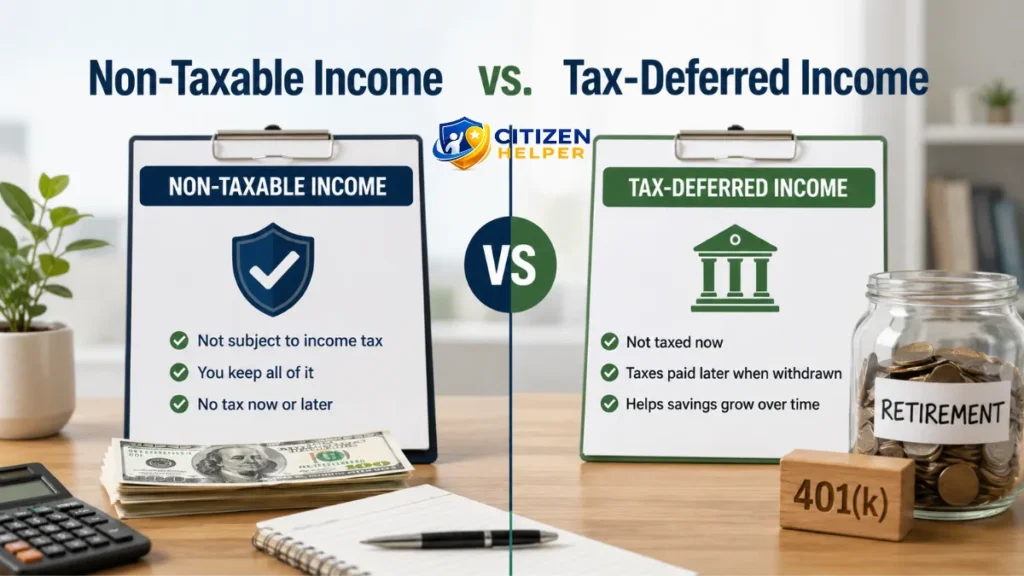
Many taxpayers confuse non-taxable income with tax-deferred income, but they are not the same.
| Non-Taxable Income | Tax-Deferred Income |
| No federal income tax is generally owed. | Taxes are postponed until a future date. |
| Often never taxed if IRS rules are met. | Usually becomes taxable when withdrawn or distributed. |
| Examples include gifts and inheritances. | Examples include many traditional retirement accounts. |
Understanding this distinction can help you make better retirement and investment decisions.
Can Non-Taxable Income Affect Government Benefits?

Yes. Even though certain income is not taxable under IRS rules, it may still be considered when determining eligibility for some government programs.
Programs may use their own definition of income rather than the IRS definition.
Depending on the program, non-taxable income may affect eligibility for:
- Medicaid
- Supplemental Nutrition Assistance Program (SNAP)
- Housing assistance
- Financial aid
- Other income-based benefits
Always review the rules for the specific program before assuming that tax-free income will be ignored.
Real-Life Examples
Example 1
Maria receives $8,000 as a gift from her parents to help buy a car.
Result: The gift is generally not taxable to Maria.
Example 2
James inherits $150,000 from his grandfather.
Result: The inheritance itself is generally not taxable.
However, if James invests the money and later earns interest, those earnings may be taxable.
Example 3
Sarah receives workers’ compensation benefits after suffering a workplace injury.
Result: The benefits are generally not taxable under federal law if they qualify under the applicable workers’ compensation law.
Common Mistakes to Avoid
Many taxpayers make avoidable errors when determining whether income is taxable. Common mistakes include:
- Assuming every payment is taxable.
- Assuming every government benefit is tax-free.
- Confusing gifts with earned income.
- Forgetting that investment earnings can still be taxable.
- Mixing up non-taxable income with tax-deferred income.
- Ignoring IRS reporting requirements.
- Relying on outdated tax advice instead of current IRS guidance.
When you’re unsure, consult the latest IRS publications or a qualified tax professional.
Does Non-Taxable Income Need to Be Reported?
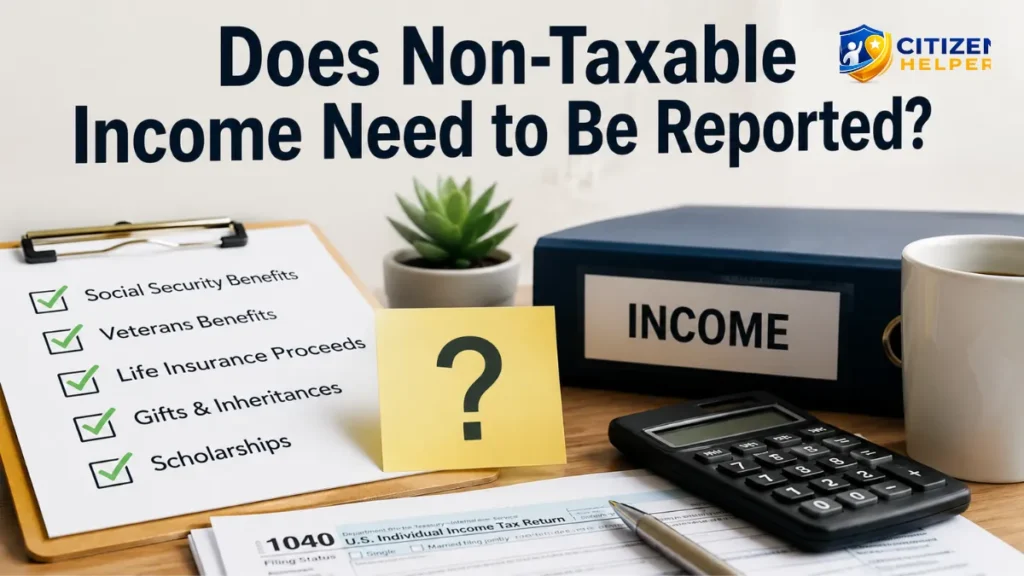
One of the most common tax questions is whether non-taxable income must be reported on a federal tax return.
The answer depends on the type of income.
Some forms of non-taxable income do not need to be reported to the IRS at all. Others may still need to be listed on your tax return, included for informational purposes, or considered when calculating eligibility for certain tax credits or deductions.
For example:
- Most gifts received do not need to be reported as income by the recipient.
- Most inheritances are not reported as taxable income.
- Some tax-free distributions or benefits may still appear on tax documents issued by the payer.
- Certain retirement distributions may require reporting even when part of the distribution is tax-free.
If you’re uncertain whether a payment should be reported, review the instructions for IRS Form 1040, the applicable IRS publication, or speak with a qualified tax professional.
Official Source: IRS – Form 1040 Instructions
Federal vs. State Tax Rules
This article focuses on federal income tax, but it’s important to remember that state tax laws may be different.
Some states follow the federal tax treatment for many types of income, while others have their own rules regarding:
- Retirement income
- Social Security benefits
- Pension income
- Government benefits
- Certain tax exemptions
For example, a payment that is not taxable under federal law may still receive different treatment under your state’s income tax laws.
Before filing your state tax return, check your state’s department of revenue or official tax agency for the most current rules.
How to Determine Whether Your Income Is Taxable

If you’re unsure whether money you received is taxable, ask yourself these questions:
1. Where did the money come from?
Was it from:
- An employer?
- A government agency?
- A family member?
- An insurance company?
- An investment?
- A retirement account?
The source of the payment often determines how it is taxed.
2. Why did you receive it?
The purpose of the payment also matters.
For example, money received as compensation for work is generally taxable, while a genuine gift from a relative is usually not.
3. Does the IRS specifically exclude it?
The IRS publishes detailed guidance describing which types of income are excluded from taxation.
If a payment is not specifically excluded, it is often taxable.
4. Did you receive a tax form?
Receiving a tax document such as a Form W-2 or Form 1099 does not automatically mean every dollar reported is taxable, but it is a signal that you should carefully review the IRS instructions for that form.
When in doubt, use official IRS resources instead of relying on social media, online rumors, or outdated tax advice.
Keep Good Records of All Income
Even if some of your income is not taxable, keeping accurate financial records is important.
Consider saving:
- Benefit award letters
- IRS notices
- Forms W-2 and 1099
- Bank statements
- Insurance payment records
- Scholarship documentation
- Workers’ compensation records
- Retirement account statements
Good recordkeeping can make filing your taxes easier and help you respond if the IRS requests additional information.
Official Source: IRS – Recordkeeping
Conclusion
Understanding what is non-taxable income can help you file your tax return with greater confidence and avoid costly mistakes. While many types of payments—such as gifts, inheritances, qualifying workers’ compensation benefits, child support, and certain government assistance programs—are generally excluded from federal income tax, each type of income has its own rules and possible exceptions.
It’s also important to remember that non-taxable does not always mean non-reportable. Some tax-free payments may still need to be disclosed on tax forms or considered when applying for financial aid or income-based government programs.
Because tax laws change over time, always verify the latest guidance before filing your return.
By understanding how the IRS classifies different types of income, you can make informed financial decisions, reduce the risk of filing errors, and ensure that you pay only the taxes you legally owe.
Frequently Asked Questions (FAQ)
Is non-taxable income ever taxed later?
Sometimes. While many forms of non-taxable income are never taxed, others may produce taxable income in the future. For example, interest earned on inherited money is generally taxable even though the inheritance itself usually is not.
Is every government benefit tax-free?
No. Some government benefits are taxable under certain circumstances, while many others are completely tax-free. The tax treatment depends on the specific program.
Are gifts always non-taxable?
In most cases, gifts are not taxable to the recipient. However, special IRS rules may apply to the person giving the gift if the amount exceeds the annual gift tax exclusion.
Do I pay taxes on inherited property?
Generally, inherited property itself is not taxable as income. However, income generated by that property after you inherit it—such as rent, interest, or dividends—may be taxable.
Is child support taxable?
No. Child support payments are generally not considered taxable income for the recipient and are not deductible by the person making the payments.
Are workers’ compensation benefits taxable?
Qualified workers’ compensation benefits paid because of a work-related injury or illness are generally not taxable under federal law.
Can tax-free income affect financial aid?
Yes. Some colleges, government agencies, and assistance programs may consider certain types of non-taxable income when determining eligibility for benefits or aid.