Yes, you can apply for disability while working. However, whether you qualify depends on how much you earn, the type of work you do, and how your medical condition affects your ability to maintain substantial employment.
The Social Security Administration (SSA) does not automatically deny a disability application simply because an applicant has a job. Some people continue working part-time, reduce their hours, perform lighter duties, or receive special workplace support while applying for benefits.
However, Social Security generally requires applicants to show that a medically determinable physical or mental condition prevents them from performing substantial gainful activity (SGA) and has lasted or is expected to last at least 12 months or result in death.
This guide explains whether you can apply for disability while working, how earnings may affect an application, the differences between SSDI and SSI, and what work information Social Security may review.
Quick Answer: Can You Apply for Disability While Working?
Yes. You may apply for Social Security disability benefits while working, especially if your earnings are below the substantial gainful activity limit or your work does not show that you can maintain substantial employment.
In 2026, Social Security generally considers monthly earnings above the following amounts to be substantial gainful activity:
- $1,690 per month for most applicants
- $2,830 per month for applicants who are blind under Social Security rules
These amounts generally refer to earnings before taxes. However, earnings are not always the only factor Social Security considers. The agency may also review your job duties, hours, productivity, workplace assistance, self-employment activity, and qualifying disability-related work expenses.
Earning less than the SGA amount does not automatically mean that you qualify. You must still meet Social Security’s medical and other eligibility requirements.
Official Source: Social Security Administration – Substantial Gainful Activity
What Does Social Security Consider a Disability?
Social Security uses a strict definition of disability. The program generally does not provide benefits for partial or short-term disabilities.
For an adult to qualify based on a disability, the medical condition generally must:
- Prevent the person from performing substantial gainful activity
- Prevent the person from doing previous work or adjusting to other work
- Have lasted or be expected to last for at least 12 continuous months, or be expected to result in death
A medical diagnosis by itself does not guarantee approval. Social Security considers how the condition affects the applicant’s ability to perform work-related activities.
For example, the agency may consider whether an applicant can:
- Sit, stand, walk, lift, carry, push, or pull
- Understand and follow instructions
- Concentrate and complete tasks
- Interact appropriately with supervisors, coworkers, or the public
- Maintain regular attendance
- Work consistently without excessive breaks
- Adapt to changes in a work environment
A person may have a serious medical condition and continue doing some work. The important question is whether the person can perform substantial work under Social Security’s rules.
Official Source: Social Security Administration – Disability Benefits
How Much Can You Work While Applying for Disability?
There is no single limit on the number of hours you may work while applying for disability. Social Security generally focuses heavily on earnings, but work hours, duties, productivity, and the circumstances under which the work is performed may also be relevant.
In 2026, earning more than $1,690 per month generally indicates substantial gainful activity for a non-blind applicant. The SGA amount for an applicant who is blind under Social Security rules is $2,830 per month.
Working below the SGA level may allow an application to move forward, but it does not guarantee approval. Social Security must still determine that the applicant meets its medical definition of disability.
Official Source: Social Security Administration – Substantial Gainful Activity
Does Social Security Look at Gross or Net Income?
For employees, Social Security generally begins by reviewing gross earnings before taxes and other deductions.
However, the amount shown on a paycheck may not always represent the full value of a person’s work. Social Security may consider certain adjustments, including qualifying impairment-related work expenses or the value of special workplace support.
Self-employment is evaluated differently because business income alone may not accurately show how much work a person performs or the value of that work.
What Is Substantial Gainful Activity?
Substantial gainful activity, commonly called SGA, is an important part of the Social Security disability evaluation process.
The term has two parts:
- Substantial activity generally involves significant physical or mental work.
- Gainful activity is work normally performed for pay or profit, whether or not the applicant actually earns a profit.
Social Security uses monthly earnings guidelines to help determine whether work may be substantial and gainful. However, the agency may examine more than earnings in some situations.
For example, Social Security may review:
- The type of work performed
- The number of hours worked
- The difficulty of the job duties
- The level of productivity
- Whether coworkers provide extra assistance
- Whether the employer allows special conditions
- Whether the applicant is self-employed
An applicant whose earnings are below the SGA amount may still need to explain how the medical condition affects work performance.
Can You Apply for SSDI While Working?

Yes, you may apply for Social Security Disability Insurance (SSDI) while working.
SSDI is generally available to people who meet Social Security’s definition of disability and have enough work history covered by Social Security. Workers earn Social Security credits by working and paying Social Security taxes.
SSDI work-credit requirements depend on the age at which the disability began. Social Security generally applies two work tests:
- A recent work test, which considers how recently the applicant worked
- A duration of work test, which considers the total amount of work completed over the applicant’s lifetime
For people whose disability begins at age 31 or older, the recent work test generally requires at least 20 work credits earned during the 10-year period immediately before the disability began. However, the total number of credits required under the duration of work test generally increases with age.
Younger workers may qualify with fewer credits because they have had less time to work.
For example, a person whose disability begins between ages 31 and 42 generally needs 20 total work credits. A person whose disability begins at an older age may need more total credits while still generally needing at least 20 credits from the previous 10 years.
Work credits alone do not establish disability eligibility. An applicant must also meet Social Security’s medical requirements and other applicable rules.
Working while applying does not automatically prevent SSDI eligibility. However, performing work at the substantial gainful activity level may make it difficult to meet Social Security’s definition of disability.
Official Source: Social Security Administration – Social Security Credits and Benefit Eligibility
Does Part-Time Work Affect an SSDI Application?
Part-time employment does not automatically disqualify an SSDI applicant.
Social Security may consider:
- Monthly gross earnings
- Weekly work hours
- Physical and mental job duties
- Changes in work performance
- Reduced hours caused by the medical condition
- Missed workdays
- Extra breaks
- Help received from coworkers
- Special conditions or accommodations provided by the employer
Even when earnings are below the SGA amount, Social Security may review whether the work shows an ability to perform substantial employment.
At the same time, limited work may help provide context about how a medical condition affects an applicant. For example, employment records may show reduced hours, frequent absences, difficulty completing tasks, lower productivity, or the need for additional assistance.
Can You Apply for SSI While Working?
Yes, you may also apply for Supplemental Security Income (SSI) while working.
SSI is a needs-based program for people who have limited income and resources and who are disabled, blind, or age 65 or older. Unlike SSDI, SSI eligibility is not based on a person’s work credits.
Employment income may affect:
- Whether an applicant meets the disability rules during the initial application process
- Whether the applicant meets SSI financial eligibility requirements
- The amount of any monthly SSI payment
Social Security does not necessarily count every dollar of earned income when calculating SSI eligibility or payments. Certain income exclusions may apply.
Because SSI calculations depend on an applicant’s individual circumstances, there is not one earnings amount that applies equally to everyone.
Official Source: Social Security Administration – Who Can Get SSI
Can Working Reduce an SSI Payment?
Yes. Earned income may reduce the amount of an SSI payment.
Social Security generally excludes certain portions of income before calculating countable income. As countable income increases, the monthly SSI payment may decrease. If countable income becomes too high, the person may not qualify for an SSI payment.
Other income may also affect SSI eligibility, including certain:
- Social Security benefits
- Pensions
- Unemployment benefits
- Financial assistance
- Income received by a spouse
- Parental income when applying for a child
SSI financial rules can be complex. Applicants should provide complete information about income, resources, and living arrangements.
Official Source: Social Security Administration – Understanding SSI Income
Does Working Part-Time Make It Harder to Get Disability?
Working part-time may affect a disability claim, but it does not automatically cause a denial.
Social Security may compare the applicant’s work activity with the limitations described in medical records and application forms.
For example, an applicant may report being unable to stand for more than 20 minutes but work several hours each day in a job that appears to require prolonged standing. Social Security may ask for additional information to understand the situation.
However, the applicant may have workplace accommodations, sit during most duties, receive help from coworkers, or work fewer hours because of the medical condition.
Applicants should explain their work accurately rather than assuming that part-time employment will automatically help or hurt the claim.
Useful information may include:
- Why work hours were reduced
- When work difficulties began
- Duties that are no longer possible
- Tasks reassigned to coworkers
- Extra breaks needed during the workday
- Medical appointments that interfere with work
- Days missed because of symptoms
- Changes in productivity
- Special equipment or accommodations
Does the Number of Hours You Work Matter?
Social Security does not use one universal hourly limit for disability applicants.
A person working only a few hours per week may still have earnings or work activity that requires additional review. Another person may work more hours but earn below the SGA amount because of reduced duties, limited responsibilities, or low wages.
The agency may consider both earnings and the nature of the work.
For example, working 15 hours per week may raise different questions depending on whether the person:
- Performs physically demanding work
- Manages a business
- Receives significant assistance
- Has flexible attendance requirements
- Works at a reduced level of productivity
- Performs highly skilled duties
Applicants should report work hours and responsibilities accurately.
What If Your Employer Gives You Special Accommodations?

Special workplace conditions may be important when Social Security evaluates a disability application.
Examples may include:
- Extra rest breaks
- A flexible work schedule
- Reduced job duties
- Lower productivity expectations
- Help from coworkers
- Special transportation assistance
- Permission to work from home
- Frequent absences without normal consequences
- Special equipment or a modified workspace
An employer may also pay an employee more than the reasonable value of the work performed. Social Security may review whether part of those earnings represents a subsidy rather than payment for the worker’s actual productivity.
Applicants should explain any special conditions clearly in their disability application and work history information.
What Are Impairment-Related Work Expenses?
Some applicants pay for items or services they need because of a disability and use those items or services to continue working. Social Security may consider certain qualifying costs as impairment-related work expenses (IRWEs).
Possible examples may include eligible expenses for:
- Certain medical devices
- Disability-related transportation
- Attendant care services
- Medical equipment
- Some medications or treatments needed for work
Not every medical expense qualifies. The expense generally must meet Social Security’s requirements, be related to the impairment, and be necessary for work.
If approved, certain impairment-related work expenses may be deducted from earnings when Social Security evaluates work activity.
Applicants should keep receipts, payment records, and documentation explaining why the expense is necessary.
Official Source: Social Security Administration – SSI Work Incentives
What If You Are Self-Employed?
Self-employment is evaluated differently from regular employment.
Business profit alone may not accurately show how much work a self-employed applicant performs. A person may report low income while spending many hours managing or operating a business.
Social Security may examine:
- The number of hours worked
- Daily responsibilities
- Management duties
- Services provided to the business
- The value of the work performed
- Business income and expenses
- Whether the applicant’s work is comparable to that of people without disabilities in similar businesses
Self-employed applicants should keep detailed records of their work hours, duties, income, expenses, and any assistance received.
Can You Apply If You Recently Stopped Working?
Yes. A person may apply after stopping work because of a medical condition.
Applicants generally do not have to wait 12 months before submitting an application. A person may apply when a condition has lasted or is expected to last at least 12 months or result in death.
When reviewing the application, Social Security may ask:
- When the applicant stopped working
- Why the applicant stopped working
- Whether work hours decreased before employment ended
- Whether the employer provided accommodations
- Whether the applicant attempted other work
- How the medical condition affected job performance
The date the medical condition began affecting the ability to work may be important to the disability evaluation.
What If You Tried to Work but Had to Stop?

Some people attempt to continue working or return to work but cannot maintain employment because of a medical condition.
Social Security may review whether a short work attempt qualifies as an unsuccessful work attempt under its rules.
The agency may consider factors such as:
- How long the work lasted
- Whether there was a significant break in employment before the attempt
- Why the work ended
- Whether earnings fell below the SGA level
- Whether the medical condition caused the person to stop working or reduce work activity
A short work attempt is not automatically disregarded. Social Security reviews the circumstances and applies specific rules.
Applicants should provide accurate dates and explain why the work ended or changed.
Can You Apply for Disability While on Medical Leave?
Yes. You may apply for Social Security disability benefits while on medical leave.
Being employed but temporarily absent from work is different from actively performing job duties. Social Security may consider:
- Whether the applicant is currently performing work
- Whether the person is receiving wages, sick pay, or other benefits
- Whether the person expects to return to work
- How long the medical condition is expected to last
- Whether the person can perform substantial work
Medical leave by itself does not establish eligibility. The applicant must still meet Social Security’s medical and other requirements.
Can You Apply While Receiving Workers’ Compensation?
Yes. A person may apply for Social Security disability benefits while receiving workers’ compensation.
Workers’ compensation and Social Security disability are separate programs with different eligibility requirements. Approval for workers’ compensation does not automatically qualify a person for SSDI, and receiving workers’ compensation does not prevent someone from applying.
However, workers’ compensation benefits and certain other public disability benefits may reduce SSDI payments. In general, Social Security may reduce SSDI benefits when the combined amount of:
- The worker’s SSDI benefits
- SSDI benefits paid to eligible family members based on the worker’s record
- Workers’ compensation benefits
- Certain other public disability benefits
exceeds 80% of the worker’s average current earnings before the disability began.
The calculation may depend on the type and amount of benefits received, the applicant’s previous earnings, applicable state rules, and whether payments are made periodically or as a lump-sum settlement.
Applicants should report all workers’ compensation payments to Social Security, including periodic payments, lump-sum settlements, and changes in payment amounts. They should also keep copies of award letters, settlement agreements, payment records, and other related documents.
Official Source: Social Security Administration – How Workers’ Compensation and Other Disability Payments May Affect Your Benefits
Can You Apply While Receiving Short-Term or Long-Term Disability Benefits?
Yes. Receiving benefits from a private short-term or long-term disability insurance policy does not prevent a person from applying for SSDI.
According to Social Security, disability payments from private sources, such as private insurance benefits or private pensions, generally do not reduce Social Security disability benefits. This differs from workers’ compensation and certain public disability benefits, which may affect SSDI payments.
However, a private disability insurance policy may have its own rules. Depending on the policy, the insurer may:
- Require the policyholder to apply for SSDI
- Reduce private disability payments after SSDI benefits begin
- Seek reimbursement for certain overpayments if SSDI benefits are awarded retroactively
- Require updates about the status of an SSDI application
These are private insurance policy provisions, not Social Security rules. Applicants should review their policy documents or contact the plan administrator or insurer to understand how an SSDI award may affect private benefits.
Private disability benefits may also be considered income when Social Security determines financial eligibility for SSI. Because SSI is a needs-based program, applicants should report private disability payments and other income to Social Security.
Approval for private short-term or long-term disability benefits does not guarantee SSDI or SSI approval. Private insurers and Social Security may use different definitions of disability and different eligibility standards.
Official Source: Social Security Administration – Will My Disability Benefits Be Reduced If I Get Workers’ Compensation or Other Public Disability Benefits?
What Work Information Should You Provide When Applying?
Social Security may request detailed information about employment performed before and after the medical condition began affecting the applicant.
Applicants should be prepared to provide:
- Employer names and addresses
- Job titles
- Employment dates
- Work hours
- Pay rates
- Monthly earnings
- Job duties
- Physical requirements
- Mental or cognitive requirements
- Equipment or tools used
- Reasons for reducing hours or stopping work
- Workplace accommodations
- Disability-related work expenses
Accurate information helps Social Security understand the relationship between the medical condition and the applicant’s ability to work.
Do not leave out employment because it was part-time, temporary, seasonal, or unsuccessful.
What Medical Evidence May Help Support a Claim?
Social Security generally needs medical evidence showing the existence and severity of the applicant’s condition.
Helpful records may include:
- Medical diagnoses
- Physical examination findings
- Laboratory results
- Imaging reports
- Treatment history
- Medication records
- Mental health evaluations
- Therapy records
- Hospital records
- Statements describing functional limitations
Applicants should provide complete contact information for doctors, clinics, hospitals, therapists, and other medical providers.
Medical evidence should help explain how the condition affects work-related activities. A diagnosis alone may not show the severity of a person’s limitations.
How to Apply for Disability While Working
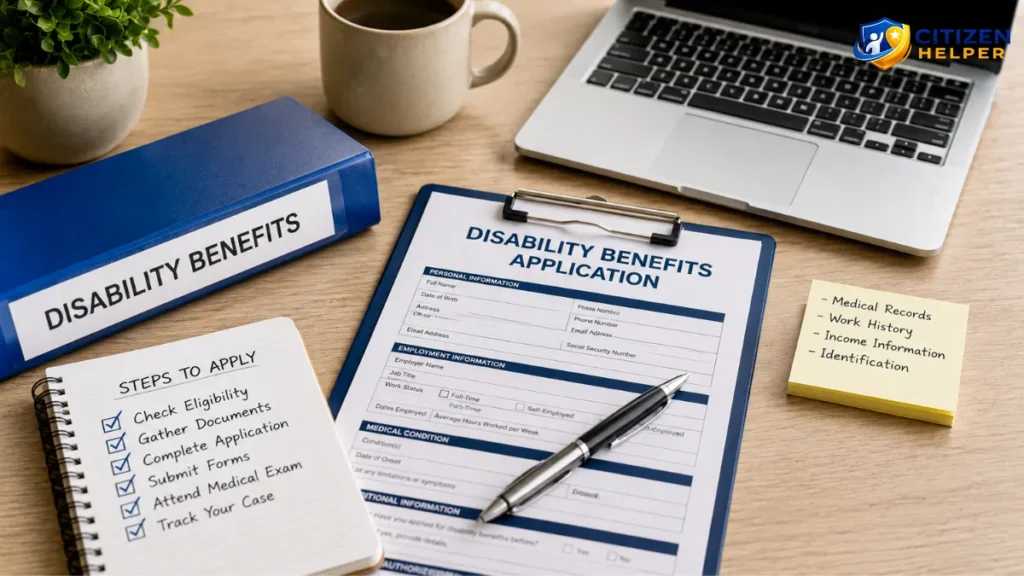
The general application process includes the following steps.
Step 1: Review Your Current Work Activity
Calculate your gross monthly earnings and compare them with the current SGA guidelines.
Also consider:
- Work hours
- Job duties
- Workplace accommodations
- Reduced productivity
- Disability-related expenses
Step 2: Gather Medical Information
Prepare information about:
- Medical conditions
- Doctors and treatment providers
- Medications
- Medical tests
- Treatment dates
- Hospitals and clinics
Step 3: Gather Work History Information
Social Security may ask about jobs performed before the disability affected the ability to work.
Prepare accurate information about job duties, employment dates, work hours, physical requirements, and skills.
Step 4: Submit the Application
You may apply for Social Security disability benefits online. You may also contact Social Security by phone or visit a local Social Security office.
Applying as soon as you have enough information may help avoid unnecessary delays. You do not necessarily need to wait until you have every medical record because Social Security may request records from healthcare providers.
Official Source: Social Security Administration – Apply Online for Disability Benefits
Step 5: Report Changes While the Application Is Pending
Tell Social Security if:
- You start a new job
- You stop working
- Your work hours change
- Your earnings increase or decrease
- Your job duties change
- Your medical condition changes
- You move or change contact information
Keeping information current may help prevent misunderstandings or delays.
Common Mistakes to Avoid When Applying While Working
Applying for disability while employed can involve additional questions about work activity. Avoid these common mistakes:
- Not reporting part-time work: Social Security may obtain wage information from other records.
- Reporting take-home pay instead of gross earnings: Gross wages are generally the starting point for evaluating employee earnings.
- Leaving out special accommodations: Extra help or reduced duties may provide important context.
- Assuming earnings below SGA guarantee approval: Applicants must still meet all medical and non-medical requirements.
- Stopping work only because you assume it will guarantee approval: Not working does not automatically establish disability.
- Providing inconsistent information: Work descriptions should be accurate and consistent with medical records and application forms.
- Failing to report work changes: New employment or changes in earnings should be reported.
Should You Stop Working Before Applying for Disability?
There is no rule requiring every applicant to stop working before applying.
Whether to continue working is a personal decision that may depend on:
- Medical limitations
- Financial needs
- Health insurance
- Employer accommodations
- Paid leave availability
- Ability to perform job duties safely
- Advice from healthcare professionals
Stopping work does not guarantee disability approval. Continuing limited work also does not automatically cause a denial.
Applicants should provide complete information about how their medical condition affects their ability to work.
What Happens If You Are Approved and Later Return to Work?
SSDI beneficiaries may have access to work incentives that allow them to test their ability to work without immediately losing benefits.
One of these work incentives is the Trial Work Period (TWP). The Trial Work Period applies to eligible SSDI beneficiaries after they become entitled to disability benefits. It is not the earnings standard used to determine eligibility during an initial disability application.
In 2026, a month generally counts as a Trial Work Period service month when an SSDI beneficiary earns more than $1,210 before taxes. Different rules may apply to self-employed beneficiaries.
The Trial Work Period allows an eligible beneficiary to test the ability to work for at least nine service months. These months do not have to be consecutive but must occur within a rolling 60-month period.
During the Trial Work Period, there is generally no limit on how much an eligible SSDI beneficiary may earn while continuing to receive the full SSDI payment, as long as the beneficiary continues to have a qualifying disability and reports work activity to Social Security.
After the nine Trial Work Period service months are completed, different work and earnings rules apply. Social Security may then evaluate earnings under the substantial gainful activity rules during the Extended Period of Eligibility.
The Trial Work Period does not apply to SSI. SSI has separate work incentives and payment-calculation rules.
Beneficiaries should report work activity, earnings, changes in hours, and changes in job duties to Social Security.
Official Source: Social Security Administration – Try Returning to Work Without Losing Disability
Official Source: Social Security Administration – Trial Work Period
Conclusion:
So, can you apply for disability while working? Yes. Social Security allows people to apply while employed, including some people working part-time or under special workplace conditions.
However, earnings and work activity can significantly affect the application. In 2026, Social Security generally considers earnings above $1,690 per month for non-blind applicants or $2,830 per month for blind applicants to be substantial gainful activity.
Earning below those amounts does not guarantee approval. Social Security will also evaluate the applicant’s medical condition, functional limitations, work history, job duties, and ability to perform other substantial work.
Because annual earnings limits and some disability program rules may change, applicants should verify current information through the official Social Security Administration website before applying.
Frequently Asked Questions (FAQ)
Can you apply for disability if you work part-time?
Yes. You may apply while working part-time. Social Security will consider your earnings, work hours, duties, and the effect of your medical condition. Working part-time does not automatically qualify or disqualify you.
Can you work 20 hours per week and receive disability?
Possibly. Social Security does not use one universal weekly-hour limit. Earnings and the nature of the work are important factors. The agency may also consider job duties, productivity, accommodations, and other circumstances.
Can you apply for disability if you are still employed?
Yes. Being employed does not automatically prevent you from applying. However, active work at or above the SGA level may affect whether Social Security considers you disabled under its rules.
Will Social Security contact your employer?
Social Security may request information about your employment, earnings, job duties, work performance, or special working conditions. Applicants should provide accurate employer information when requested.
Does working from home affect a disability application?
Working from home is still work activity. Social Security may consider earnings, hours, responsibilities, productivity, and any special conditions that allow the applicant to work remotely.
Can you get disability if you earn less than the SGA limit?
Possibly. Earning below the SGA amount may allow Social Security to continue evaluating the claim, but it does not guarantee approval. The applicant must still meet all medical and other eligibility requirements.
Can you apply for both SSDI and SSI while working?
Possibly. Some applicants may be considered for both programs. SSDI is based mainly on disability and covered work history, while SSI also has income and resource requirements.