Finding an affordable rental home can be difficult, especially when housing costs are rising and available units are limited. If you have a Housing Choice Voucher, searching for houses for rent that accept Section 8 is an important step toward using your rental assistance.
Section 8, officially known as the Housing Choice Voucher (HCV) Program, helps eligible low-income families, older adults, people with disabilities, and other qualifying households afford privately owned rental housing. Voucher holders generally search for their own housing, but the landlord must participate in the program and the rental unit must receive approval from the local Public Housing Agency (PHA).
This guide explains where to find Section 8 houses for rent, how the rental approval process works, what landlords may require, and what to do if you are having difficulty finding a home.
Quick Answer: How Do You Find Houses for Rent That Accept Section 8?
To find houses for rent that accept Section 8, start by contacting the Public Housing Agency that issued your voucher. Ask whether it provides rental listings, landlord contacts, housing search assistance, or access to an approved housing search website.
You can also search:
- Affordable housing websites
- General rental listing websites
- Local property-management companies
- Community housing organizations
- Local housing nonprofits
- Newspaper and community advertisements
- Online rental marketplaces
When contacting a landlord, ask whether the property can be rented through the Housing Choice Voucher Program.
Finding a landlord willing or legally required to consider a voucher does not automatically mean the rental unit will be approved. The PHA generally must review the proposed rent, inspect the property, approve the tenancy, and complete required documents before housing assistance can begin.
Official Source: U.S. Department of Housing and Urban Development – Housing Choice Voucher Tenants
What Does “Section 8 Accepted” Mean?
A rental advertisement that says “Section 8 accepted” generally means the landlord is willing to consider applicants who use Housing Choice Vouchers.
However, this wording does not guarantee that:
- The rental unit is still available
- The applicant will meet the landlord’s rental requirements
- The rent will be approved by the PHA
- The property will pass the required inspection
- The voucher will cover the full rent
- The household will qualify for that unit size
- The tenancy will receive final approval
The landlord and voucher holder must complete the required housing authority process before rental assistance begins.
Landlords participating in the Housing Choice Voucher Program generally sign a lease with the tenant and a Housing Assistance Payments contract with the PHA. The housing agency pays the approved housing assistance payment directly to the landlord, while the tenant is responsible for the required tenant portion of the rent.
How Does Section 8 Work for Rental Houses?
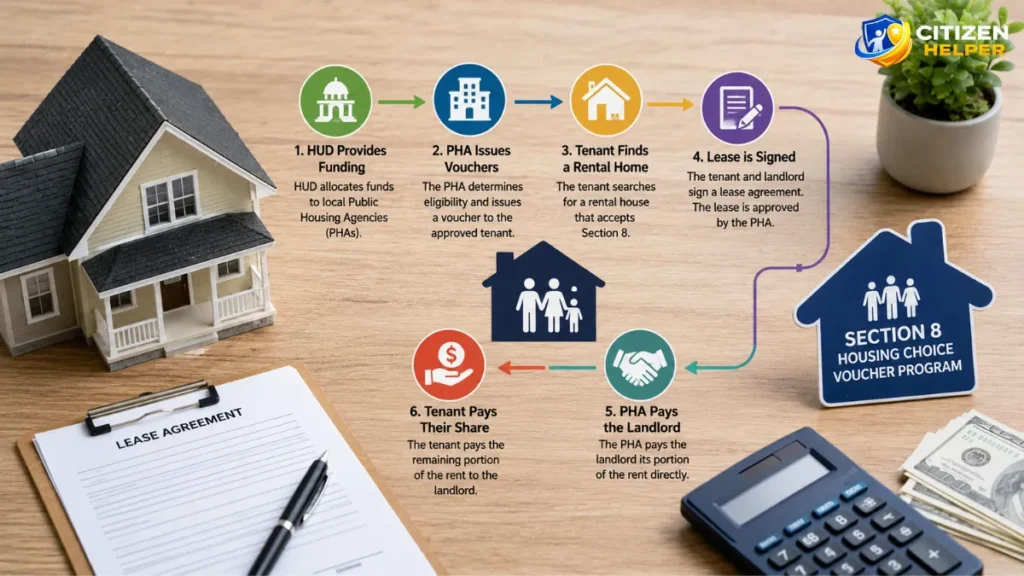
The Housing Choice Voucher Program allows eligible households to search for qualifying rental housing in the private market.
Depending on local availability and program requirements, a voucher may be used for:
- Single-family houses
- Apartments
- Townhouses
- Duplexes
- Condominiums
- Other eligible rental units
The household generally chooses where to live rather than being assigned to a specific property. However, the rental unit must meet program requirements and receive approval from the PHA.
The general process works like this:
- An eligible household receives a Housing Choice Voucher.
- The household searches for a suitable rental property.
- The landlord agrees to participate or otherwise complies with applicable local or state requirements.
- The tenant and landlord complete the required tenancy approval documents.
- The PHA reviews the proposed rent.
- The rental unit is inspected.
- The PHA approves the tenancy if all requirements are met.
- The tenant and landlord complete the required lease documents.
- The PHA begins making approved housing assistance payments.
Voucher holders should not assume that assistance will begin immediately after finding a house.
Official Source: U.S. Department of Housing and Urban Development – Housing Choice Voucher Program
Where to Find Houses for Rent That Accept Section 8
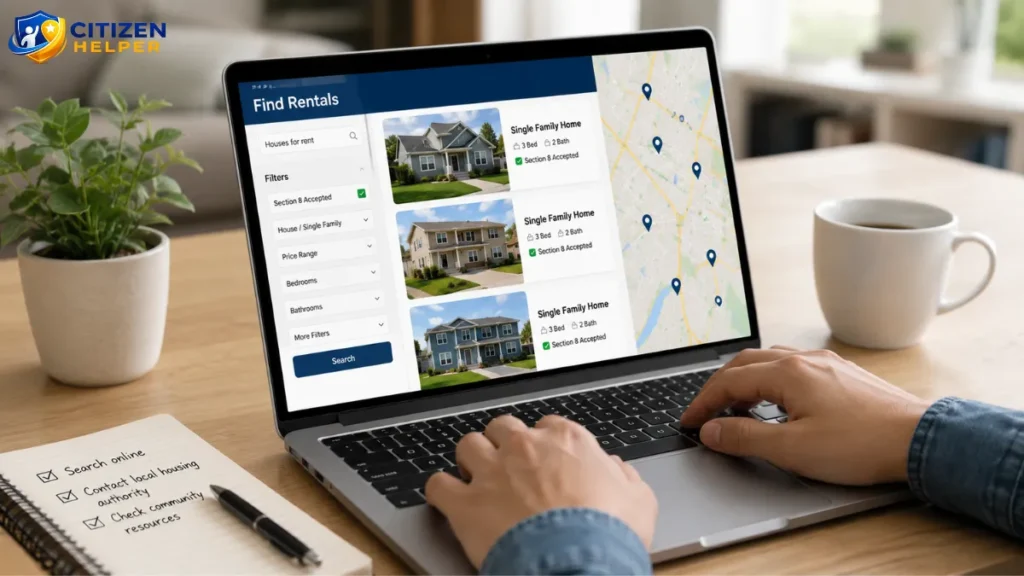
There is no single nationwide list containing every available Section 8 rental house. Rental availability changes frequently, and housing search resources differ by location.
The following options may help you find available homes.
1. Contact Your Local Public Housing Agency
The PHA that issued your voucher should usually be your first source of information.
Ask whether the agency provides:
- Lists of participating landlords
- Available rental property listings
- Housing search websites
- Landlord contact information
- Housing search workshops
- Assistance for voucher holders having difficulty finding housing
- Information about available search-time extensions
Some PHAs maintain online rental listings, while others work with third-party housing search services.
The housing agency may also explain:
- Your voucher bedroom size
- The current payment standards
- The geographic area where you may search
- Your voucher expiration date
- The process for requesting tenancy approval
- Portability rules
Do not rely only on old housing lists. Rental availability can change quickly, so contact landlords directly to confirm that a unit is still available.
2. Search Affordable Housing Websites
Affordable housing websites may allow users to search by:
- City
- State
- ZIP code
- Number of bedrooms
- Monthly rent
- Property type
- Accessibility features
- Voucher acceptance
Some housing authorities direct voucher holders to specific rental listing platforms.
When using a housing website, confirm all information with the landlord or property manager. An online listing may be outdated, and a property advertised as accepting vouchers must still complete the PHA approval process.
3. Use General Rental Listing Websites
Many landlords advertise houses on general rental websites rather than Section 8-specific platforms.
Try search terms such as:
- Section 8 houses for rent near me
- Houses for rent that accept Section 8 in [city]
- Housing Choice Voucher rentals in [county]
- Section 8 single-family homes for rent
- Voucher-friendly landlords near me
- Affordable houses for rent in [ZIP code]
Some websites allow users to filter listings by price, number of bedrooms, location, and property type.
If a listing does not mention Section 8, contact the landlord and ask whether the property may be rented with a Housing Choice Voucher.
4. Contact Local Property-Management Companies
Property-management companies may manage multiple rental houses and apartment communities.
Ask whether the company:
- Has properties available within your voucher range
- Participates in the Housing Choice Voucher Program
- Has experience working with the local PHA
- Maintains a waiting list for available rentals
- Manages properties in other nearby neighborhoods
Even if no suitable property is available immediately, ask whether you can receive notifications about future vacancies.
5. Contact Local Housing Nonprofits
Housing nonprofits may help voucher holders search for rental homes.
Depending on the organization, assistance may include:
- Rental listings
- Landlord referrals
- Housing search counseling
- Application assistance
- Help communicating with landlords
- Security deposit assistance
- Moving-cost assistance
- Fair housing information
Some organizations provide specialized help for older adults, veterans, people with disabilities, families experiencing homelessness, or people moving from shelters.
6. Ask Community Organizations for Referrals
Local organizations may know landlords who have previously rented to voucher holders.
Contact:
- Community Action Agencies
- Churches and faith-based organizations
- Family resource centers
- Local housing counseling agencies
- Homelessness-prevention programs
- Disability service organizations
- Veterans’ organizations
- Senior service agencies
These organizations may not own rental housing, but they may provide referrals or housing search support.
7. Look for Local Rental Signs and Advertisements
Some smaller landlords do not advertise on major rental websites.
Check:
- “For Rent” signs
- Community bulletin boards
- Local newspapers
- Neighborhood groups
- Community centers
- Local rental publications
Contact the property owner and ask whether the landlord is familiar with the Housing Choice Voucher Program.
Be careful when responding to online advertisements. Confirm that the person advertising the property is authorized to rent it before providing money or sensitive personal information.
How to Search for Section 8 Houses Near You

Start with a focused search based on your voucher and preferred location.
Step 1: Review Your Voucher Information
Before searching, confirm:
- Voucher bedroom size
- Voucher expiration date
- PHA service area
- Payment standard information
- Estimated tenant payment
- Utility responsibilities
- Required housing search procedures
Your voucher bedroom size may affect the type of property that can be approved.
Step 2: Choose Several Neighborhoods
Searching only one small area may limit your options.
Consider:
- Distance from work
- Schools
- Public transportation
- Grocery stores
- Medical care
- Child-care services
- Accessibility needs
- Neighborhood safety
- Utility costs
Ask your PHA whether payment standards vary by ZIP code or neighborhood.
Step 3: Create a List of Available Rentals
Record important information for each property:
- Address
- Monthly rent
- Number of bedrooms
- Landlord or property manager
- Phone number
- Application fee
- Security deposit
- Utilities included
- Date contacted
- Application status
Keeping a housing search record can help you avoid contacting the same property repeatedly.
Step 4: Contact Landlords Quickly
Affordable rental properties may receive many applications.
When contacting a landlord, provide clear information and ask:
- Is the property still available?
- Can the property be rented through the Housing Choice Voucher Program?
- What are the rental requirements?
- What utilities are included?
- What is the security deposit?
- Is there an application fee?
- When is the property available?
- Has the landlord worked with the local PHA before?
Do not assume that a landlord is familiar with every part of the program.
Step 5: View the Property Before Applying
If possible, inspect the property in person before paying an application fee or signing documents.
Look for possible concerns involving:
- Plumbing
- Electricity
- Heating
- Windows and doors
- Smoke alarms
- Water damage
- Mold
- Pests
- Structural condition
- Security
A PHA inspection does not replace your responsibility to decide whether the property meets your household’s needs.
What Should You Say When Contacting a Landlord?
You can keep the conversation simple and professional.
For example:
“Hello, I am interested in the rental house at [property address]. Is it still available? I have a Housing Choice Voucher through [housing agency]. Can this property be rented through the program?”
If the landlord is unfamiliar with Section 8, explain that the PHA can provide information about the required process.
Avoid promising that the housing authority will approve the rent or property. Final approval depends on the PHA’s review.
Can a Landlord Refuse Section 8?
The answer depends partly on state and local law.
The federal Fair Housing Act prohibits housing discrimination based on protected characteristics, including race, color, national origin, religion, sex, familial status, and disability. However, Housing Choice Voucher status is not itself a nationwide protected category under the federal Fair Housing Act.
Some states, counties, and cities have source-of-income discrimination laws that protect applicants who use Section 8 vouchers or other lawful forms of rental assistance. In those areas, a landlord may be prohibited from rejecting an applicant simply because the applicant uses a Housing Choice Voucher.
Protections vary by location. Some laws apply broadly, while others contain exemptions or specific requirements.
Even where voucher protections apply, landlords may generally use lawful and consistently applied rental criteria. Depending on local law, landlords may review factors such as:
- Rental history
- Credit history
- References
- Criminal history, subject to applicable laws
- Ability to pay the tenant’s required share
- Compliance with lease requirements
Landlords must also comply with federal, state, and local fair housing laws.
If you believe a landlord discriminated against you, contact a local fair housing organization, state or local civil rights agency, or HUD for information.
Official Source: U.S. Department of Housing and Urban Development – Housing Discrimination Under the Fair Housing Act
Can Landlords Require Income From Section 8 Applicants?
Landlords may use lawful income requirements, but the rules may depend on state and local law.
In areas with source-of-income protections, landlords may be required to consider the value of the voucher and may need to apply income requirements only to the tenant-paid portion of the rent rather than the full monthly rent.
For example, if a PHA will pay part of the rent directly to the landlord, local law may affect how the landlord evaluates the applicant’s income.
Voucher holders should check the rules in their state, county, or city. Contact a local fair housing organization if you believe an income requirement improperly excludes voucher holders.
Can a Landlord Check Your Credit With Section 8?
Receiving Section 8 assistance does not automatically prevent a landlord from conducting a credit check.
A landlord may generally use lawful screening requirements that are applied consistently to applicants. However, state and local laws may affect how screening criteria can be used.
Landlords may also review:
- Rental history
- Previous evictions
- References
- Background information
- Household size
- Ability to pay the tenant portion of rent
Having a voucher does not guarantee approval by a landlord.
If you have credit problems, explain any relevant circumstances when appropriate and provide positive rental references if available.
What Happens After You Find a Section 8 House?

After finding a rental property, contact your PHA before signing a lease or moving into the home.
The process generally includes several steps.
Step 1: Complete the Request for Tenancy Approval
The tenant and landlord generally complete a Request for Tenancy Approval (RFTA) or a similar PHA form.
The form may include information about:
- Property address
- Proposed rent
- Lease terms
- Utilities
- Appliances
- Property owner
- Property-management company
Submit the completed documents according to the PHA’s instructions.
Step 2: The PHA Reviews the Proposed Rent
The PHA reviews whether the proposed rent is reasonable compared with similar unassisted rental properties.
The housing agency may consider factors such as:
- Location
- Number of bedrooms
- Property type
- Unit size
- Property condition
- Amenities
- Utilities included
- Comparable local rents
The landlord may be asked to accept a different rent if the proposed amount does not meet program requirements.
Official Source: U.S. Department of Housing and Urban Development – Housing Choice Voucher Tenants
Step 3: The Rental Unit Is Inspected
The PHA arranges an inspection to determine whether the property meets applicable program standards.
The inspection may review areas such as:
- Electricity
- Plumbing
- Heating
- Water supply
- Windows and doors
- Smoke alarms
- Structural condition
- Sanitation
- Security
- Other health and safety conditions
If the unit does not meet the required standards, the landlord may need to complete repairs before approval.
Step 4: The PHA Approves or Denies the Tenancy
The PHA reviews the required information and determines whether the rental arrangement can be approved.
Approval may depend on:
- Inspection results
- Rent reasonableness
- Voucher size
- Household eligibility
- Required documents
- Program requirements
Do not move into the property expecting the PHA to approve it later unless your housing agency specifically authorizes the arrangement.
Step 5: Required Contracts and Lease Documents Are Completed
After approval, the tenant and landlord complete the lease, and the landlord and PHA complete the required Housing Assistance Payments contract.
The PHA then makes the approved housing assistance payment directly to the landlord.
The tenant remains responsible for:
- The required tenant portion of rent
- Any tenant-paid utilities
- Security deposit obligations
- Lease compliance
- Reporting required household changes
- Other approved charges under the lease
Does a Section 8 House Have to Pass an Inspection?

Yes. A rental unit generally must meet applicable Housing Choice Voucher inspection requirements before housing assistance begins.
The purpose of the inspection is to confirm that the home meets required health, safety, and housing standards.
A failed initial inspection does not always mean the property is permanently ineligible. The landlord may be able to make required repairs and arrange another inspection.
The inspection process can delay move-in if repairs are needed.
Official Source: U.S. Department of Housing and Urban Development – Housing Choice Voucher Tenants
What Is Rent Reasonableness?
Rent reasonableness means that the rent charged for a Section 8 unit must be reasonable compared with rents for similar unassisted properties.
The PHA may compare factors such as:
- Location
- Property size
- Number of bedrooms
- Unit type
- Property age
- Condition
- Amenities
- Utilities
- Maintenance services
A landlord’s advertised rent is not automatically the amount the PHA will approve.
If the PHA determines that the proposed rent is too high, the landlord may need to lower the rent before the tenancy can be approved.
What Is a Section 8 Payment Standard?
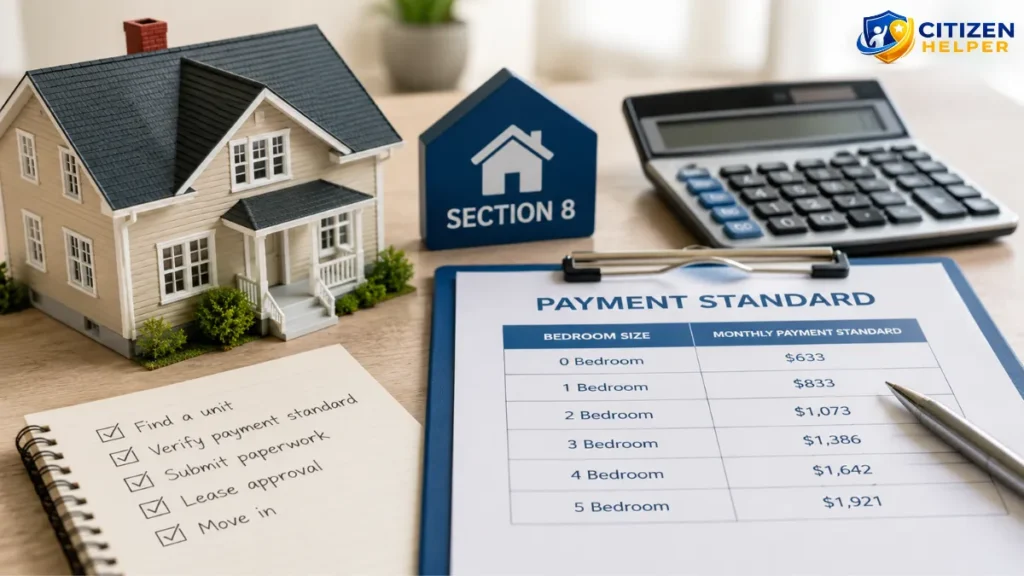
A payment standard is an amount used by the PHA when calculating housing assistance.
The payment standard is not necessarily:
- The maximum rent a landlord may charge
- The exact amount the PHA will pay
- The tenant’s final rent payment
- A guarantee that a property will be approved
Payment standards may vary by:
- PHA
- Voucher bedroom size
- ZIP code
- Local rental market
The household’s actual payment depends on program calculations, household income, approved rent, utility allowances, and other factors.
Ask your PHA for current payment standard information before applying for a rental house.
Can You Rent a House Above the Section 8 Payment Standard?
A house with rent above the payment standard may sometimes be approved, but the household may be responsible for a larger portion of the rent.
Program limits apply, especially when a household first moves into a unit.
The PHA must still determine that the proposed rent is reasonable.
Before applying, ask your housing agency to explain how the rent may affect your estimated tenant payment. Do not assume that the voucher will cover every rental amount.
Who Pays the Security Deposit?
Housing Choice Voucher assistance generally does not automatically pay the security deposit.
The tenant may be responsible for:
- Security deposit
- Application fees
- Moving expenses
- Utility deposits
- Other lawful move-in costs
Some PHAs, local governments, charities, and nonprofit organizations offer separate security deposit or move-in assistance programs.
Ask your PHA or call 211 to find local assistance.
Can You Use a Section 8 Voucher for a Single-Family House?

Yes. Housing Choice Vouchers may generally be used for eligible single-family rental houses when the property, rent, lease, and tenancy meet program requirements.
However, availability depends on the local rental market.
A single-family home may have additional costs, including:
- Higher utility bills
- Lawn care
- Trash services
- Water or sewer charges
- Other tenant responsibilities
Review the lease carefully and ask which utilities and maintenance responsibilities belong to the tenant.
Can You Use Section 8 in Another City or State?
Housing Choice Vouchers may be portable.
Portability generally allows eligible voucher holders to move to another PHA’s jurisdiction and continue receiving assistance, subject to HUD rules and housing authority procedures.
Before searching outside your current area:
- Contact the PHA that issued your voucher.
- Ask whether you are eligible to move through portability.
- Follow the required transfer procedures.
- Contact the receiving housing authority when instructed.
- Review the receiving PHA’s payment standards and local rules.
- Wait for required approval before moving.
Do not assume that your current payment standard or voucher procedures will remain the same in another area.
What Should You Do If Your Voucher Is About to Expire?
Housing Choice Vouchers generally provide a limited amount of time to find housing.
If your voucher is close to expiring:
- Contact your PHA immediately.
- Ask whether an extension is available.
- Follow the agency’s extension request procedure.
- Keep records of your housing search.
- Save copies of rental applications and landlord communications.
- Explain any barriers affecting your search.
- Ask about reasonable accommodation if a disability affects your ability to search for housing.
Extensions are not automatic and depend on PHA policies and individual circumstances.
Do not wait until the expiration date to request help.
What If You Cannot Find a Landlord Who Accepts Section 8?

Many voucher holders experience difficulty finding an available rental property.
If your search is unsuccessful:
- Contact your PHA for updated rental listings.
- Expand your search area when possible.
- Search nearby ZIP codes.
- Contact property-management companies.
- Ask housing nonprofits for assistance.
- Use affordable housing search websites.
- Ask about landlord outreach programs.
- Request information about voucher extensions.
- Review portability options.
- Keep records of your housing search.
If you believe landlords are refusing your voucher in violation of state or local source-of-income laws, contact a local fair housing organization.
Can You Stay in Your Current Home With Section 8?
In some cases, a household may be able to use a voucher in its current rental home.
The landlord must complete applicable program requirements, and the PHA must approve:
- The rental unit
- Proposed rent
- Lease terms
- Required documents
The property must also meet applicable inspection standards.
Contact your PHA before making plans. Approval is not automatic.
Section 8 Houses vs. Project-Based Section 8 Housing
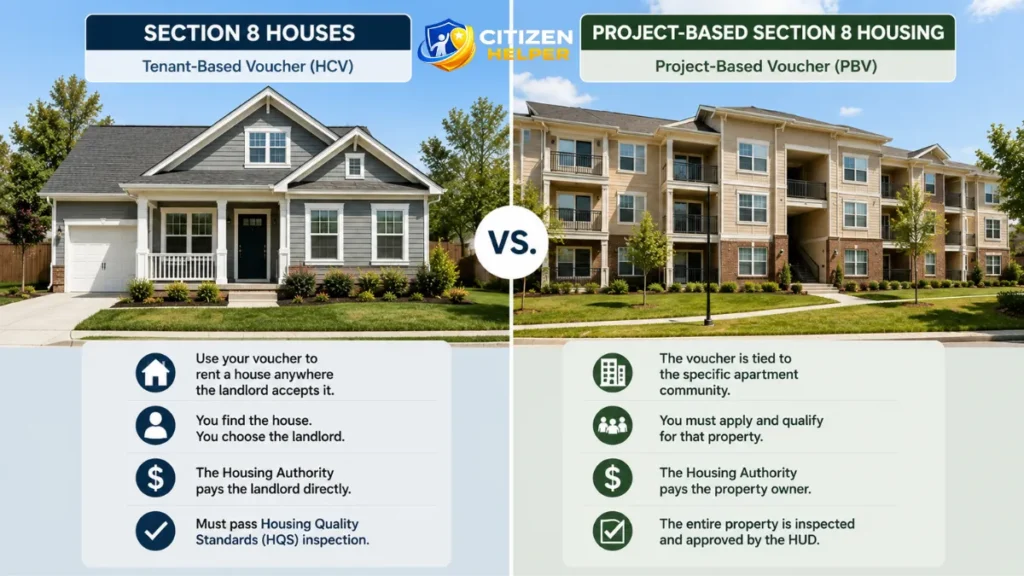
Tenant-based Housing Choice Vouchers and project-based rental assistance work differently.
| Housing Type | How It Generally Works |
| Tenant-Based Housing Choice Voucher | The voucher is generally connected to the household, allowing the household to search for an eligible rental property. |
| Project-Based Voucher | Rental assistance is connected to a specific property or unit. |
| Other Project-Based Section 8 Housing | Assistance is generally tied to the participating property rather than moving with the tenant. |
Waiting lists and eligibility procedures may differ.
A household may be allowed to apply to multiple housing programs when applications are open.
How to Avoid Section 8 Rental Scams
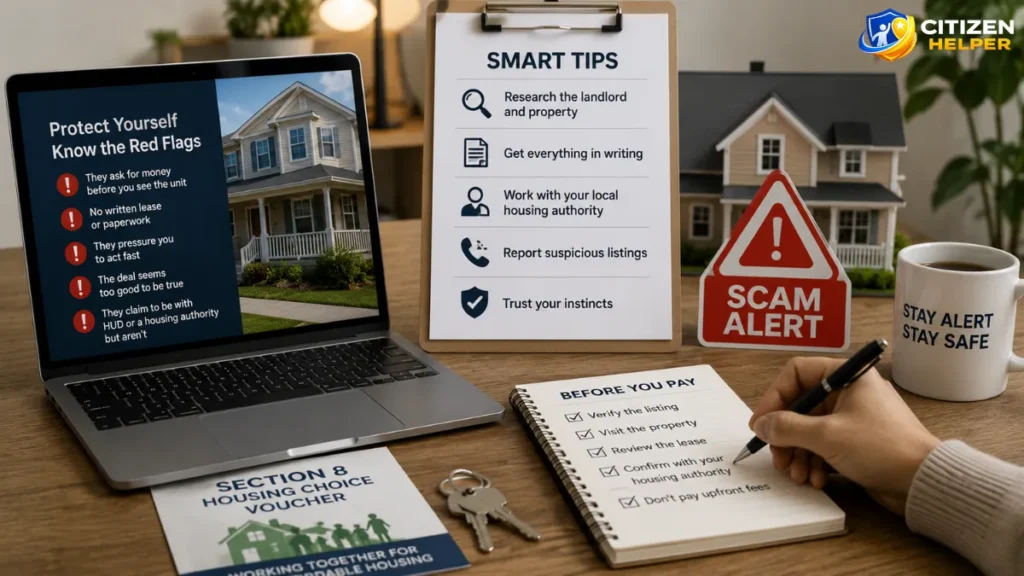
Rental scams can target people searching for affordable housing.
Watch for warning signs such as:
- Requests for payment before viewing the property
- Prices that appear unrealistically low
- Refusal to show the inside of the home
- Requests for gift cards or cryptocurrency
- Pressure to send money immediately
- Claims that no lease is required
- Requests to send money to another country
- Someone claiming to be a landlord without proof
- Guaranteed PHA approval
Before paying money:
- View the property when possible.
- Confirm the landlord or property manager’s identity.
- Verify that the person has authority to rent the property.
- Review the lease.
- Contact your PHA.
- Get payment terms in writing.
- Request receipts.
Do not provide Social Security numbers, banking information, or identification documents through an unverified listing.
Tips for Finding a Section 8 House Faster
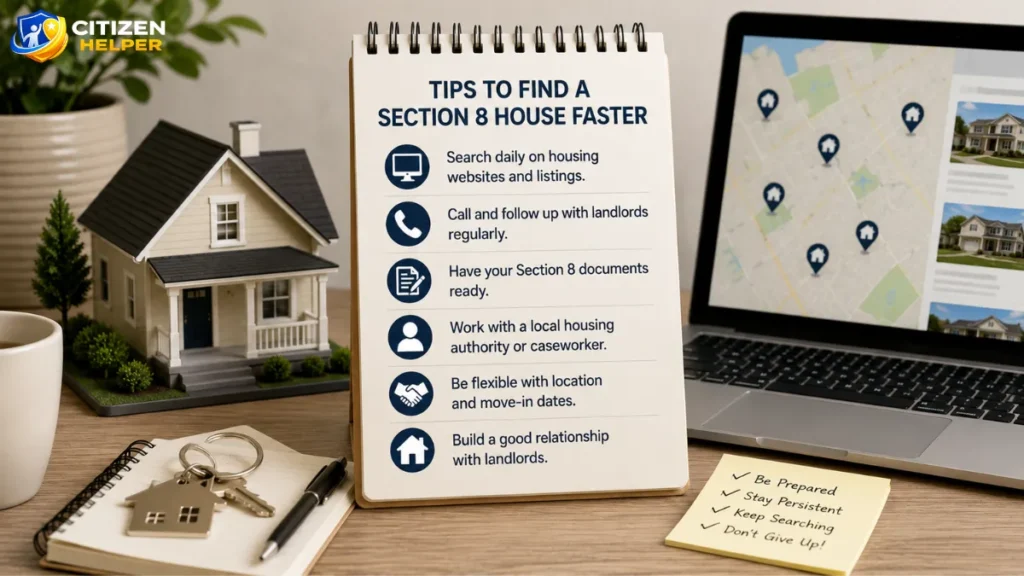
A well-organized housing search may help you respond quickly when a suitable rental becomes available.
Try these steps:
- Begin searching as soon as your voucher is issued.
- Contact several landlords each day.
- Check rental listings regularly.
- Prepare identification and rental documents.
- Keep landlord references available.
- Know your voucher bedroom size.
- Review payment standard information.
- Search more than one neighborhood.
- Respond quickly to landlord messages.
- Keep a housing search log.
- Follow up on applications.
- Stay in contact with your PHA.
Never provide false information on a rental application. Landlords and PHAs may verify application details.
Conclusion:
Finding houses for rent that accept Section 8 can take time, but using several housing search methods may improve your chances of finding a suitable home.
Start with your local Public Housing Agency, affordable housing websites, property-management companies, housing nonprofits, and local rental listings. Confirm your voucher bedroom size, expiration date, payment standard information, and housing search requirements before applying.
After you find a rental house, the PHA generally must review the proposed rent, inspect the property, approve the tenancy, and complete required documents before housing assistance begins. Do not assume that a rental advertisement guarantees Section 8 approval.
Because rental availability, payment standards, inspection procedures, and voucher rules may vary, stay in contact with your PHA throughout the housing search process.
Internal Linking Suggestions
- How Does Section 8 Housing Work?
- How Much Rent Do You Pay With Section 8?
- How to Find Private Landlords That Accept Section 8
- Can You Use a Section 8 Voucher in Another State?
- What Happens During a Section 8 Housing Inspection?
Frequently Asked Questions (FAQ)
How do I find houses for rent that accept Section 8 near me?
Contact your local PHA, review its rental listings, search affordable housing websites, contact property-management companies, and ask local housing nonprofits for help.
Can Section 8 be used to rent a house?
Yes. A Housing Choice Voucher may generally be used for an eligible single-family rental house if the property and tenancy meet program requirements and receive PHA approval.
Does every landlord have to accept Section 8?
Not nationwide. State and local source-of-income laws may require landlords in some areas to consider Housing Choice Vouchers. Rules vary by location.
Can a landlord deny a Section 8 applicant?
A landlord may generally use lawful and consistently applied screening requirements. However, landlords must follow federal fair housing laws and any applicable state or local source-of-income protections.
Does a Section 8 rental house need an inspection?
Yes. The PHA generally inspects the property to determine whether it meets applicable program requirements.
Can I move into a house before the Section 8 inspection?
Do not move in before receiving the required PHA approval unless your housing agency specifically authorizes the arrangement. Moving in early may create financial risks.
Will Section 8 pay my entire rent?
Not necessarily. The PHA calculates the housing assistance payment, and the tenant is generally responsible for an approved share of the housing costs.
Can I rent a house that costs more than my voucher payment standard?
Possibly, but program limits apply, and the household may need to pay more. The PHA must also determine that the rent is reasonable.
Does Section 8 pay the security deposit?
Housing Choice Voucher assistance generally does not automatically cover security deposits. Separate local programs may provide move-in assistance.