Getting a Texas driver’s license often involves passing a knowledge test that checks your understanding of traffic laws, road signs, safe driving practices, and other important rules. Taking a Texas drivers license practice test can help you become familiar with the types of topics you should study before taking the official exam.
However, a practice test should not replace studying the official Texas Driver Handbook. The actual knowledge test is based on Texas driving laws and safe-driving principles, and the questions you receive may vary.
This guide explains how the Texas driver’s license knowledge test works, who may need to take it, what topics to study, the passing requirement, how to prepare effectively, what happens if you do not pass, and where to find reliable official resources.
Quick Answer: What Is a Texas Drivers License Practice Test?
A Texas drivers license practice test is a study tool designed to help you prepare for the knowledge exam that may be required when applying for a Texas driver’s license or learner license.
Practice questions may cover topics such as:
- Texas traffic laws
- Road signs and traffic signals
- Right-of-way rules
- Speed and safe driving
- Parking rules
- School buses
- Emergency vehicles
- Railroad crossings
- Sharing the road
- Alcohol and impaired driving laws
The best starting point for preparation is the official Texas Driver Handbook, published by the Texas Department of Public Safety (DPS).
Official Source: Texas Department of Public Safety – Driver License Publications
Texas Driver’s License Knowledge Test at a Glance
| Topic | What You Should Know |
| Purpose of the test | To demonstrate an understanding of traffic laws and safe-driving practices |
| Who may need to take it | First-time applicants and other applicants whose licensing circumstances require a knowledge exam |
| Main topics covered | Traffic laws, road signs, traffic signals, right-of-way, safe driving, parking, impaired driving, and sharing the road |
| Official study resource | Texas Driver Handbook published by Texas DPS |
| Practice-test purpose | To identify weak areas and reinforce knowledge from the official handbook |
| Testing method or location | Depending on the applicant’s situation, testing requirements may be completed at a DPS office, through an authorized third-party provider, or as part of qualifying driver education |
Official Source: Texas Department of Public Safety – Apply for a Texas Driver License
What Is the Texas Driver’s License Knowledge Test?
The Texas driver’s license knowledge test is designed to evaluate whether you understand the traffic laws and safety rules necessary to drive legally and responsibly.
Depending on your age, license type, driver education history, previous licensing history, and other circumstances, you may be required to pass a knowledge exam as part of the licensing process.
The test evaluates knowledge of subjects covered in the official Texas Driver Handbook, including traffic laws, road signs, right-of-way rules, and safe-driving practices.
Applicants should study current official materials because driving laws and licensing procedures can change.
Official Source: Texas Department of Public Safety – Texas Driver Handbook
Who Needs to Take the Texas Driver’s License Knowledge Test?
Not every applicant follows exactly the same testing process. Whether you need to take a knowledge exam can depend on factors such as your age, the type of license you are applying for, previous licensing history, and completion of an approved driver education program.
People who may need to take a knowledge test include:
- First-time driver’s license applicants
- Teen applicants seeking a learner license
- Certain adult applicants without previous driving credentials
- Applicants whose circumstances require retesting
- People applying for certain types or classes of licenses
For example, Texas DPS explains that teen learner-license applicants must provide evidence of successfully passing the driver knowledge exam. If the test was not completed during the classroom portion of driver education, the applicant takes it at the driver license office.
Because requirements vary, applicants should review the official DPS information that applies to their individual circumstances.
Official Source: Texas Department of Public Safety – Texas Learners License as a Teen
How Many Questions Are on the Texas Driver’s License Test?
Texas DPS does not publish a single fixed question count in the official Texas Driver Handbook that applies to every knowledge exam, applicant, license class, or testing method.
Different knowledge examinations may apply depending on the type of license or endorsement involved. For example, the Texas Driver Handbook identifies different knowledge exams for different license classes and circumstances.
For this reason, it is better not to rely on unofficial websites that claim every Texas driver’s license knowledge test always contains a specific number of questions. Instead, applicants should study the current Texas Driver Handbook and verify any test-specific requirements that apply to their particular license application.
Official Source: Texas Department of Public Safety – Texas Driver Handbook
What Score Do You Need to Pass the Texas Driver’s License Test?
According to the official Texas Driver Handbook, you must score 70 percent or better to pass any knowledge exam.
This is the official passing standard stated by Texas DPS. However, applicants may face different knowledge exams depending on the class of license or type of credential they are seeking.
A strong score on an unofficial practice test can show that you are making progress, but it does not guarantee that you will pass the actual knowledge exam. The official test may cover different topics or phrase questions differently.
Official Source: Texas Department of Public Safety – Texas Driver Handbook
What Topics Should You Study for the Texas Driver’s License Test?
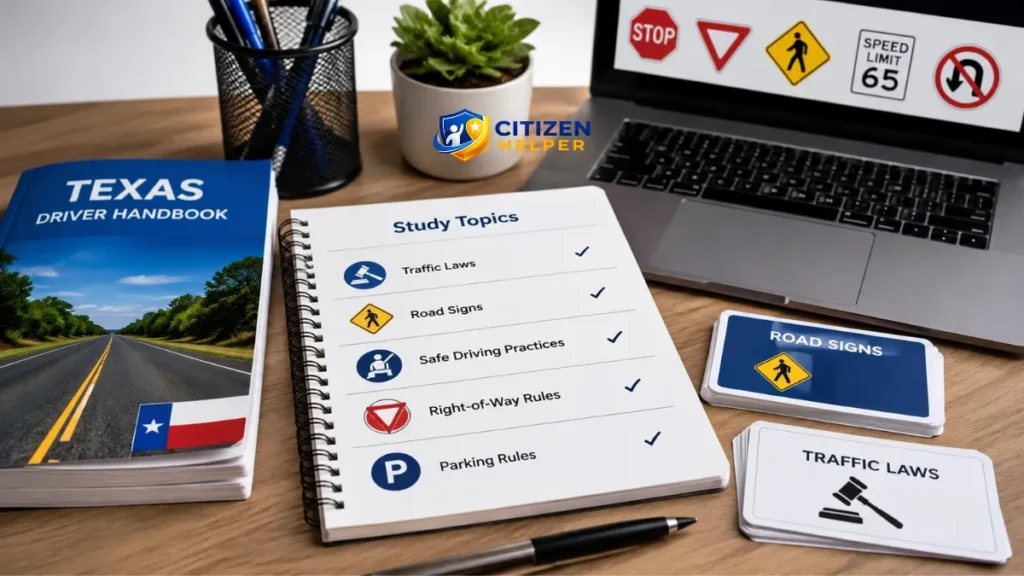
A good Texas driver’s license study plan should cover the major topics included in the official Texas Driver Handbook.
Road Signs
You should be able to recognize different types of road signs and understand what they mean.
Important categories include:
- Regulatory signs
- Warning signs
- Guide signs
- Construction and maintenance signs
- Railroad crossing signs
Pay attention to sign shapes, colors, symbols, and written instructions.
Traffic Signals and Pavement Markings
Study the meaning of:
- Red, yellow, and green traffic lights
- Flashing signals
- Turn arrows
- Solid and broken lane lines
- Yellow and white pavement markings
- Crosswalks
- Stop lines
Understanding pavement markings is important because they help determine lane use and when passing, changing lanes, or turning may be permitted.
Right-of-Way Rules
Right-of-way questions can involve:
- Intersections
- Four-way stops
- Pedestrians
- Emergency vehicles
- Left turns
- Vehicles entering a roadway
- Roundabouts
Even when you have the right-of-way, you should take reasonable action to avoid a collision.
Speed Limits and Safe Speed
Drivers should understand posted speed limits and the importance of adjusting speed for conditions.
Weather, traffic, visibility, road construction, and other hazards may require driving more slowly than the posted limit.
Parking Rules
Study where parking is prohibited and how to park safely in different situations.
Questions may involve parking near:
- Fire hydrants
- Intersections
- Crosswalks
- Railroad crossings
- Driveways
- Traffic-control devices
Sharing the Road
Drivers must safely share Texas roads with:
- Motorcyclists
- Bicyclists
- Pedestrians
- School buses
- Large trucks
- Emergency vehicles
Each type of road user presents different safety considerations.
Alcohol, Drugs, and Driving
The Texas Driver Handbook includes important information about alcohol, drugs, impaired driving, and related laws.
Applicants should understand how alcohol and drugs can affect driving ability and the serious legal and safety consequences of impaired driving.
Official Source: Texas Department of Public Safety – Texas Driver Handbook
How to Use a Texas Drivers License Practice Test Effectively
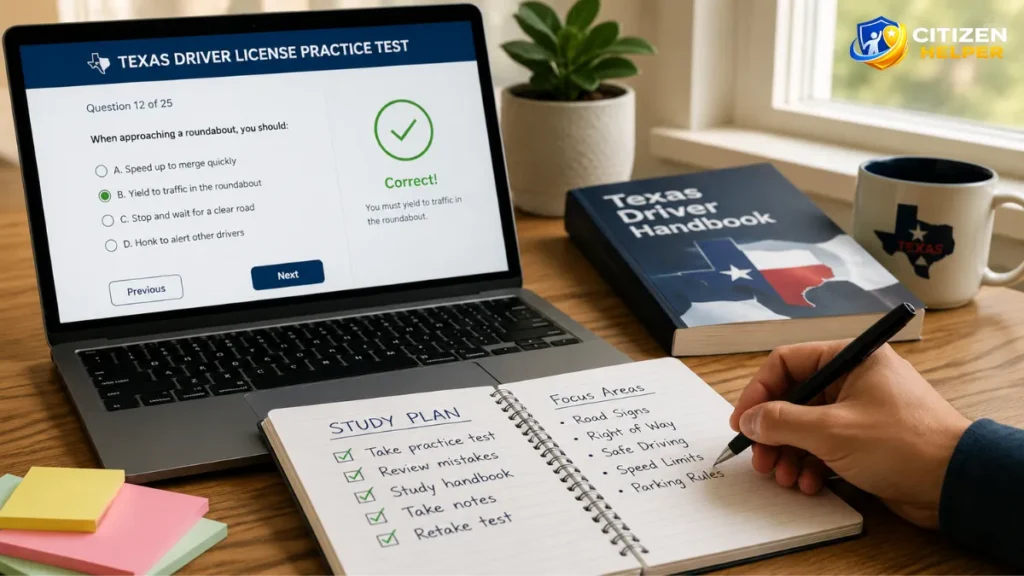
Simply answering practice questions repeatedly is not always the best preparation
strategy. You should use practice tests to identify gaps in your knowledge.
A useful study method is:
- Read the official Texas Driver Handbook.
- Take a practice test without looking up the answers.
- Review every question you answered incorrectly.
- Return to the relevant handbook section.
- Study the rule until you understand why the correct answer is correct.
- Take another practice test with different questions.
- Repeat the process until your scores are consistently strong.
Avoid memorizing answers without understanding the underlying rules. The real exam may ask about the same law or safety principle in a different way.
Texas Drivers License Practice Test: Sample Questions
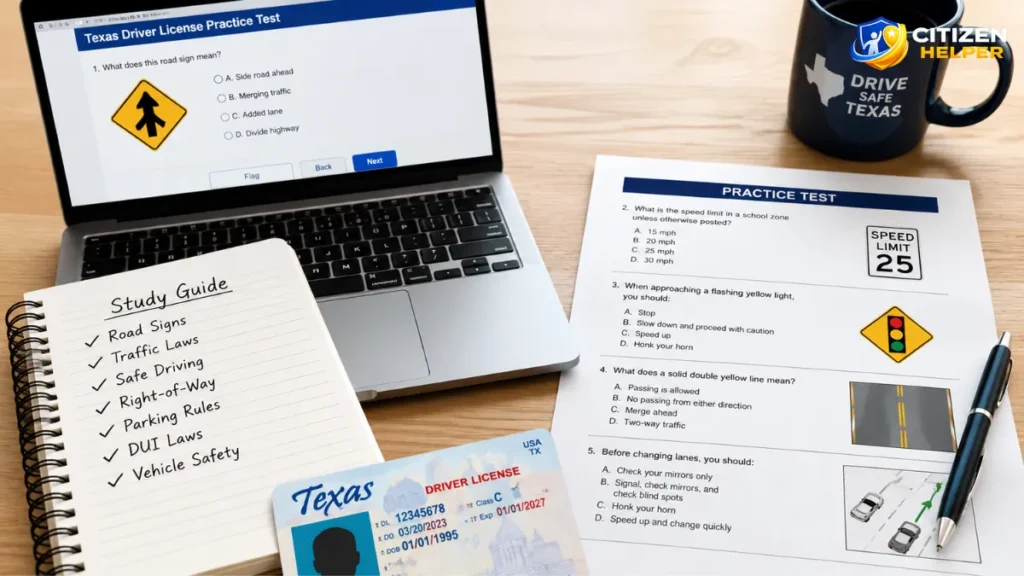
The following questions are original study examples created for practice purposes only. They are not actual Texas DPS exam questions and should not be treated as official test content. The answers and explanations are based on safe-driving principles and information covered in the official Texas Driver Handbook.
Question 1: Road Signs
What does an octagonal red sign mean?
A. Yield
B. Stop
C. Railroad crossing
D. School zone
Correct Answer: B. Stop
Explanation: The eight-sided shape is reserved for stop signs. Drivers must come to a complete stop and proceed only when it is legal and safe.
Question 2: Traffic Signals
What should you do when approaching a steady red traffic signal?
A. Slow down and continue if no vehicles are coming
B. Stop and proceed only when legally permitted and safe
C. Speed up before cross traffic begins moving
D. Honk and continue through the intersection
Correct Answer: B. Stop and proceed only when legally permitted and safe.
Explanation: A steady red signal requires a complete stop. Any movement after stopping must comply with applicable traffic laws and current conditions.
Question 3: Right-of-Way
Two vehicles arrive at an intersection controlled by stop signs at approximately the same time. Which driver should generally yield?
A. The driver on the right
B. The driver on the left
C. The driver traveling faster
D. The driver in the larger vehicle
Correct Answer: B. The driver on the left.
Explanation: When vehicles arrive at approximately the same time, the driver on the left should generally yield to the driver on the right.
Question 4: Speed and Safe Driving
What should you do when weather, visibility, or road conditions become hazardous?
A. Always continue at the posted maximum speed
B. Increase speed to leave the area quickly
C. Adjust your speed and driving behavior to match conditions
D. Follow the vehicle ahead more closely
Correct Answer: C. Adjust your speed and driving behavior to match conditions.
Explanation: A posted speed limit does not mean that speed is safe under all conditions. Drivers should reduce speed when necessary for weather, visibility, traffic, or roadway hazards.
Question 5: Parking
Before leaving a parked vehicle, what should you do?
A. Leave the engine running
B. Secure the vehicle so it cannot move unexpectedly
C. Leave the vehicle in neutral
D. Park facing against traffic whenever possible
Correct Answer: B. Secure the vehicle so it cannot move unexpectedly.
Explanation: Drivers should properly secure a parked vehicle, including setting the parking brake when appropriate and following safe parking procedures.
Question 6: School Buses
What should you do when you approach a school bus that is stopped to load or unload students and is displaying the legally required warning signals?
A. Speed up and pass quickly
B. Stop as required by Texas law and remain stopped until you may legally proceed
C. Honk to warn students before passing
D. Continue if you do not see any children
Correct Answer: B. Stop as required by Texas law and remain stopped until you may legally proceed.
Explanation: Texas law requires drivers to stop in applicable situations when a school bus is loading or unloading students and displaying required warning signals. The rules can differ when roadways are separated by certain physical barriers, so applicants should study the full school-bus rules in the Texas Driver Handbook.
Question 7: Emergency Vehicles
What should you do when an authorized emergency vehicle approaches using audible and visual signals?
A. Continue at the same speed
B. Race ahead of the emergency vehicle
C. Follow Texas rules for yielding and moving out of its path
D. Stop in the middle of an intersection
Correct Answer: C. Follow Texas rules for yielding and moving out of its path.
Explanation: Drivers must yield appropriately to approaching emergency vehicles using required warning signals and should avoid blocking intersections.
Question 8: Railroad Crossings
What is the safest action when warning lights are flashing at a railroad crossing?
A. Drive around the lowered gate if no train is visible
B. Stop and wait until it is legal and safe to cross
C. Speed across before the train arrives
D. Follow the vehicle ahead without checking
Correct Answer: B. Stop and wait until it is legal and safe to cross.
Explanation: Never drive around a lowered railroad gate. A train may be closer or moving faster than it appears, and another train may be approaching on a different track.
Question 9: Sharing the Road With Motorcycles
Why should drivers take extra care when checking for motorcycles?
A. Motorcycles always have the right-of-way
B. Their smaller size can make them harder to see and can affect your ability to judge their speed and distance
C. Motorcycles are not allowed to use normal traffic lanes
D. Motorcycles cannot stop quickly
Correct Answer: B. Their smaller size can make them harder to see and can affect your ability to judge their speed and distance.
Explanation: Drivers should carefully check mirrors and blind spots because motorcycles can be less visible than larger vehicles.
Question 10: Alcohol and Impaired Driving
Why is driving after consuming alcohol dangerous?
A. Alcohol can affect judgment, reaction time, coordination, and other driving abilities
B. Alcohol improves concentration at low speeds
C. Alcohol affects only inexperienced drivers
D. Alcohol makes night driving safer
Correct Answer: A. Alcohol can affect judgment, reaction time, coordination, and other driving abilities.
Explanation: Alcohol can impair important skills needed for safe driving. Texas law also imposes serious consequences for impaired driving.
Question 11: Bad Weather
Why should drivers reduce speed and increase caution during heavy rain?
A. Wet roads can reduce traction and increase stopping distance
B. Rain makes tires grip the road more effectively
C. Speed limits automatically increase during rain
D. Other vehicles must always move out of your way
Correct Answer: A. Wet roads can reduce traction and increase stopping distance.
Explanation: Rain can make roads slippery and reduce visibility. Slowing down and allowing more space can help drivers respond safely.
Question 12: Following Distance
Why should you leave adequate space between your vehicle and the vehicle ahead?
A. To prevent other drivers from changing lanes
B. To give yourself more time and distance to react and stop
C. To reduce the need to use mirrors
D. To encourage the other vehicle to drive faster
Correct Answer: B. To give yourself more time and distance to react and stop.
Explanation: Adequate following distance gives you more time to respond if the vehicle ahead suddenly slows or stops. More space may be necessary in poor weather, heavy traffic, or other hazardous conditions.
Official Source: Texas Department of Public Safety – Texas Driver Handbook
How Should You Study for the Texas Driver’s License Test?
Preparation does not have to be complicated. A consistent approach is usually more effective than trying to memorize the entire handbook in one sitting.
Start by dividing the Texas Driver Handbook into manageable sections. Study one or two topics at a time and take notes on rules that are difficult to remember.
Focus extra attention on:
- Road signs and signals
- Right-of-way rules
- Safe following distances
- Parking restrictions
- Speed and stopping
- School buses
- Emergency vehicles
- Railroad crossings
- Alcohol and drug laws
After each study session, test yourself without looking at your notes.
How Long Should You Study Before Taking the Test?
There is no single study period that works for everyone. Some applicants may be ready after several focused study sessions, while others may need more time.
Your preparation time can depend on:
- Your previous driving experience
- Your familiarity with Texas traffic laws
- How much time you study each day
- Your performance on practice questions
- Whether English is your first language
Instead of choosing a test date based only on how many days you have studied, focus on whether you can consistently explain important rules and correctly answer varied practice questions.
Can You Take the Texas Driver’s License Knowledge Test Online?
Whether you can complete the knowledge test online or through another authorized method depends on your age, driver education program, and individual licensing situation.
Some applicants may complete the knowledge examination as part of an approved driver education course. Others may take required tests at a DPS office or through an authorized third-party provider, depending on the applicant and testing requirement.
Do not assume that any website offering an online Texas driver’s license test is authorized to provide the official exam. Many websites offer only unofficial practice tests.
Verify your options through Texas DPS or an authorized provider.
Official Source: Texas Department of Public Safety – Apply for a Texas Driver License
Can You Take the Texas Driver’s License Test in Another Language?
Testing options and available languages may vary. If you need language assistance or want to know whether a knowledge test is available in a particular language, check with Texas DPS before your appointment.
Texas DPS also provides certain driver license publications in multiple languages.
Official Source: Texas Department of Public Safety – Driver License Publications
What Happens If You Fail the Texas Driver’s License Knowledge Test?
Failing a knowledge test does not necessarily mean the licensing process is over. However, retesting procedures and requirements can depend on your application and testing circumstances.
If you do not pass, review the areas where you struggled before trying again. Do not focus only on memorizing questions you remember from the test.
Instead:
- Review the relevant sections of the Texas Driver Handbook.
- Study road signs carefully.
- Practice right-of-way situations.
- Review Texas-specific laws.
- Take varied practice tests.
For current retesting requirements that apply to your particular situation, check directly with Texas DPS or your authorized testing provider.
Texas Driver’s License Test vs. Road Test
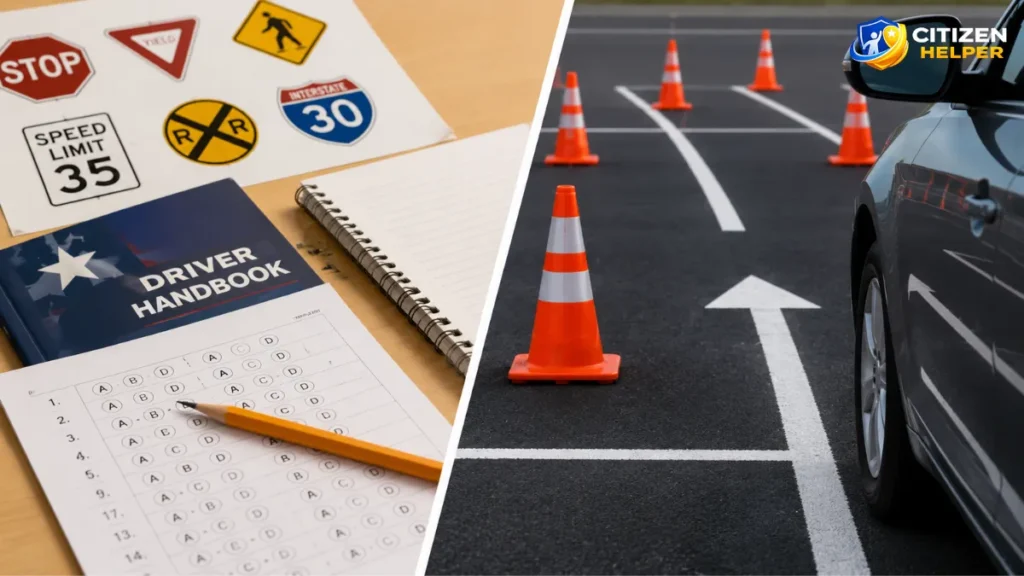
The knowledge test and driving skills test evaluate different abilities.
The knowledge test checks your understanding of traffic laws, road signs, and safe-driving principles.
The driving skills test, commonly called the road test, evaluates your ability to safely operate a motor vehicle.
Depending on your licensing situation, you may need to complete one or both examinations.
During a driving skills test, applicants may be evaluated on vehicle control, observation, signaling, positioning, stopping, turning, and compliance with traffic laws.
Official Source: Texas Department of Public Safety – Apply for a Texas Driver License
What Should You Bring When Applying for a Texas Driver’s License?
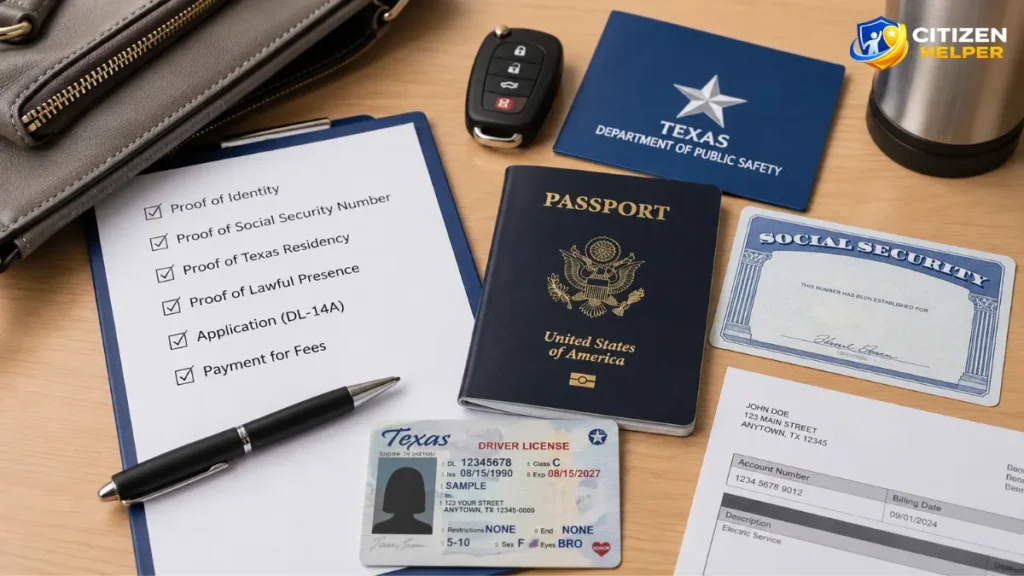
Required documents depend on your age, citizenship or lawful presence status, residency, and type of application.
Applicants may need documentation related to:
- U.S. citizenship or lawful presence
- Identity
- Social Security number
- Texas residency
- Vehicle registration
- Proof of insurance, when applicable
- Driver education completion, when required
Do not rely on a general checklist without checking the requirements for your specific circumstances.
Official Source: Texas Department of Public Safety – Apply for a Texas Driver License
Common Mistakes to Avoid When Preparing for the Test
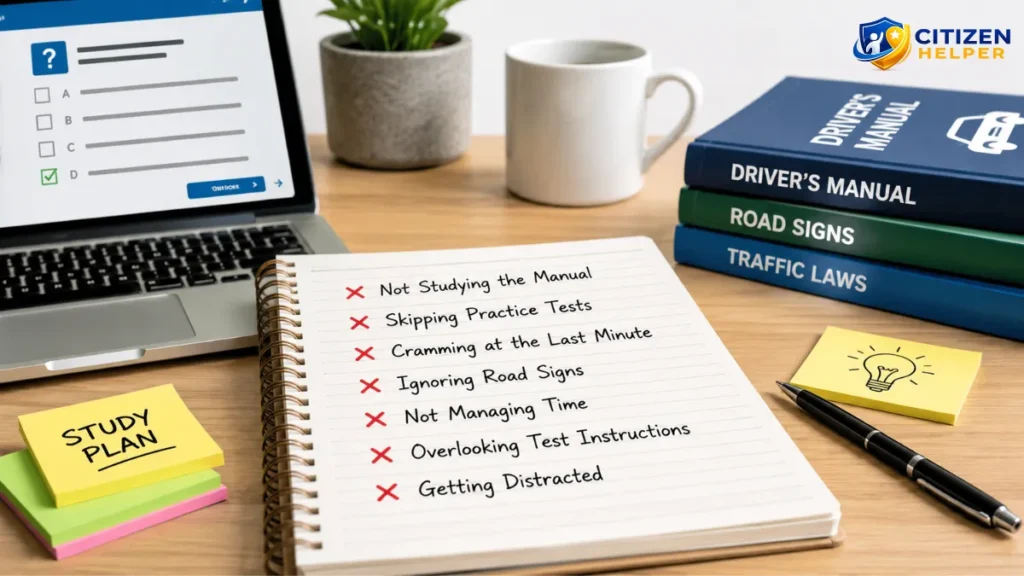
Many applicants make preparation harder by using ineffective study methods.
Avoid these common mistakes:
- Studying only unofficial practice questions: Use the Texas Driver Handbook as your primary source.
- Memorizing answers without understanding the rule: Questions can be worded differently on the actual test.
- Ignoring road signs: Signs are an important part of driving knowledge.
- Using an outdated handbook: Laws and procedures can change.
- Studying everything at once: Breaking material into smaller sections can improve understanding.
- Assuming a high practice score guarantees success: Practice tests are preparation tools, not copies of the official exam.
Conclusion:
A Texas drivers license practice test can be a valuable part of your preparation for the Texas driver’s license knowledge exam. It can help you identify weak areas, become more comfortable answering driving-related questions, and reinforce what you learn from the official handbook.
However, practice tests should supplement—not replace—the official Texas Driver Handbook. Focus on understanding traffic laws, road signs, right-of-way rules, safe-driving practices, and other Texas-specific requirements.
Before applying or taking an exam, verify current requirements with the Texas Department of Public Safety, especially if you have questions about testing, documents, driver education, or eligibility.
Frequently Asked Questions (FAQ)
Is the Texas drivers license practice test the same as the real DPS test?
No. An unofficial practice test is a study tool. It should not be represented as the actual Texas DPS knowledge exam, and the real test questions may be different.
How many questions are on the Texas driver’s license knowledge test?
Texas DPS does not publish one fixed question count in the Texas Driver Handbook that applies to every applicant, license class, exam type, or testing method. Applicants should verify requirements for their specific situation through official DPS resources.
What score do you need to pass a Texas driver’s license knowledge test?
According to the official Texas Driver Handbook, applicants must score 70 percent or better to pass any knowledge exam.
What is the best way to prepare for the Texas driver’s license knowledge test?
Start with the current Texas Driver Handbook, study each major topic, and then use practice questions to identify areas that need more review.
Should I memorize practice-test answers?
No. Understanding the traffic law or safety principle behind each answer is more useful because the official exam may phrase questions differently.