Choosing between a Green Card and U.S. citizenship is one of the most important decisions many immigrants face. While both statuses allow you to live in the United States, they are not the same. A Green Card gives you permanent resident status, allowing you to live and work in the U.S. indefinitely as long as you maintain your status. U.S. citizenship, on the other hand, provides additional rights and protections, including the ability to vote in federal elections, obtain a U.S. passport, and avoid many of the risks associated with losing permanent resident status.
If you’re comparing green card vs citizenship, this guide explains the key differences, the rights and responsibilities of each status, and how becoming a U.S. citizen may affect your future. Whether you’re a new permanent resident or considering naturalization, understanding these distinctions can help you make an informed decision.
Quick Answer
A Green Card gives you lawful permanent resident (LPR) status, allowing you to live and work permanently in the United States. However, Green Card holders remain citizens of another country unless they later become naturalized U.S. citizens.
U.S. citizenship offers the highest immigration status available in the United States. Citizens generally have additional rights, such as voting in federal elections, applying for a U.S. passport, serving on federal juries when called, and being protected from losing their status in the same ways that permanent residents can.
Many Green Card holders eventually choose to apply for U.S. citizenship if they meet the eligibility requirements.
Green Card vs Citizenship at a Glance
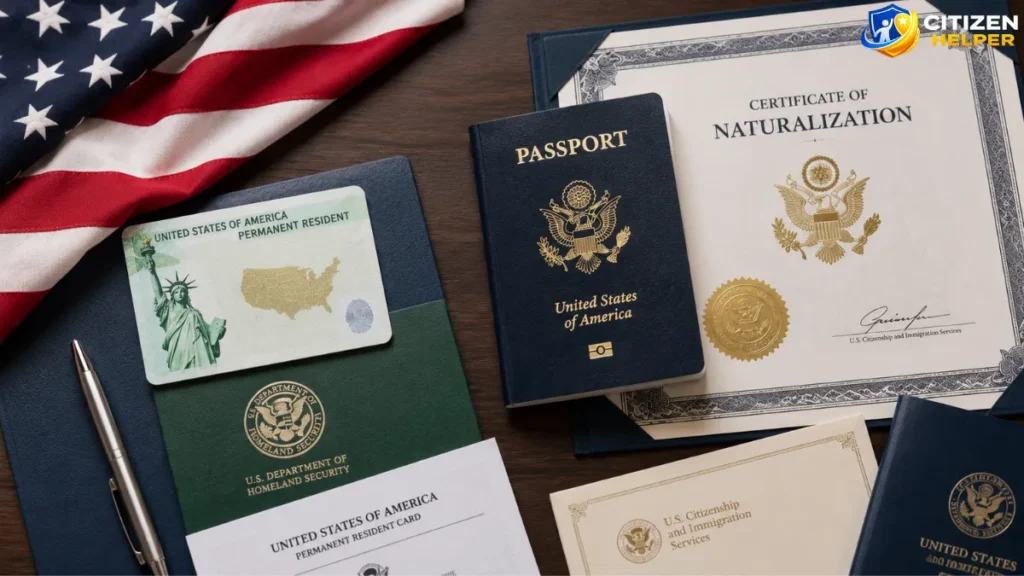
| Feature | Green Card (Permanent Resident) | U.S. Citizen |
| Can live permanently in the U.S. | ✔ Yes | ✔ Yes |
| Can work in the U.S. | ✔ Yes | ✔ Yes |
| Receives a U.S. passport | ✘ No | ✔ Yes |
| Can vote in federal elections | ✘ No | ✔ Yes |
| May sponsor certain family members | ✔ Yes | ✔ Yes (with broader eligibility for some relatives) |
| Can be deported for certain immigration or criminal violations | ✔ In some cases | Very limited circumstances under U.S. law |
| Must renew immigration document | ✔ Green Card generally must be renewed periodically | ✘ No Green Card renewal required |
| Eligible to run for most federal elected offices | ✘ No | Some offices have additional constitutional requirements |
| Eligible to apply for citizenship | ✔ Yes, if eligible | Already a citizen |
This comparison highlights why many permanent residents eventually choose to become naturalized U.S. citizens.
What Is a Green Card?
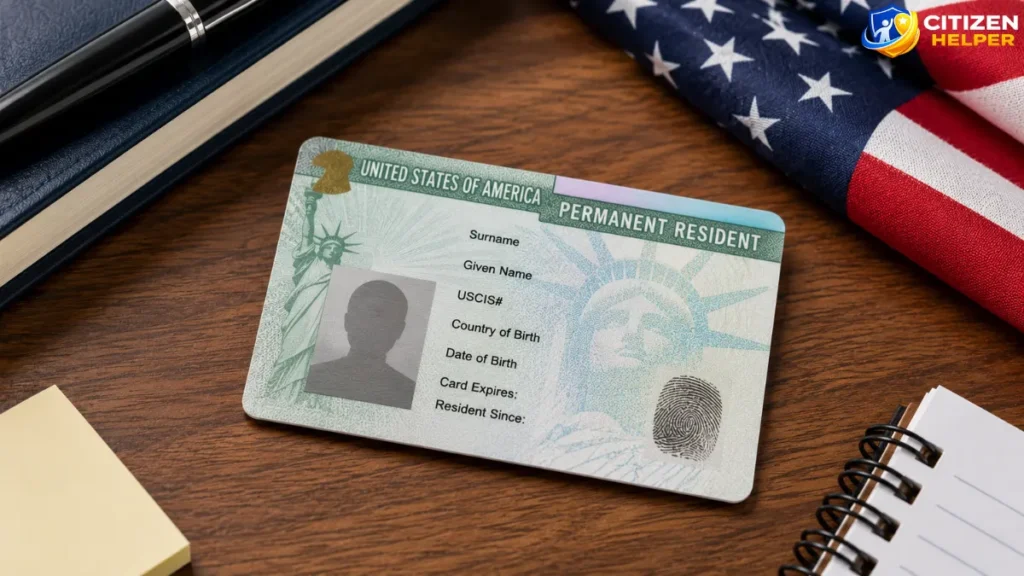
A Green Card, officially known as a Permanent Resident Card, is evidence that a person has been granted lawful permanent resident (LPR) status in the United States.
A Green Card holder has permission to:
- Live permanently in the United States.
- Work for most employers.
- Attend school.
- Own property.
- Travel outside the United States, provided they continue to maintain their permanent resident status and comply with U.S. immigration rules.
Although permanent residence has no fixed expiration date, the physical Green Card generally must be renewed periodically if it expires.
Having a Green Card does not automatically make someone a U.S. citizen.
Official Source: USCIS – Green Card
How Can Someone Get a Green Card?
There are several pathways to lawful permanent residence.
Common categories include:
- Family-sponsored immigration
- Employment-based immigration
- Refugee or asylee adjustment
- Diversity Visa Lottery
- Certain humanitarian programs
- Special immigrant categories
Each pathway has its own eligibility rules and application process.
Rights of Green Card Holders
Permanent residents receive many of the same everyday rights as U.S. citizens.
These include the ability to:
- Live anywhere in the United States.
- Work legally for most employers.
- Open bank accounts.
- Buy a home.
- Attend colleges and universities.
- Apply for a Social Security number if eligible.
- Travel internationally while following U.S. immigration requirements.
These rights make permanent residence an attractive long-term option for many immigrants.
Responsibilities of Green Card Holders
Having a Green Card also comes with important responsibilities.
Permanent residents are generally expected to:
- Obey all federal, state, and local laws.
- File U.S. income tax returns when required.
- Carry evidence of permanent resident status as required by law.
- Notify USCIS of qualifying address changes.
- Maintain their permanent resident status by avoiding actions that could be considered abandonment of residence.
Failing to meet these responsibilities may create immigration issues in certain situations.
What Is U.S. Citizenship?

U.S. citizenship is the highest legal immigration status available under U.S. law.
Citizens have permanent legal status and receive additional constitutional rights and protections that are not available to lawful permanent residents.
A person may become a U.S. citizen by:
- Birth in the United States (subject to applicable law).
- Birth abroad to qualifying U.S. citizen parents.
- Naturalization after meeting eligibility requirements.
- Automatic acquisition or derivation of citizenship in certain situations established by law.
Once someone becomes a U.S. citizen through naturalization, they generally do not need to maintain permanent resident status or renew a Green Card.
Official Source: USCIS – Naturalization Eligibility
Rights of U.S. Citizens
Citizens receive all the rights available to permanent residents, plus additional benefits.
Depending on the circumstances, these may include:
- Voting in federal elections.
- Applying for a U.S. passport.
- Serving on a federal jury when selected.
- Running for many public offices if constitutional and legal requirements are met.
- Greater flexibility when traveling internationally.
- Additional options for sponsoring certain family members for immigration.
These added rights are among the main reasons eligible permanent residents decide to pursue naturalization.
Responsibilities of U.S. Citizens
Citizens also have civic responsibilities.
These include:
- Obeying federal, state, and local laws.
- Serving on a jury if summoned and qualified.
- Paying taxes when required.
- Participating in civic life.
- Registering with the Selective Service if required by federal law.
Citizens are encouraged to take an active role in their communities and democratic processes.
Green Card vs Citizenship: Key Differences
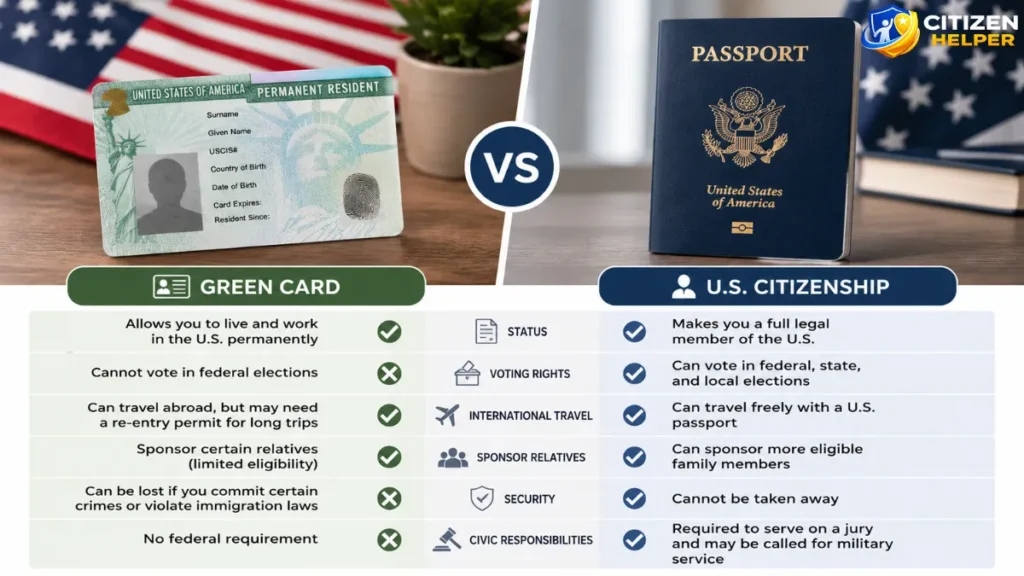
Although permanent residents and citizens share many rights, there are several important differences.
Immigration Status
A Green Card holder is a lawful permanent resident, while a citizen has full U.S. citizenship.
Permanent residents maintain immigration status under federal immigration law.
Citizens are no longer classified as immigrants after naturalization.
Voting Rights
One of the biggest differences involves voting.
Only U.S. citizens may vote in federal elections.
Some local jurisdictions may have different rules for certain local elections, but permanent residents generally cannot vote in federal elections.
Attempting to vote unlawfully can have serious immigration consequences.
Official Source: USCIS – Citizenship Rights and Responsibilities
Passport
Permanent residents continue using the passport issued by their country of citizenship.
U.S. citizens may apply for a U.S. passport, which can be used for international travel and serves as proof of U.S. citizenship.
Length of Status
A Green Card holder keeps permanent resident status as long as it is maintained under U.S. immigration law.
The physical Green Card itself usually expires and must be renewed periodically, but the underlying permanent resident status does not automatically end simply because the card expires.
Citizenship generally does not require renewing immigration status.
Risk of Losing Status
Another important distinction is immigration security.
A lawful permanent resident may lose permanent resident status under certain circumstances, such as abandoning U.S. residence or being removed following certain immigration or criminal violations.
A naturalized U.S. citizen generally has much stronger protection against losing citizenship, although citizenship can be revoked in rare situations, such as if it was obtained through fraud during the naturalization process.
Understanding this distinction is an important factor when comparing green card vs citizenship.
Why Many Green Card Holders Choose Citizenship
For many immigrants, a Green Card is the first major milestone toward building a life in the United States.
After meeting the eligibility requirements for naturalization, many permanent residents choose to become U.S. citizens because citizenship can provide:
- Greater immigration security
- The right to vote in federal elections
- A U.S. passport
- Expanded opportunities to sponsor certain family members
- Full participation in civic life
However, the decision is personal, and each individual should consider their own circumstances, family situation, and long-term goals before applying for naturalization.
Rights and Responsibilities: Green Card vs Citizenship
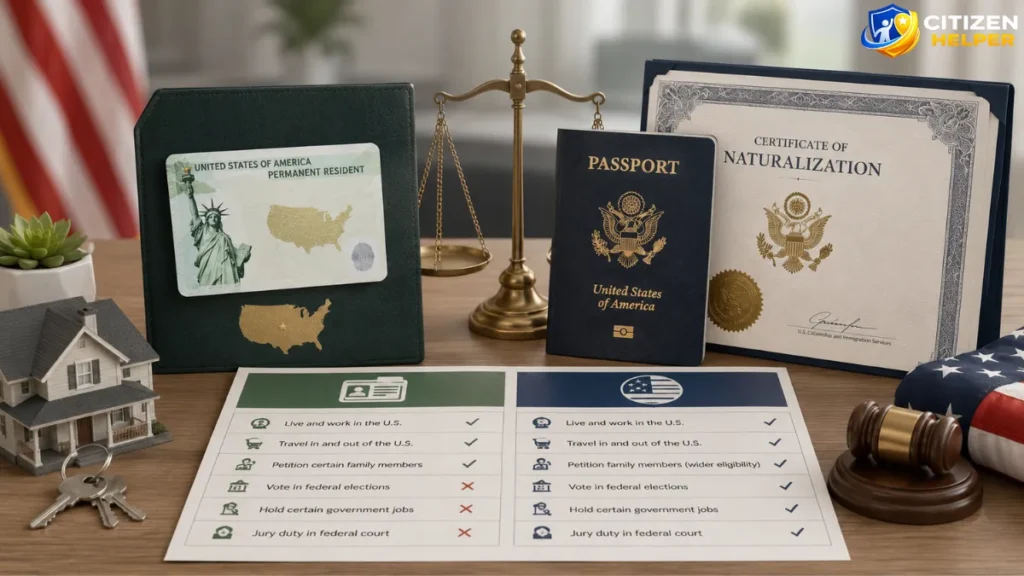
Although Green Card holders and U.S. citizens share many of the same everyday freedoms, there are important legal differences that can affect travel, voting, family immigration, and long-term security.
The table below summarizes some of the most significant distinctions.
| Right or Responsibility | Green Card Holder | U.S. Citizen |
| Live permanently in the U.S. | ✔ Yes | ✔ Yes |
| Work for most employers | ✔ Yes | ✔ Yes |
| Vote in federal elections | ✘ No | ✔ Yes |
| Obtain a U.S. passport | ✘ No | ✔ Yes |
| Serve on a federal jury (when eligible) | ✘ Generally no | ✔ Yes |
| Sponsor certain family members | ✔ Yes | ✔ Yes (broader options) |
| Subject to removal (deportation) under immigration law | ✔ Yes | Generally no |
| Renew Green Card | ✔ Required | ✘ Not applicable |
These differences often become more important the longer someone plans to live in the United States.
Voting Rights
Voting is one of the clearest distinctions between permanent residents and U.S. citizens.
Green Card Holders
Lawful permanent residents cannot vote in federal elections.
Voting in a federal election when you are not eligible can lead to serious immigration consequences, including possible removal proceedings and future immigration problems.
Some local governments have adopted limited rules allowing certain non-citizens to vote in specific local elections, but these exceptions do not apply to federal elections and are not available nationwide.
U.S. Citizens
Naturalized and U.S.-born citizens generally may:
- Vote in presidential elections.
- Vote for members of Congress.
- Vote in most state and local elections, subject to state voter registration laws.
- Participate fully in the democratic process.
International Travel
Both permanent residents and U.S. citizens can travel internationally, but the rules differ.
Traveling With a Green Card
Green Card holders typically travel using:
- Their foreign passport.
- Their valid Permanent Resident Card (Green Card).
When returning to the United States, they generally must demonstrate that they have maintained their permanent resident status.
Long trips outside the United States may raise questions about whether permanent residence has been abandoned.
Travel plans involving extended stays abroad should be carefully reviewed before departure.
Traveling as a U.S. Citizen
U.S. citizens usually travel internationally using a U.S. passport.
Benefits include:
- Easier re-entry into the United States.
- Access to U.S. embassy and consular assistance abroad.
- No concerns about maintaining permanent resident status while traveling.
Many frequent international travelers view citizenship as providing greater flexibility.
Official Source: U.S. Department of State – U.S. Passports
Can You Be Deported?
One of the most important differences in the green card vs citizenship comparison involves immigration protection.
Green Card Holders
Permanent residents generally have strong legal rights, but they can still lose their status under certain circumstances.
Examples may include:
- Certain criminal convictions.
- Immigration fraud.
- Abandonment of permanent residence.
- Other violations of U.S. immigration law.
Each case depends on the specific facts and applicable law.
U.S. Citizens
Naturalized citizens generally cannot be deported simply because they committed an immigration violation after becoming citizens.
However, citizenship obtained through fraud or willful misrepresentation may be subject to revocation in rare cases through legal proceedings.
For most naturalized citizens, citizenship provides substantially greater long-term immigration security.
Sponsoring Family Members
Family immigration is another area where citizenship provides additional advantages.
Green Card Holders Can Sponsor
Permanent residents may generally petition for:
- A spouse.
- Unmarried children.
These family members usually fall within preference categories that may involve waiting periods depending on visa availability.
U.S. Citizens Can Sponsor
U.S. citizens generally have broader sponsorship options.
Depending on eligibility, they may petition for:
- A spouse.
- Children.
- Parents (if the citizen is at least 21 years old).
- Brothers and sisters (if the citizen is at least 21 years old).
Some immediate relatives of U.S. citizens are not subject to annual immigrant visa limits, which may reduce waiting times compared with family preference categories.
Official Source: USCIS – Family of U.S. Citizens
Government Jobs
Some government positions are available to permanent residents.
However, many federal jobs—especially those involving national security, law enforcement, or classified information—require U.S. citizenship.
Examples may include positions with:
- Federal law enforcement agencies.
- Intelligence agencies.
- Certain military occupations.
- National security organizations.
Citizenship can therefore expand employment opportunities in the public sector.
Public Benefits
Eligibility for public benefits depends on the specific program and its legal requirements.
Green Card Holders
Some lawful permanent residents may qualify for certain federal, state, or local benefit programs if they meet the applicable eligibility rules.
Eligibility often depends on factors such as:
- Immigration status.
- Length of lawful residence.
- Household income.
- Program-specific requirements.
U.S. Citizens
Citizens may also qualify for many public benefit programs if they satisfy the program’s eligibility criteria.
Becoming a citizen does not automatically qualify someone for benefits, nor does it guarantee higher benefit amounts.
Each benefit program has its own rules.
Taxes
Many people mistakenly believe that becoming a U.S. citizen changes their basic tax obligations.
In reality, both permanent residents and citizens are generally required to comply with U.S. federal tax laws if they meet the filing requirements.
Both groups are generally expected to:
- File federal income tax returns when required.
- Report worldwide income if required under U.S. tax law.
- Pay applicable federal, state, and local taxes.
Tax obligations depend on individual circumstances rather than citizenship alone.
Official Source: Internal Revenue Service (IRS) – Taxation of Resident Aliens
Military Service
Lawful permanent residents may be eligible to serve in certain branches or roles within the U.S. Armed Forces if they meet military enlistment requirements.
U.S. citizens generally qualify for a broader range of military career opportunities, including many positions requiring security clearances or officer commissions.
Military eligibility requirements are established by the Department of Defense and individual service branches.
Jury Duty
Serving on a federal jury is considered an important civic responsibility.
Green Card Holders
Permanent residents are generally not eligible to serve on federal juries.
U.S. Citizens
U.S. citizens may be called for jury service if they meet the qualifications established by federal or state law.
Jury service helps ensure the fair administration of justice.
How to Become a U.S. Citizen From a Green Card
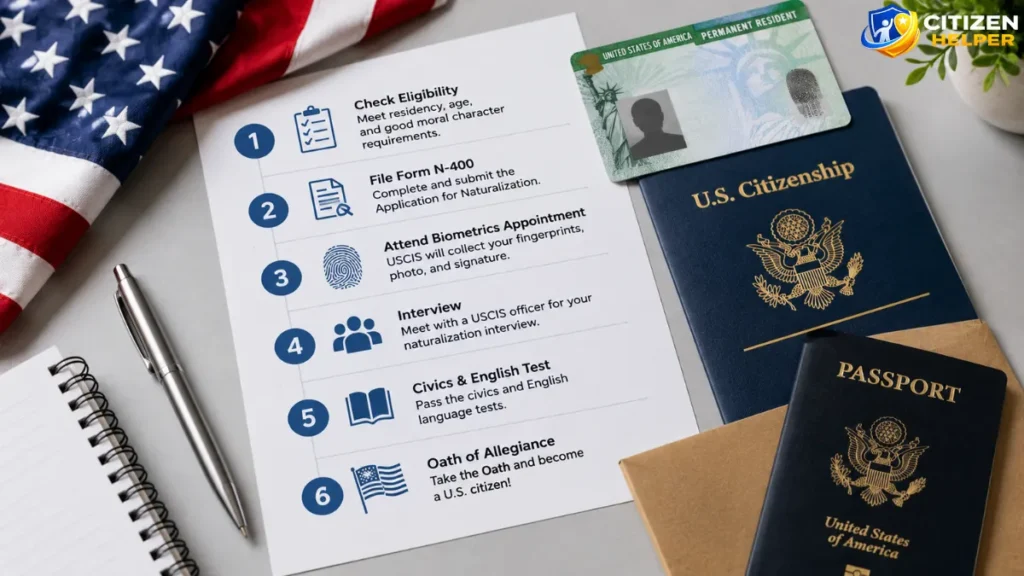
For many immigrants, obtaining a Green Card is the first step toward naturalization.
Although requirements vary, the naturalization process generally includes the following steps.
Step 1: Meet the Residency Requirement
Most applicants must first satisfy the required period of lawful permanent residence before applying.
The required length of time depends on the eligibility category.
Step 2: Meet Physical Presence Requirements
Applicants generally must demonstrate that they have been physically present in the United States for the amount of time required by law.
Extended trips outside the United States may affect eligibility.
Step 3: Demonstrate Good Moral Character
USCIS evaluates whether an applicant has demonstrated good moral character during the applicable statutory period.
Factors may include:
- Criminal history.
- Compliance with tax obligations.
- Truthfulness during the immigration process.
- Other conduct relevant under immigration law.
Step 4: Pass Required Tests
Unless an exemption applies, applicants generally must complete:
- An English language assessment.
- A U.S. civics test covering American history and government.
USCIS provides free study materials to help applicants prepare.
Step 5: Attend the Naturalization Interview
A USCIS officer reviews the application, verifies eligibility, and asks questions about the applicant’s background and supporting documents.
Step 6: Take the Oath of Allegiance
If approved, the final step is attending a naturalization ceremony and taking the Oath of Allegiance.
After completing the oath, the applicant officially becomes a U.S. citizen.
Is Becoming a Citizen Required?
No.
Many immigrants remain lawful permanent residents for many years or even for life.
However, if you meet the eligibility requirements and want the additional rights and protections that citizenship provides, applying for naturalization may be worth considering.
The right choice depends on your personal goals, travel plans, family circumstances, and long-term future in the United States.
Pros and Cons of Having a Green Card
A Green Card provides many of the benefits of living permanently in the United States without requiring naturalization. However, it also comes with certain limitations.
Advantages of a Green Card
Some of the benefits include:
- Live and work permanently in the United States.
- Work for most employers without needing a separate work visa.
- Travel internationally while maintaining permanent resident status.
- Sponsor certain qualifying family members for immigration.
- Become eligible to apply for U.S. citizenship after meeting naturalization requirements.
- Access many of the same employment, education, and financial opportunities available to U.S. citizens.
For many immigrants, a Green Card is an excellent long-term option, especially if they are not yet ready to pursue citizenship.
Disadvantages of a Green Card
Permanent residents also face certain restrictions.
These include:
- Cannot vote in federal elections.
- Cannot obtain a U.S. passport.
- May lose permanent resident status under certain immigration laws.
- Must renew the physical Green Card periodically.
- Some government jobs are unavailable.
- International travel requires careful planning to avoid issues related to maintaining permanent residence.
These limitations often encourage eligible permanent residents to consider naturalization.
Pros and Cons of U.S. Citizenship
Becoming a U.S. citizen provides additional legal rights and protections beyond permanent residency.
Advantages of Citizenship
Benefits generally include:
- The right to vote in federal elections.
- Eligibility to apply for a U.S. passport.
- Greater protection against losing immigration status.
- Broader options for sponsoring family members.
- Eligibility for many federal government positions requiring citizenship.
- Ability to serve on a federal jury when qualified.
- No need to renew a Green Card.
For many immigrants who intend to make the United States their permanent home, these benefits make naturalization an attractive choice.
Possible Considerations Before Becoming a Citizen
Naturalization is an important legal decision.
Some people may wish to consider:
- Whether their home country permits dual citizenship.
- Family obligations in another country.
- Personal or financial considerations.
- The time and effort involved in completing the naturalization process.
Understanding both U.S. law and the laws of your current country of citizenship can help you make an informed decision.
Which Is Better: Green Card or Citizenship?
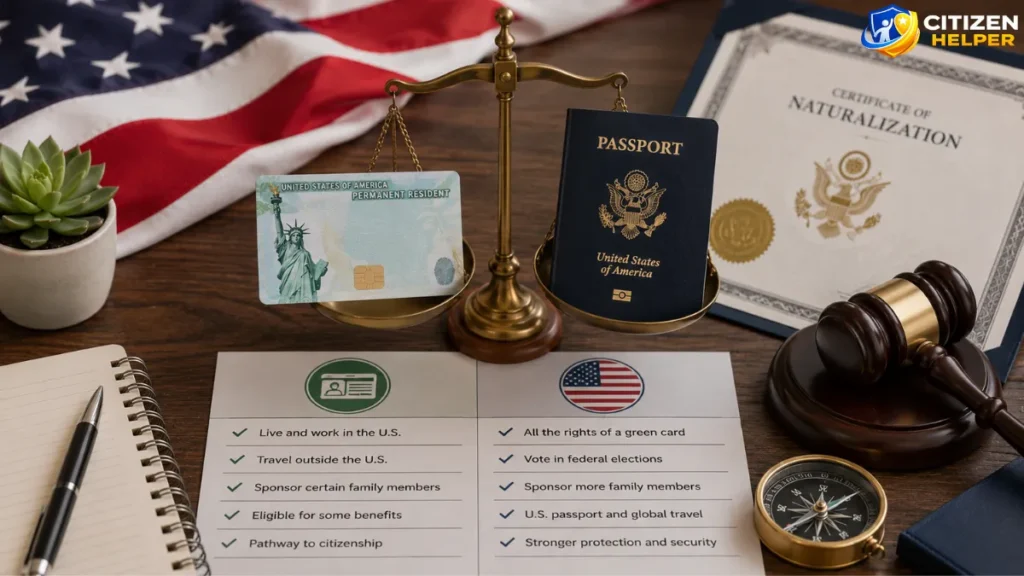
There is no single answer that fits everyone.
A Green Card may be sufficient if you:
- Plan to live and work permanently in the United States.
- Do not need voting rights.
- Prefer to remain a citizen only of your current country.
- Are not yet eligible for naturalization.
On the other hand, U.S. citizenship may be the better choice if you:
- Want to vote in federal elections.
- Want a U.S. passport.
- Plan to live permanently in the United States.
- Want greater immigration security.
- Hope to sponsor additional family members for immigration.
- Want access to employment opportunities that require U.S. citizenship.
For many eligible immigrants, citizenship represents the final step in their immigration journey.
Common Misconceptions
Many people misunderstand the differences between permanent residency and citizenship.
Myth: A Green Card holder is already a U.S. citizen.
Reality: A Green Card holder is a lawful permanent resident, not a U.S. citizen.
Myth: A Green Card lasts forever.
Reality: Permanent resident status may continue indefinitely if maintained, but the physical Green Card generally must be renewed before it expires.
Myth: Green Card holders can vote in presidential elections.
Reality: Only U.S. citizens may vote in federal elections.
Myth: Becoming a citizen automatically increases government benefits.
Reality: Eligibility for government benefits depends on each program’s rules. Citizenship alone does not automatically qualify someone for benefits or increase benefit amounts.
Myth: You lose your Green Card immediately after becoming a citizen.
Reality: After naturalization, your permanent resident status ends because you become a U.S. citizen. Your Green Card is no longer valid, and you will generally surrender it as part of the naturalization process.
Conclusion:
Understanding the differences between green card vs citizenship is essential if you’re planning your future in the United States. While a Green Card offers the ability to live and work in the country permanently, it does not provide all the rights and protections that come with U.S. citizenship. Naturalized citizens enjoy additional privileges such as voting in federal elections, obtaining a U.S. passport, and sponsoring a wider range of family members for immigration.
For many immigrants, a Green Card is an important milestone, while citizenship is the final step toward fully participating in American civic life. If you’re eligible to naturalize, carefully review the requirements, consider your long-term goals, and use official government resources to guide your decision.
Frequently Asked Questions (FAQ)
Is a Green Card the same as citizenship?
No.
A Green Card grants lawful permanent resident status, while citizenship provides the full legal rights and responsibilities of being a U.S. citizen.
Can a Green Card holder become a U.S. citizen?
Yes.
Like U.S. citizens, lawful permanent residents are generally required to file U.S. federal income tax returns if they meet IRS filing requirements.
Can Green Card holders leave the United States?
Yes.
Permanent residents may travel internationally, but extended trips abroad can affect their permanent resident status if they appear to have abandoned their U.S. residence.
Can Green Card holders receive Social Security benefits?
Possibly.
Eligibility for Social Security depends on factors such as work history, earned credits, and program rules—not solely on immigration status.
Do Green Card holders need a visa to return to the United States?
Generally, lawful permanent residents return using:
A valid Green Card, and
A valid passport from their country of citizenship, if required.
Travel requirements vary depending on individual circumstances.
Can Green Card holders sponsor parents?
No.
Only U.S. citizens who are at least 21 years old may petition for their parents to become lawful permanent residents.
Does becoming a U.S. citizen cancel my original citizenship?
Not necessarily.
Whether you keep your original citizenship depends on the laws of your home country. The United States generally recognizes dual citizenship, but other countries may have different rules.
How long do I have to wait before applying for citizenship?
The required period depends on your eligibility category.
Many Green Card holders become eligible after meeting the required period of lawful permanent residence and satisfying all other naturalization requirements.
Always review the current USCIS eligibility rules before applying.
Is citizenship worth it?
For many immigrants, yes.
Citizenship provides additional legal rights, stronger immigration protection, broader family sponsorship options, and full participation in American civic life.
Whether it is the right choice depends on your personal circumstances and long-term goals.
Key Takeaways
A Green Card gives you lawful permanent resident status, while U.S. citizenship provides the highest legal status available under U.S. law.
Both Green Card holders and citizens can live and work permanently in the United States, but only citizens can vote in federal elections and obtain a U.S. passport.
Green Card holders must maintain their permanent resident status and generally renew their physical Green Card before it expires.
U.S. citizens generally have greater protection from losing their status and broader options for sponsoring family members.
Many permanent residents eventually apply for naturalization after meeting USCIS eligibility requirements.
The best choice depends on your personal goals, family circumstances, and long-term plans in the United States.