Preparing for the citizenship test questions 2026 is an important step if you’re applying to become a U.S. citizen through naturalization. During your USCIS interview, most applicants must complete both an English test and a civics test covering U.S. history and government. Understanding how the test works and studying the official questions in advance can help you feel more confident on interview day.
In this guide, you’ll learn who must take the citizenship test, how the interview is structured, what topics are covered, and review sample civics questions based on the current official USCIS study materials. We’ll also explain where to find the latest resources and share practical tips to help you prepare successfully.
Quick Answer
The citizenship test questions 2026 are based on the current USCIS naturalization civics test. Most applicants are asked up to 10 questions selected from the official list of 100 civics questions and generally must answer at least 6 correctly to pass the civics portion of the interview. Applicants must also meet the English language requirements unless they qualify for a legal exemption.
Because USCIS policies and study materials can change, always prepare using the latest official USCIS resources.
What Is the U.S. Citizenship Test?
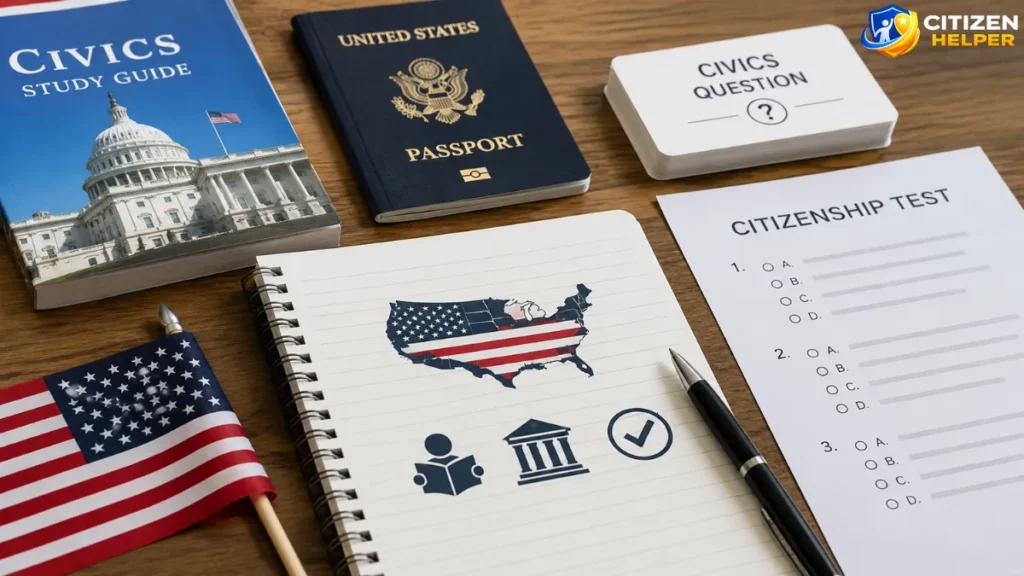
The U.S. citizenship test is part of the naturalization process for lawful permanent residents who want to become U.S. citizens.
During the naturalization interview, a USCIS officer reviews your Form N-400, verifies your eligibility, and administers the required tests.
For most applicants, the interview includes two main parts:
- English Test
- Speaking
- Reading
- Writing
- Civics Test
- U.S. history
- U.S. government
- Rights and responsibilities of U.S. citizens
Passing both portions is generally required before USCIS can approve your naturalization application unless you qualify for an exemption or accommodation.
Official Source: USCIS – Naturalization Test Overview
Who Must Take the Citizenship Test?
Most people applying for U.S. citizenship through Form N-400, Application for Naturalization, must complete the naturalization interview and pass the required tests.
Generally, you’ll need to take the test if you:
- Are applying for naturalization.
- Meet the eligibility requirements for U.S. citizenship.
- Do not qualify for an English language or civics exemption.
Certain applicants may qualify for modified testing requirements or exemptions based on age, the length of time they have been lawful permanent residents, or a qualifying disability.
Official Source: USCIS – Exceptions and Accommodations
What Changed for Citizenship Test Questions in 2026?
As of 2026, USCIS continues to use the current official civics test based on the list of 100 civics questions for most naturalization applicants.
Applicants should always download the latest study materials directly from USCIS before their interview because official resources and guidance may change over time.
Avoid relying on unofficial websites or outdated study guides that may contain incorrect or obsolete information.
English Test vs. Civics Test
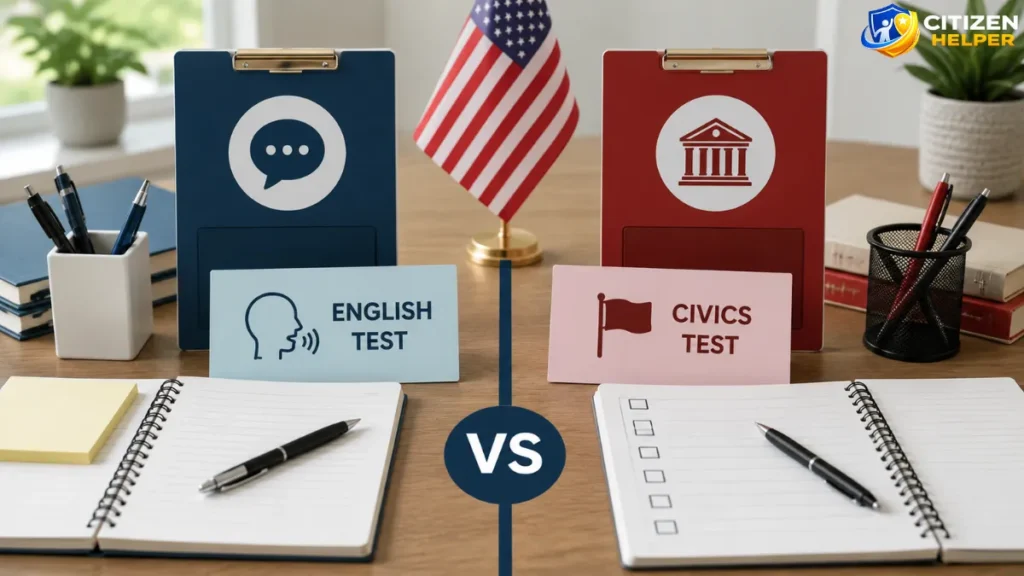
Many applicants think the citizenship test consists only of civics questions, but there are actually two separate tests.
| English Test | Civics Test |
| Speaking | U.S. history |
| Reading | U.S. government |
| Writing | Principles of American democracy |
The speaking portion is evaluated throughout your interview as the USCIS officer reviews your application and asks questions.
The reading and writing portions require you to read and write simple English sentences related to civics topics.
How the Civics Test Works
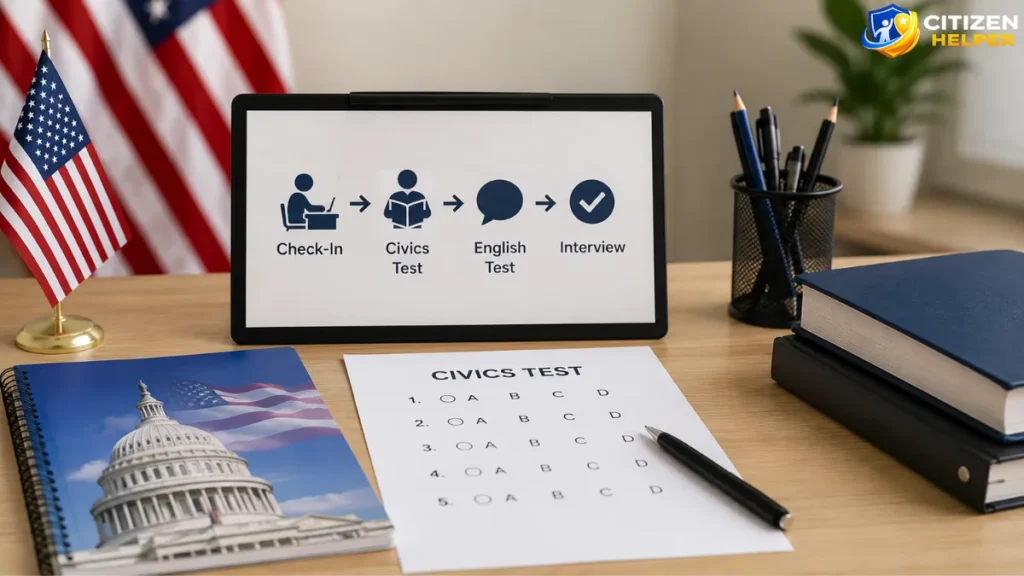
The civics test is conducted verbally during your naturalization interview.
For most applicants:
- The USCIS officer asks up to 10 questions from the official list of 100 civics questions.
- You generally must answer 6 questions correctly to pass.
- Once you answer enough questions correctly to pass, the officer usually stops asking additional civics questions.
- All questions are asked verbally, and your answers are given orally.
The questions cover several subjects, including:
- Principles of American democracy
- The U.S. Constitution
- The federal government
- Rights and responsibilities of citizens
- American history
- Geography
- National symbols
- National holidays
Each applicant receives a different combination of questions during the interview.
Official Source: USCIS – Civics Questions and Answers for the Naturalization Test
Sample Citizenship Test Questions 2026 (Questions 1–20)
The following examples come from the current official USCIS civics study materials.
1. What is the supreme law of the land?
Answer: The Constitution.
2. What does the Constitution do?
Acceptable answers include:
- Sets up the government.
- Defines the government.
- Protects the basic rights of Americans.
3. The idea of self-government is in the first three words of the Constitution. What are these words?
Answer: We the People.
4. What is an amendment?
Acceptable answers include:
- A change to the Constitution.
- An addition to the Constitution.
5. What do we call the first ten amendments to the Constitution?
Answer: The Bill of Rights.
6. What is one right or freedom from the First Amendment?
Acceptable answers include:
- Freedom of speech.
- Freedom of religion.
- Freedom of assembly.
- Freedom of the press.
- Freedom to petition the government.
7. How many amendments does the Constitution have?
Answer: 27.
8. What did the Declaration of Independence do?
Acceptable answers include:
- Announced independence from Great Britain.
- Declared independence.
- Said the United States is free.
9. What are two rights in the Declaration of Independence?
Acceptable answers include:
- Life.
- Liberty.
- The pursuit of happiness.
10. What is freedom of religion?
Answer: You can practice any religion, or not practice a religion.
11. What is the economic system in the United States?
Acceptable answers include:
- Capitalist economy.
- Market economy.
12. What is the rule of law?
Acceptable answers include:
- Everyone must follow the law.
- Leaders must obey the law.
- Government must obey the law.
- No one is above the law.
13. Name one branch or part of the government.
Acceptable answers include:
- Congress.
- Legislative branch.
- President.
- Executive branch.
- Courts.
- Judicial branch.
14. What stops one branch of government from becoming too powerful?
Acceptable answers include:
- Checks and balances.
- Separation of powers.
15. Who is in charge of the executive branch?
Answer: The President.
16. Who makes federal laws?
Acceptable answers include:
- Congress.
- The Senate and House of Representatives.
- The U.S. Congress.
17. What are the two parts of the U.S. Congress?
Answer:
- The Senate.
- The House of Representatives.
18. How many U.S. Senators are there?
Answer: 100.
19. We elect a U.S. Senator for how many years?
Answer: Six years.
20. Who does a U.S. Senator represent?
Answer: All the people of the state.
Why You Should Study the Official USCIS Questions
Many websites publish practice tests, but the safest approach is to study directly from the official USCIS materials.
The official study resources:
- Reflect the current civics test.
- Include all accepted answers.
- Are updated when USCIS changes its materials.
- Help you avoid learning outdated or incorrect information.
Using official resources alongside regular practice can significantly improve your confidence before your naturalization interview.
Additional Official Civics Question Examples (Questions 21–100)
Below are additional examples from the official USCIS civics test. While USCIS maintains a list of 100 possible questions, applicants are generally asked up to 10 questions during the interview.
To make studying easier, the remaining questions are grouped by topic.
Congress and the Federal Government
Below are examples of official civics questions related to Congress and the federal government.
21. Why do some states have more Representatives than others?
Answer: Because of the state’s population.
22. We elect a U.S. Representative for how many years?
Answer: Two years.
23. Name your U.S. Representative.
Answer: This answer depends on where you live.
24. Who does a U.S. Senator represent?
Answer: All the people of the state.
25. Who signs bills to become law?
Answer: The President.
26. Who vetoes bills?
Answer: The President.
27. What does the President’s Cabinet do?
Answer: Advises the President.
28. What are two Cabinet-level positions?
Possible answers include:
- Secretary of State
- Secretary of Defense
- Secretary of the Treasury
- Attorney General
- Secretary of Homeland Security
- Secretary of Education
29. What does the judicial branch do?
Possible answers include:
- Reviews laws.
- Explains laws.
- Resolves disputes.
- Decides whether laws are constitutional.
30. What is the highest court in the United States?
Answer: The Supreme Court.
American History
The citizenship test also includes questions about important events, historical documents, and influential people in American history.
Examples include:
What ocean is on the East Coast of the United States?
Answer: Atlantic Ocean.
What ocean is on the West Coast of the United States?
Answer: Pacific Ocean.
Name one U.S. territory.
Possible answers include:
- Puerto Rico
- Guam
- U.S. Virgin Islands
- American Samoa
- Northern Mariana Islands
Name one state that borders Canada.
Possible answers include:
- Alaska
- Washington
- Idaho
- Montana
- North Dakota
- Minnesota
- Michigan
- New York
- Vermont
- New Hampshire
- Maine
Name one state that borders Mexico.
Possible answers include:
- California
- Arizona
- New Mexico
- Texas
What is the capital of the United States?
Answer: Washington, D.C.
Where is the Statue of Liberty?
Possible answers include:
- New York Harbor
- Liberty Island
- New York
American Symbols and Holidays
Applicants should also understand basic questions about national symbols and holidays.
Examples include:
- Why does the flag have 13 stripes?
- Why does the flag have 50 stars?
- What is the national anthem?
- When do we celebrate Independence Day?
- Name one national U.S. holiday.
Studying the meaning behind these questions can make them easier to remember than simply memorizing answers.
Current Government Officials
Several official civics questions require you to identify current officeholders.
Examples include:
- Who is the current President of the United States?
- Who is the current Vice President?
- Who is your state’s Governor?
- Name one of your state’s U.S. Senators.
These answers change after elections or appointments, so review the latest information shortly before your interview.
How to Study for the Citizenship Test
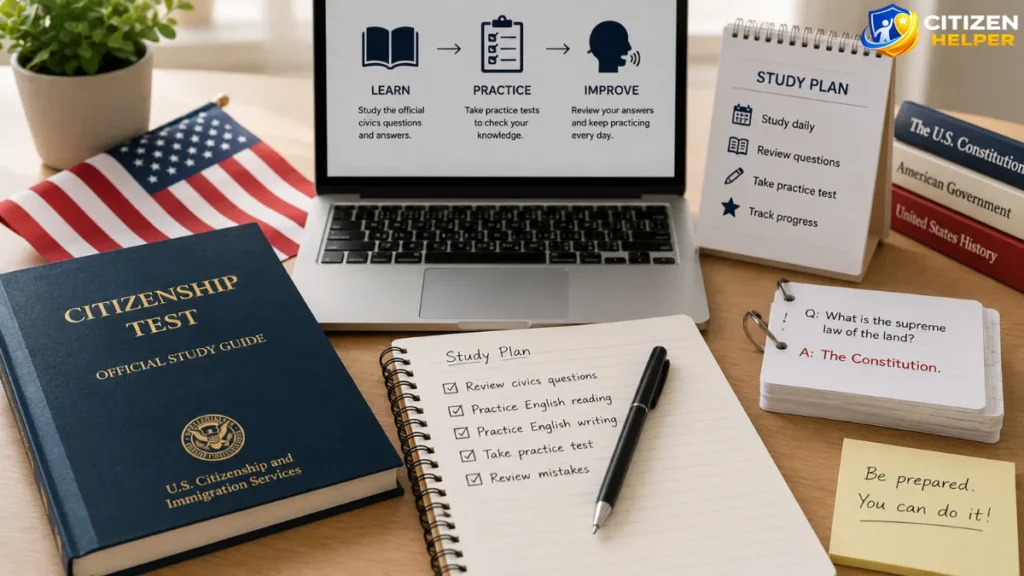
Preparing consistently is usually more effective than trying to memorize everything at once.
A simple study routine might include:
- Learn 10 civics questions each day.
- Read each question aloud.
- Practice answering without looking at the answer.
- Review questions you answered incorrectly.
- Take full-length practice quizzes.
- Study with a family member or friend.
- Listen to USCIS audio study materials during your commute or free time.
Even 20 to 30 minutes of daily study can help build confidence before your interview.
Best Free USCIS Study Resources
USCIS provides several free resources to help applicants prepare.
These include:
- Official list of 100 civics questions.
- Flashcards.
- Reading vocabulary.
- Writing vocabulary.
- Audio study materials.
- Naturalization interview videos.
- Practice resources for the English test.
Using official study materials helps ensure you’re learning accurate information.
Common Mistakes Applicants Make
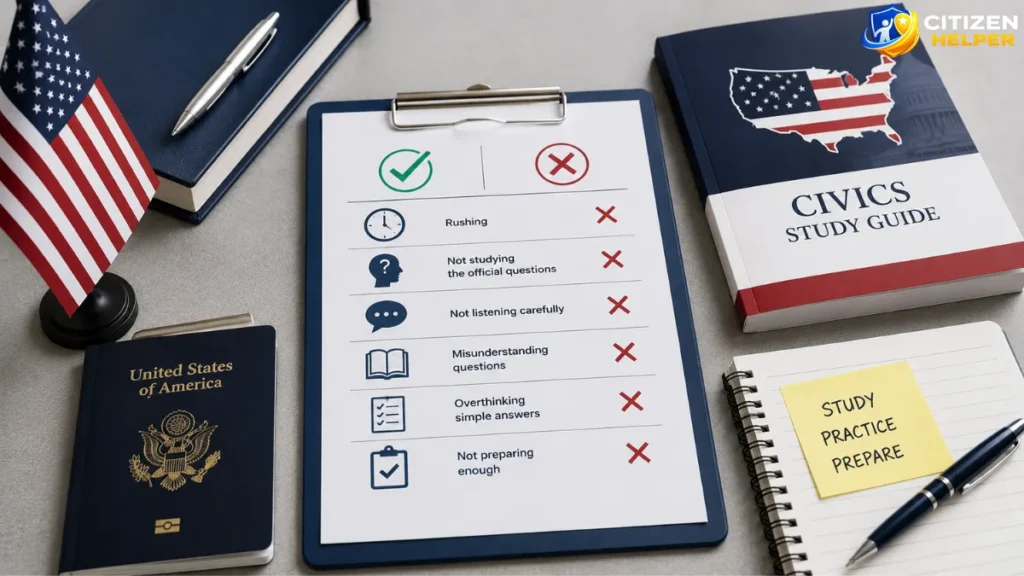
Many applicants know the material but still make avoidable mistakes during preparation.
Studying Only Popular Questions
Every question on the official list is fair game.
Instead of focusing only on commonly asked questions, review the entire set of 100 questions.
Using Outdated Study Guides
Older books, YouTube videos, and websites may contain outdated information.
Always compare your materials with the latest USCIS study guide before your interview.
Forgetting Current Government Officials
Questions involving the President, Vice President, Governor, or U.S. Senators may change after elections.
Verify current officeholders shortly before your interview.
Ignoring the English Test
Some applicants spend all their time studying civics questions but overlook the English portion.
Unless you qualify for an exemption, you’ll generally need to demonstrate:
- Speaking
- Reading
- Writing
Practicing all three skills can improve your overall performance.
Waiting Until the Last Minute
Trying to memorize all 100 questions the night before the interview usually creates unnecessary stress.
A steady study schedule is generally much more effective.
What Happens If You Fail the Citizenship Test?
Failing the civics or English portion during your first interview does not automatically end your naturalization application.
If you do not pass one or both sections, USCIS generally schedules one additional opportunity to retake only the portion you did not pass.
The second interview is typically scheduled within the timeframe established by USCIS procedures.
If you do not pass after the second opportunity, USCIS may deny your naturalization application. Depending on your situation, you may submit a new application in the future.
English Test Exemptions and Accommodations
Some applicants qualify for modified testing requirements.
For example, certain applicants may receive exemptions based on:
- Age and the length of lawful permanent residence.
- A qualifying physical, developmental, or mental disability supported by appropriate documentation.
USCIS evaluates each request individually.
Do not assume you qualify for an exemption without reviewing the official eligibility requirements.
Practice Tips Before Your Interview
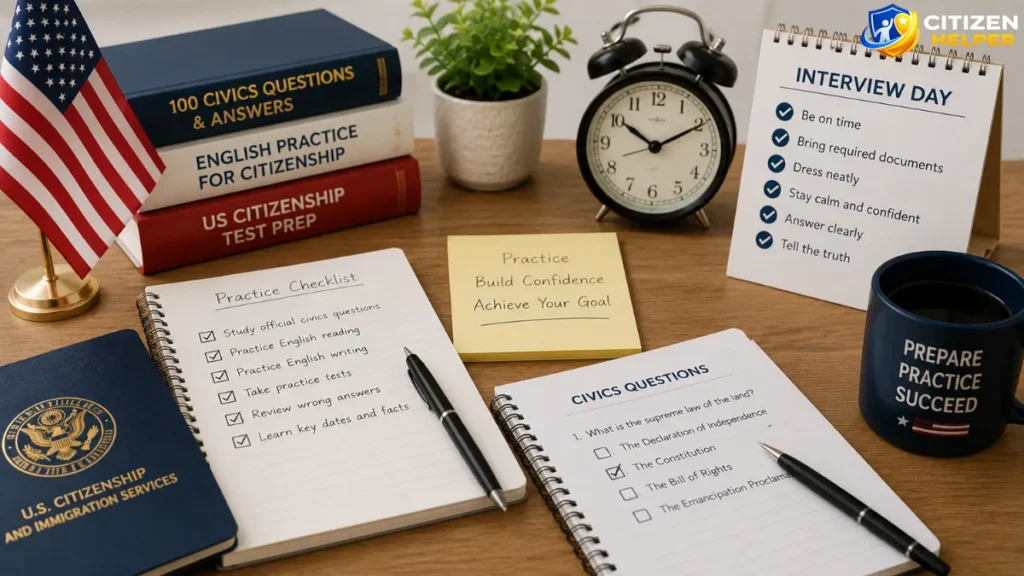
As your interview approaches:
- Review all 100 official civics questions.
- Practice speaking your answers aloud.
- Read simple English sentences every day.
- Practice writing short civics-related sentences.
- Review your completed Form N-400 carefully.
- Bring every document listed on your interview notice.
- Arrive early for your appointment.
- Stay calm and listen carefully to each question before answering.
Consistent preparation often makes applicants feel much more comfortable during the interview.
Citizenship Interview Tips for 2026
The naturalization interview is more than just a civics test. A USCIS officer will also review your Form N-400, verify your identity, and ask questions about your background and eligibility.
Preparing for both the interview and the test can help you feel more confident.
Before Your Interview
A few weeks before your appointment:
- Review all 100 official civics questions.
- Practice reading and writing simple English sentences.
- Go over every answer on your Form N-400.
- Gather all documents listed in your interview notice.
- Confirm your interview location and travel time.
- Get enough rest the night before.
Being organized can reduce stress and help the interview go more smoothly.
During the Interview
When meeting with the USCIS officer:
- Answer honestly and clearly.
- Listen carefully before responding.
- Speak naturally—you do not need to memorize long speeches.
- If you don’t understand a question, politely ask the officer to repeat or clarify it.
- Stay calm if you make a mistake and focus on the next question.
Remember, the officer is evaluating your eligibility based on U.S. immigration law, not trying to trick you.
Documents to Bring
Although every case is different, applicants are commonly instructed to bring:
- Interview appointment notice.
- Permanent Resident Card (Green Card).
- Current and expired passports, if requested.
- State-issued identification, if applicable.
- Any documents specifically requested in your interview notice.
- Supporting evidence for updates to your application, if required.
Always review your USCIS appointment notice carefully because document requirements may vary.
Conclusion:
Preparing for the citizenship test questions 2026 is one of the most important steps on your journey to becoming a U.S. citizen. While the naturalization interview may seem intimidating at first, understanding the test format and studying the official USCIS materials can greatly improve your confidence and readiness.
Rather than trying to memorize answers at the last minute, focus on learning a little each day, reviewing your Form N-400 carefully, and practicing both the English and civics portions of the test. By using official government resources and maintaining a consistent study routine, you’ll be well prepared for your interview and one step closer to achieving U.S. citizenship.
Frequently Asked Questions (FAQ)
How many citizenship test questions are there in 2026?
The official USCIS civics study guide contains 100 possible civics questions. During the interview, most applicants are asked up to 10 questions and generally must answer at least 6 correctly to pass the civics portion.
Are the citizenship test questions the same in every state?
Yes.
The official USCIS civics questions are used nationwide. However, questions about your U.S. Representative, Governor, and U.S. Senators depend on where you live.
Is the citizenship test difficult?
The answer depends on your preparation.
Many applicants pass on their first attempt by studying the official USCIS materials consistently and practicing both the civics and English portions of the test.
Can I study online for free?
Yes.
USCIS provides free study materials, including:
Official civics questions and answers.
Flashcards.
Reading and writing vocabulary.
Audio study materials.
Practice videos.
Naturalization interview resources.
Using these official resources helps ensure you’re preparing with accurate information.
Can I retake the citizenship test if I fail?
Generally, yes.
If you do not pass one or both parts of the naturalization test during your first interview, USCIS typically provides one additional opportunity to retake the portion you did not pass.
Do I have to memorize every answer exactly?
No.
Many official civics questions have more than one acceptable answer. Your response should match one of the approved USCIS answers.
Will USCIS ask all 100 questions?
No.
Most applicants are asked up to 10 questions. Once you answer 6 correctly, the civics portion of the interview generally ends because you have passed.
What if my English is not very good?
Some applicants qualify for English language exemptions based on age and the number of years they have been lawful permanent residents. Others may qualify for accommodations due to a qualifying disability.
If you do not qualify for an exemption, practicing English every day can help improve your confidence before the interview.
How long should I study before the interview?
There is no required study period.
Many applicants begin preparing several weeks or even months before their interview, depending on their English proficiency and familiarity with U.S. history and government.
Consistent daily study is generally more effective than last-minute cramming.
Where can I find the official citizenship test questions?
The safest source is the official USCIS website, which publishes the complete list of current civics questions, accepted answers, flashcards, audio files, and additional study materials.
30-Day Study Plan
If your interview is about one month away, this study plan can help you prepare without feeling overwhelmed.
Time Before InterviewStudy Goal4 weeksLearn Questions 1–25 and review your Form N-400.3 weeksLearn Questions 26–50 and practice reading English sentences.2 weeksLearn Questions 51–75 and complete practice quizzes.1 weekLearn Questions 76–100 and review missed questions.Final 2–3 daysReview all 100 questions, current government officials, and organize your interview documents.
Key Takeaways
The citizenship test questions 2026 are based on the current USCIS civics test used during most naturalization interviews.
Most applicants are asked up to 10 questions from the official list of 100 civics questions and generally must answer at least 6 correctly to pass.
The naturalization interview also includes an English test unless you qualify for a legal exemption or accommodation.
Studying directly from official USCIS materials is the best way to prepare and avoid outdated or inaccurate information.
Reviewing your Form N-400, practicing English regularly, and taking practice quizzes can improve your confidence before interview day.
Always verify the latest study materials and current government officials on the official USCIS website before your interview.
Note: USCIS may update study materials, accepted answers, or government official information over time. Always review the latest official USCIS resources before your interview.