Spanish citizenship by descent is one of the most common pathways to becoming a Spanish citizen if you have Spanish parents, grandparents, or, in some cases, other Spanish ancestors. Depending on your family’s history and the applicable nationality laws, you may be able to claim Spanish citizenship without first living in Spain for several years. However, eligibility depends on factors such as when your ancestor was born, how they acquired or lost Spanish nationality, and whether special legislation—such as Spain’s Democratic Memory Law—applies to your case.
In this guide, you’ll learn who may qualify for Spanish citizenship by descent, how Spanish nationality laws work, the documents you’ll likely need, and what to expect during the application process. We’ll also explain common misconceptions and help you determine whether you may have a valid claim.
Quick Answer
Spanish citizenship by descent allows certain individuals with Spanish parents, grandparents, or other qualifying ancestors to obtain Spanish nationality based on their family relationship.
You may qualify if you:
- Were born to at least one Spanish citizen.
- Are eligible under Spain’s Democratic Memory Law (Ley de Memoria Democrática).
- Meet specific legal conditions established by Spain’s nationality laws.
Eligibility depends on your individual family history and current Spanish legislation.
What Is Spanish Citizenship by Descent?
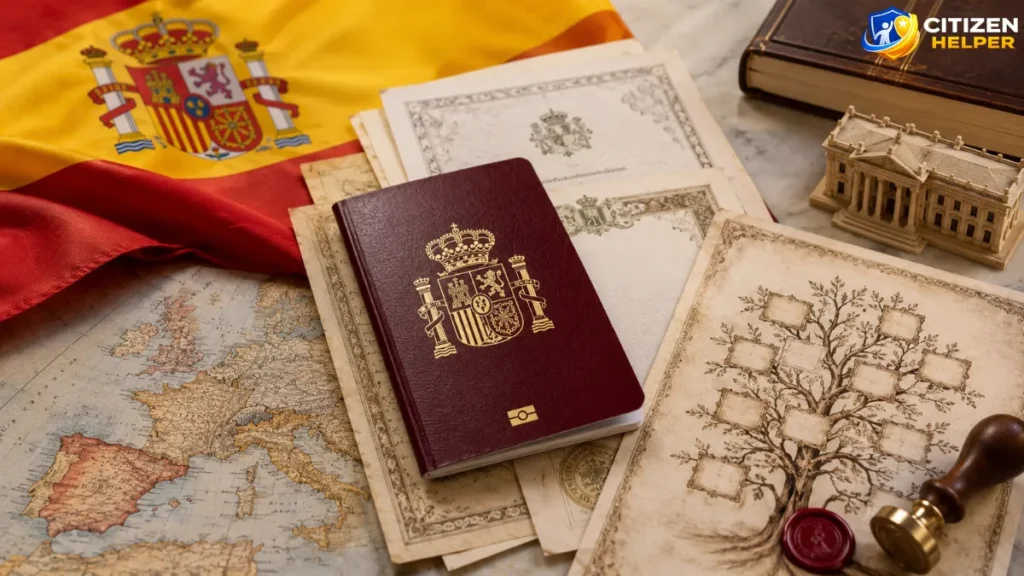
Spanish citizenship by descent, often called citizenship by ancestry, is a legal process that allows certain people to become Spanish citizens because of their family relationship to Spanish nationals.
Unlike naturalization, which usually requires years of legal residence in Spain, citizenship by descent is based primarily on ancestry.
The exact eligibility rules depend on:
- Your relationship to the Spanish ancestor
- Whether your ancestor was a Spanish citizen
- When you and your ancestor were born
- Whether Spanish nationality was maintained or lost
- Current Spanish nationality laws
Because these factors vary from one family to another, no two applications are exactly alike.
How Does Spanish Nationality by Descent Work?
Spain primarily follows the legal principle known as jus sanguinis, meaning “right of blood.”
Under this system, nationality is generally passed from parent to child rather than being determined solely by the place of birth.
This means many people born outside Spain may still qualify for Spanish nationality if one or both parents were Spanish citizens or if they qualify under specific legal provisions involving grandparents or descendants of Spanish emigrants.
Spanish nationality laws have changed several times over the years, so eligibility often depends on the law that applies to your family’s circumstances.
Who Can Qualify for Spanish Citizenship by Descent?
Several categories of applicants may qualify.
The most common include:
- Children of Spanish citizens
- Some grandchildren of Spanish citizens
- Descendants covered by the Democratic Memory Law
- Individuals whose parents recovered Spanish nationality
- Certain persons affected by historical nationality laws
Each category has different legal requirements.
Children of Spanish Citizens
The simplest pathway usually involves having a Spanish parent.
In many situations, if one of your parents was a Spanish citizen at the time of your birth, you may already have a claim to Spanish nationality or be eligible to register your citizenship.
Whether you were born:
- In Spain
- In the United States
- In Canada
- In Latin America
- Anywhere else in the world
may not prevent you from qualifying if the legal requirements are met.
However, the circumstances surrounding your parent’s nationality remain important.
Grandchildren of Spanish Citizens
Many people hope to obtain Spanish citizenship through a grandparent.
Historically, this was more difficult than applying through a parent.
However, changes in Spanish legislation have expanded opportunities for certain grandchildren of Spanish citizens.
Eligibility often depends on factors such as:
- Why the grandparent left Spain
- Whether the grandparent lost Spanish nationality
- Whether political exile was involved
- Whether the applicant falls under current legislation
Not every grandchild of a Spanish citizen automatically qualifies.
Descendants Covered by the Democratic Memory Law
One of the most significant recent developments is Spain’s Democratic Memory Law (Ley de Memoria Democrática).
This law created additional opportunities for certain descendants of Spaniards who:
- Left Spain because of exile.
- Lost or renounced nationality under historical circumstances.
- Were affected by earlier nationality laws.
The law allows many eligible descendants to apply for Spanish nationality even if previous legislation did not provide a pathway.
Applications under this law must meet the legal requirements established by Spain and are generally submitted through Spanish consulates or other designated authorities.
Official Source: Ministry of the Presidency, Justice and Parliamentary Relations – Democratic Memory Law Guidance
Can Great-Grandchildren Qualify?
Sometimes.
Unlike children and certain grandchildren, great-grandchildren do not automatically qualify simply because they have Spanish ancestry.
However, eligibility may exist if:
- A parent becomes or recovers Spanish citizenship first.
- The applicant qualifies under specific provisions of current nationality laws.
- Family circumstances satisfy the requirements of the Democratic Memory Law.
Every case depends on the family’s nationality history.
Does Birth Outside Spain Matter?
Not necessarily.
Many successful applicants were born entirely outside Spain.
People born in countries such as:
- The United States
- Mexico
- Argentina
- Cuba
- Venezuela
- Canada
- Australia
may still qualify if they satisfy Spain’s nationality laws.
The location of birth is only one factor among many.
Spanish Citizenship by Descent vs. Naturalization
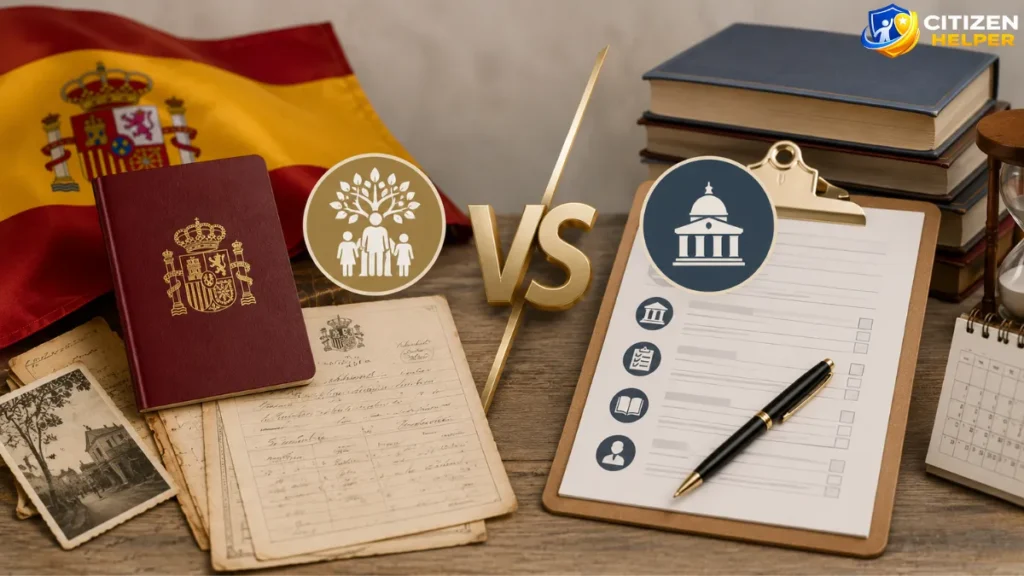
Many people confuse these two immigration pathways.
| Citizenship by Descent | Naturalization |
| Based on family ancestry | Based on legal residence |
| Usually does not require years of residence in Spain | Generally requires a qualifying period of legal residence |
| Family relationship is the primary factor | Residence, integration, and other legal requirements are the primary factors |
| May apply through a Spanish consulate abroad | Often completed after residing legally in Spain |
Understanding the difference helps applicants choose the correct legal pathway.
Why Family Records Matter
One of the most important parts of a citizenship-by-descent application is proving your family relationship.
Applicants are often required to establish a documented family line linking themselves to the Spanish ancestor.
Supporting records may include:
- Birth certificates
- Marriage certificates
- Death certificates
- Spanish civil registry records
- Nationality certificates
- Family registry documents
Missing or inconsistent records can delay an application, so gathering documentation early is highly recommended.
Common Situations That May Qualify
Although every case is unique, these examples illustrate situations where a person may be eligible to explore Spanish citizenship by descent.
Example 1
Your father was a Spanish citizen when you were born.
You may have a direct claim to Spanish nationality, depending on the applicable law.
Example 2
Your grandmother emigrated from Spain decades ago, and your family believes she lost Spanish nationality after moving abroad.
You may wish to determine whether the Democratic Memory Law provides an application pathway.
Example 3
Your parents were born outside Spain, but your grandfather was born in Spain and remained a Spanish citizen.
Depending on the facts of your family’s history and current legislation, you may have a potential claim.
These examples are only illustrations. Every application must be evaluated under current Spanish nationality law.
Common Misconceptions
Many applicants begin the process with inaccurate information.
Here are some common myths.
| Myth | Reality |
| Anyone with Spanish ancestry automatically qualifies. | False. Eligibility depends on Spanish nationality law and individual family circumstances. |
| Having a Spanish surname guarantees citizenship. | False. A surname alone is not evidence of nationality. |
| You must be born in Spain. | False. Many applicants are born abroad. |
| All grandchildren qualify automatically. | False. Eligibility varies depending on current law and family history. |
| Citizenship by descent is the same as obtaining a visa. | False. Citizenship and immigration status are different legal concepts. |
Why You Should Verify Your Eligibility Early
If you believe you may qualify, it’s a good idea to begin collecting family records as soon as possible.
Early preparation can help you:
- Locate missing civil records.
- Identify inconsistencies in family documents.
- Determine which legal pathway applies.
- Prepare for appointments with a Spanish consulate.
- Avoid unnecessary delays later in the application process.
Starting early is especially important when historical records must be obtained from multiple countries.
Official Source: Ministry of Foreign Affairs, European Union and Cooperation – Spanish Consular Services
Eligibility Requirements for Spanish Citizenship by Descent
While every application is unique, most applicants must satisfy the legal requirements established by Spain’s nationality laws.
Your eligibility depends on several factors, including:
- Your relationship to the Spanish ancestor.
- Whether your parent or grandparent was a Spanish citizen.
- The nationality law that applies to your situation.
- Whether your ancestor lost or retained Spanish nationality.
- Whether your case falls under the Democratic Memory Law or another legal provision.
Spanish authorities evaluate each application individually based on the evidence submitted.
How to Determine If You May Qualify
Before gathering documents, ask yourself the following questions:
- Was one of your parents born as a Spanish citizen?
- Was one of your grandparents born in Spain?
- Did your Spanish ancestor emigrate to another country?
- Did your ancestor lose Spanish nationality?
- Has anyone else in your family already obtained Spanish citizenship?
- Could your family qualify under the Democratic Memory Law?
The answers help determine which legal pathway may apply.
Documents Commonly Required
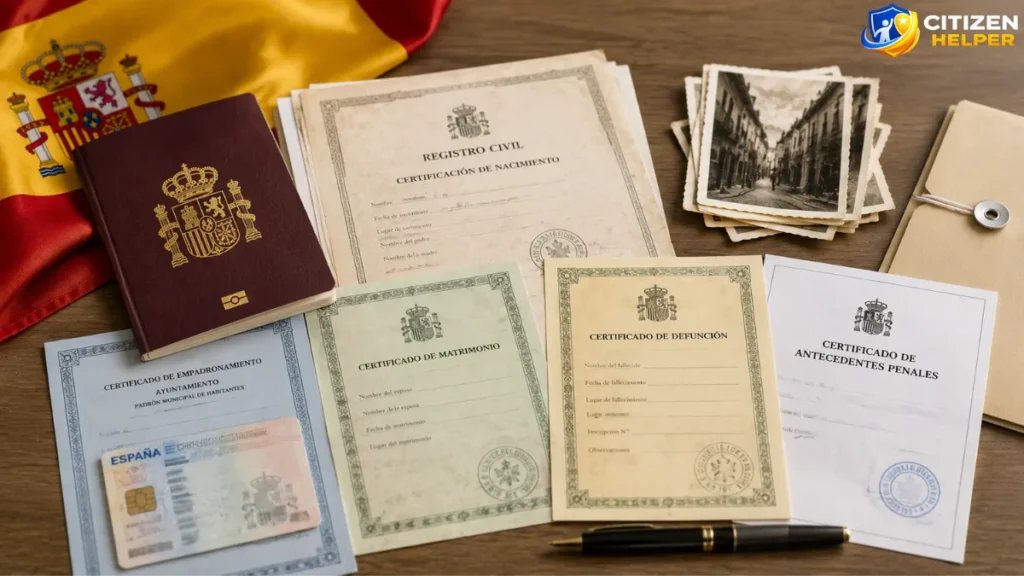
Although document requirements vary depending on the application type, many applicants are asked to provide official records establishing their family relationship.
These may include:
- Applicant’s birth certificate
- Parent’s birth certificate
- Grandparent’s birth certificate
- Marriage certificates
- Death certificates (if applicable)
- Spanish Civil Registry records
- Passport or national identity documents
- Current government-issued identification
- Proof of legal name changes (if applicable)
Foreign documents often must meet Spain’s authentication and translation requirements before they can be accepted.
Certified Translations
If your documents were issued in a language other than Spanish, you may need an official translation.
Depending on your circumstances, Spanish authorities may require:
- Certified Spanish translations
- Official translations completed by an authorized translator
- Documents translated according to Spanish legal requirements
Translation requirements can differ depending on where the application is submitted.
Apostille or Legalization
Many foreign civil documents must also be authenticated before Spain will recognize them.
Depending on the country that issued the document, this may involve:
- An Apostille under the Hague Apostille Convention, or
- Consular legalization if the issuing country is not part of the Hague Convention.
Always verify the current authentication requirements before requesting documents.
How to Apply for Spanish Citizenship by Descent
Although procedures differ depending on the legal basis for your application, the overall process generally follows these steps.
Step 1: Determine Your Eligibility
Identify which nationality law applies to your case.
This is one of the most important steps because different legal pathways have different documentation requirements.
Step 2: Gather Family Documents
Collect official records proving each generation of your family relationship.
Double-check:
- Names
- Birth dates
- Places of birth
- Marriage information
Small discrepancies can delay processing.
Step 3: Obtain Missing Spanish Records
If necessary, request documents from Spain, such as:
- Spanish birth certificates
- Civil Registry records
- Marriage records
- Other historical records
Depending on the age of the records, obtaining them may take time.
Step 4: Complete the Required Forms
The forms you’ll complete depend on the legal basis for your application.
Read every question carefully and ensure all information matches your supporting documents.
Step 5: Submit Your Application
Many applicants living outside Spain submit their applications through the Spanish Consulate responsible for their place of residence.
Applicants living in Spain may complete the process through the appropriate Civil Registry or other designated authority, depending on their circumstances.
Applying Through a Spanish Consulate
If you live outside Spain, your local Spanish Consulate is usually your primary point of contact.
The consulate may:
- Review your documents.
- Schedule appointments.
- Accept applications.
- Request additional evidence.
- Register nationality when approved.
Many consulates require appointments before accepting nationality applications.
Always review your specific consulate’s current procedures before visiting.
Can You Apply Online?
Some stages of the process may be available electronically depending on:
- Your location.
- The type of application.
- The authority handling your case.
However, many nationality applications still require:
- Original documents.
- Identity verification.
- In-person appointments.
Check the instructions provided by the relevant Spanish authority or consulate.
How Long Does the Process Take?
Processing times vary significantly.
Factors affecting the timeline include:
- Application type.
- Number of applications being processed.
- Whether additional documents are requested.
- Consulate workload.
- Civil Registry processing times.
Some applications move relatively quickly, while others may take considerably longer.
Because processing times change, there is no guaranteed approval period.
Can Family Members Apply Together?
In some situations, multiple family members may qualify through the same Spanish ancestor.
For example:
- Brothers and sisters
- Parents and children
- Multiple grandchildren
However, each applicant generally submits an individual application and must independently satisfy the applicable legal requirements.
Does Spain Allow Dual Citizenship?
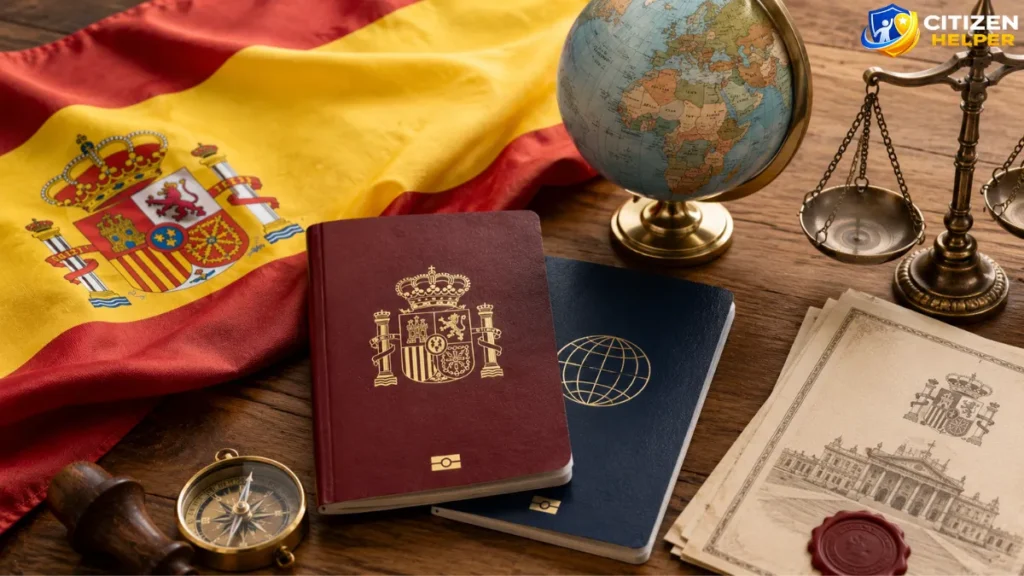
Spain’s dual citizenship rules are more complex than many people realize.
Whether you may keep another nationality depends on several factors, including:
- The legal basis for your Spanish nationality.
- Your country of citizenship.
- Any applicable treaties or legal exceptions.
- Spanish nationality law.
Some applicants may retain another nationality automatically, while others may have additional legal considerations.
Because dual nationality rules can vary, you should verify the requirements that apply to your individual circumstances before applying.
Common Reasons Applications Are Delayed
Many applications experience delays because of documentation issues rather than eligibility problems.
Common reasons include:
- Missing birth certificates
- Inconsistent names
- Incorrect dates
- Missing translations
- Documents lacking required authentication
- Incomplete application forms
- Missing appointments
- Difficulty locating historical records
Carefully reviewing your paperwork before submission can help avoid unnecessary delays.
Can an Application Be Denied?
Yes.
Applications may be denied if:
- The legal requirements are not met.
- Required documents are missing.
- Family relationships cannot be established.
- Supporting evidence is insufficient.
- The applicant does not qualify under the applicable nationality law.
If questions arise during the review process, Spanish authorities may request additional documentation before making a final decision.
Tips Before You Apply
Before submitting your application:
- Start gathering documents early.
- Verify each generation of your family records.
- Obtain certified translations if required.
- Confirm authentication requirements.
- Follow the instructions issued by your Spanish Consulate.
- Keep copies of every document you submit.
- Check that names and dates are consistent across all records.
Thorough preparation can make the application process much smoother.
Benefits of Spanish Citizenship by Descent
Obtaining Spanish citizenship offers more than the right to hold a Spanish passport. As a Spanish citizen, you become a citizen of the European Union (EU), giving you access to a wide range of rights and opportunities.
Some of the main benefits include:
- The right to live in Spain without immigration restrictions.
- The ability to work in Spain without a work permit.
- Freedom to live, work, or study in other EU countries, subject to applicable EU rules.
- Access to Spain’s public education system under applicable regulations.
- Eligibility for public healthcare under Spain’s healthcare laws and residency requirements.
- The right to vote in Spanish elections if you meet the legal requirements.
- Access to Spanish consular assistance while abroad.
- The ability to apply for a Spanish passport.
Keep in mind that some benefits depend on where you live and whether you establish legal residence in Spain.
Can You Pass Spanish Citizenship to Your Children?
Possibly.
Whether your children automatically acquire Spanish nationality depends on factors such as:
- When they were born.
- Whether you were already a Spanish citizen at the time of their birth.
- The nationality laws in effect when they were born.
- Where the child was born.
If you obtain Spanish citizenship after your child is born, additional legal procedures may be necessary depending on the circumstances.
Because these rules can be complex, it’s important to verify the current legal requirements before assuming eligibility.
Can You Lose Spanish Citizenship?
Spanish citizenship can be lost in certain situations established by Spanish law.
Examples may include:
- Voluntarily acquiring another nationality under circumstances specified by Spanish law.
- Formal renunciation in situations permitted by law.
- Failure to comply with certain nationality retention requirements in limited cases.
However, not every Spanish citizen is subject to the same rules, and many people retain their citizenship for life.
The applicable law depends on how citizenship was acquired and the individual’s circumstances.
Common Mistakes to Avoid
Many applicants unintentionally delay their applications because of avoidable errors.
Assuming Every Descendant Qualifies
Having Spanish ancestry alone does not automatically make someone eligible.
Eligibility depends on current Spanish nationality law and documented family history.
Waiting Too Long to Gather Records
Historical records can sometimes take months to obtain.
Starting early gives you more time to locate missing documents and correct errors.
Ignoring Name Differences
Even small differences between documents—such as spelling variations, missing middle names, or different date formats—can create delays.
Carefully compare every record before submitting your application.
Submitting Untranslated Documents
Documents issued in another language may need certified Spanish translations.
Always confirm the translation requirements before filing your application.
Forgetting Document Authentication
Some foreign documents require an Apostille or consular legalization before Spanish authorities will accept them.
Submitting unauthenticated documents may delay processing.
Applying Under the Wrong Legal Pathway
Spain has multiple nationality provisions.
Choosing the incorrect application route may result in unnecessary delays or a denied application.
If you’re unsure, review the official guidance from your Spanish Consulate.
Conclusion:
For many families around the world, Spanish citizenship by descent offers a meaningful opportunity to reconnect with their heritage while gaining the rights and privileges of Spanish and European Union citizenship. Whether your claim comes through a Spanish parent, grandparent, or another qualifying ancestor under the Democratic Memory Law, understanding the applicable legal pathway is the first step toward a successful application.
Since every family’s history is unique, there is no one-size-fits-all process. Taking the time to gather accurate records, verify your eligibility, and follow the guidance provided by Spanish authorities can help you avoid unnecessary delays and improve your chances of success. If you believe you may qualify, begin researching your family’s documentation early and consult the appropriate Spanish Consulate or official government resources for the most up-to-date requirements.
Frequently Asked Questions (FAQ)
Can I get Spanish citizenship through my grandparents?
Possibly.
Some grandchildren of Spanish citizens may qualify under current nationality laws, including provisions of the Democratic Memory Law. Eligibility depends on your family’s specific circumstances and the applicable legal requirements.
Is there an age limit for applying?
The applicable age requirements depend on the legal basis for your application.
Some pathways are available to both adults and minors, while others have specific legal conditions.
Review the requirements that apply to your case before applying.
Do I have to move to Spain?
Not necessarily.
Many citizenship-by-descent applications are submitted through Spanish Consulates outside Spain, and applicants do not need to relocate simply to file their application.
Do I need to speak Spanish?
Unlike some naturalization pathways, citizenship by descent is generally based on family eligibility rather than residence or language integration requirements.
However, requirements vary depending on the legal basis for your application.
Can I apply if my Spanish ancestor passed away?
Yes.
A deceased ancestor does not automatically prevent eligibility, provided you can document the family relationship and satisfy the applicable nationality laws.
Can adopted children qualify?
Possibly.
Spanish nationality laws include provisions relating to adoption, but eligibility depends on the specific legal circumstances and the age at which the adoption occurred.
Can I apply from the United States?
Yes.
Many U.S. residents submit applications through the Spanish Consulate responsible for their state of residence.
Always follow the instructions provided by your assigned consulate.
How much does it cost?
The costs vary depending on your circumstances.
Possible expenses include:
Obtaining civil records
Certified translations
Apostilles or legalizations
Passport photos
Consular fees (if applicable)
Check your Spanish Consulate’s official website for current fees and accepted payment methods.
How long does it take to receive a decision?
Processing times vary significantly.
The timeline depends on:
Your application type.
Document completeness.
Consulate workload.
Civil Registry processing.
Whether additional evidence is requested.
There is no guaranteed approval timeframe.
Can I apply if I don’t have all my family documents yet?
Yes, you can begin gathering information, but you’ll generally need sufficient documentation before your application can be approved.
If records are missing, you may need to request copies from civil registries or archives before proceeding.
Key Takeaways
Spanish citizenship by descent allows certain people with Spanish parents, grandparents, or other qualifying ancestors to claim Spanish nationality.
Spain primarily follows the principle of jus sanguinis, meaning nationality is often passed through family relationships rather than place of birth.
The Democratic Memory Law has expanded eligibility for many descendants of Spanish emigrants and exiles.
Every application depends on individual family history and the nationality laws that apply to that case.
Applicants should gather official records early, verify translation and authentication requirements, and follow instructions from the appropriate Spanish Consulate or Civil Registry.
Because nationality laws can change, always confirm the latest requirements through official Spanish government sources before applying.