If your Permanent Resident Card is about to expire, knowing how to renew a Green Card is essential to maintaining proof of your lawful permanent resident status in the United States. Although an expired Green Card does not automatically end your permanent resident status, it can create problems when traveling internationally, applying for a job, or verifying your identity.
The Green Card renewal process is generally straightforward. Most permanent residents renew their card by filing Form I-90, Application to Replace Permanent Resident Card, with U.S. Citizenship and Immigration Services (USCIS). Depending on your situation, you may be able to submit the application online or by mail.
In this guide, you’ll learn who needs to renew a Green Card, when to apply, the documents you’ll need, filing fees, processing times, common mistakes to avoid, and answers to frequently asked questions.
Quick Answer
If you’re wondering how to renew a Green Card, here’s the short answer:
- Renew your Green Card if it will expire within the next 6 months or has already expired.
- File Form I-90 with USCIS.
- Submit the required supporting documents.
- Pay the applicable filing fee if required.
- Attend a biometrics appointment if USCIS schedules one.
- Wait for USCIS to process your application and mail your new Green Card.
Official Source: USCIS – Form I-90, Application to Replace Permanent Resident Card
What Is Green Card Renewal?
Green Card renewal is the process of replacing an expiring or expired Permanent Resident Card with a new one. The card serves as proof that you are a lawful permanent resident (LPR) of the United States.
For most permanent residents, a Green Card is valid for 10 years. When the expiration date approaches, you should renew the card to continue having valid evidence of your immigration status.
It’s important to understand that an expired Green Card does not mean you lose your lawful permanent resident status. However, carrying an expired card may cause difficulties when:
- Returning to the United States after international travel
- Completing employment verification (Form I-9)
- Applying for certain government benefits
- Renewing a driver’s license in some states
- Verifying your identity for financial or legal purposes
Official Source: USCIS – Green Card
Who Needs to Renew a Green Card?

Most lawful permanent residents with a 10-year Green Card should renew it before it expires.
You should generally renew your Green Card if:
- Your card will expire within the next six months.
- Your Green Card has already expired.
- Your card is damaged or unreadable.
- Your card has been lost or stolen.
- You legally changed your name or other identifying information.
- USCIS issued your card with incorrect information.
However, conditional permanent residents who have a 2-year Green Card follow a different process. Instead of filing Form I-90, they must file the appropriate petition to remove the conditions on their residence before the card expires.
Official Source: USCIS – Remove Conditions on Permanent Residence
When Should You Renew Your Green Card?
USCIS recommends renewing your Green Card if it will expire within six months.
Applying early helps reduce the chance of experiencing problems while waiting for your new card.
Many people wait until the last minute, but renewing early can help avoid complications involving:
- International travel
- Employment verification
- Government identification
- State-issued licenses
- Financial institutions
If your Green Card has already expired, you should file Form I-90 as soon as possible.
Remember, your immigration status generally remains the same even if the physical card expires. However, having valid proof of permanent residence is important for many everyday situations.
Can You Renew an Expired Green Card?
Yes.
If your Green Card has already expired, you can usually still renew it by filing Form I-90.
Many permanent residents don’t realize they can continue living in the United States even after the card expires because permanent resident status itself does not automatically expire with the card.
However, delaying renewal may create unnecessary difficulties, especially if you need to:
- Start a new job
- Travel outside the United States
- Return after international travel
- Prove your immigration status
- Obtain certain government services
For that reason, it’s best to renew your Green Card before the expiration date whenever possible.
How To Renew A Green Card Step By Step
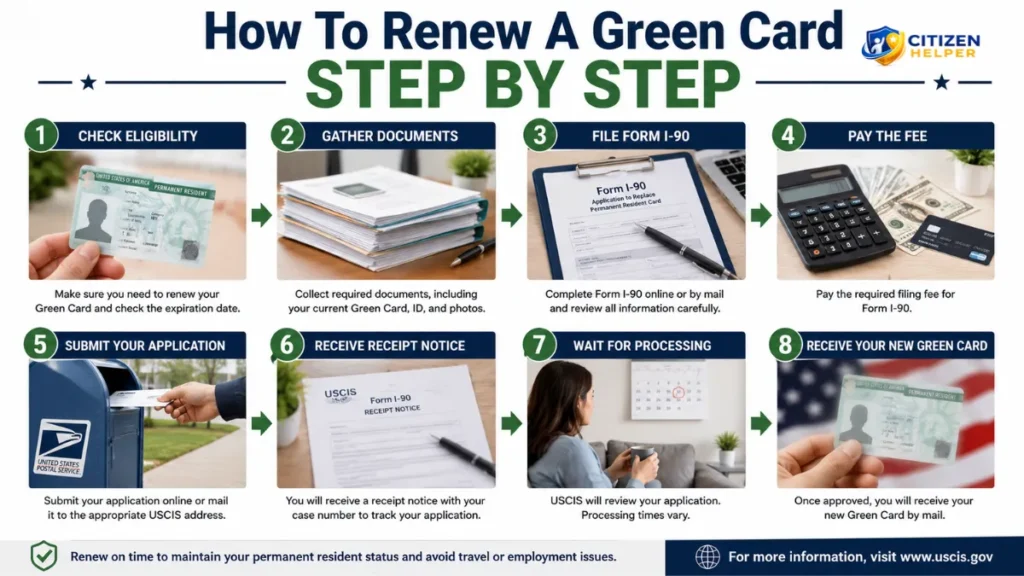
Renewing a Green Card is usually a simple process if you carefully follow each step.
Step 1: Confirm You’re Eligible
Before filing, confirm that you’re eligible to renew using Form I-90.
Generally, Form I-90 is used by lawful permanent residents with a standard 10-year Green Card.
If you have a conditional Green Card, you’ll likely need a different USCIS form instead.
Step 2: Gather the Required Documents
The documents you’ll need vary depending on why you’re renewing your Green Card.
Common documents include:
- Copy of your current Green Card (front and back)
- Government-issued identification (if requested)
- Legal name change documents (if applicable)
- Police report (if your card was stolen)
- Court documents (when required)
- Supporting evidence related to your specific situation
USCIS may request additional documents after reviewing your application.
Preparing accurate documentation before filing can help prevent delays.
Official Source: USCIS – Form I-90 Instructions
Step 3: Complete Form I-90
The next step in learning how to renew a Green Card is completing Form I-90, Application to Replace Permanent Resident Card.
This form asks for information about your identity, immigration history, and the reason you’re renewing or replacing your Green Card. Before submitting the application, review every answer carefully to make sure it is accurate and complete.
Providing incorrect information or leaving required fields blank may delay your application or result in USCIS requesting additional evidence.
Official Source: USCIS – Form I-90
Step 4: Submit Your Green Card Renewal Application
USCIS allows many applicants to submit Form I-90 online, while others may need to file by mail depending on their circumstances.
Filing Online
Filing online is often the quickest and most convenient option. After creating a USCIS online account, you can:
- Complete Form I-90 electronically.
- Upload supporting documents.
- Pay any required fees online.
- Receive case updates.
- Respond to USCIS requests electronically.
- Track your application status.
Many applicants prefer online filing because it reduces paperwork and makes it easier to monitor the progress of the case.
Filing by Mail
If you choose to file by mail, complete Form I-90, include the required supporting documents, and send your application to the correct USCIS filing address listed for your situation.
Always use the latest mailing instructions provided by USCIS before sending your application.
Official Source: USCIS – Form I-90 Filing Information
Step 5: Pay the Required Filing Fee
Depending on your situation, you may need to pay a filing fee when renewing your Green Card.
The amount can vary based on USCIS regulations and whether any fee exemptions apply.
Before submitting your application, always verify the current fee on the official USCIS website, as immigration filing fees may change.
If you qualify for a fee waiver or another exception, review the USCIS eligibility requirements before filing.
Official Source: USCIS – Fee Schedule
Step 6: Attend Your Biometrics Appointment (If Required)
After USCIS receives your application, you may be scheduled for a biometrics appointment.
During this appointment, USCIS may collect:
- Fingerprints
- Photograph
- Digital signature
The information helps USCIS verify your identity and complete background checks.
If you receive a biometrics appointment notice, attend it on the scheduled date unless USCIS approves a request to reschedule.
Missing your appointment without following USCIS instructions could delay your application.
Step 7: Wait for USCIS to Process Your Application
After completing the required steps, USCIS reviews your application and supporting documents.
Processing times vary depending on several factors, including:
- USCIS workload
- Your application type
- Whether additional evidence is requested
- Background checks
- Individual case circumstances
Some applicants receive their new Green Card sooner than others, so there is no guaranteed timeline.
You can monitor your application’s progress through your USCIS online account or by using the USCIS Case Status tool.
Official Source: USCIS – Check Case Processing Times
How Long Does It Take to Renew a Green Card?
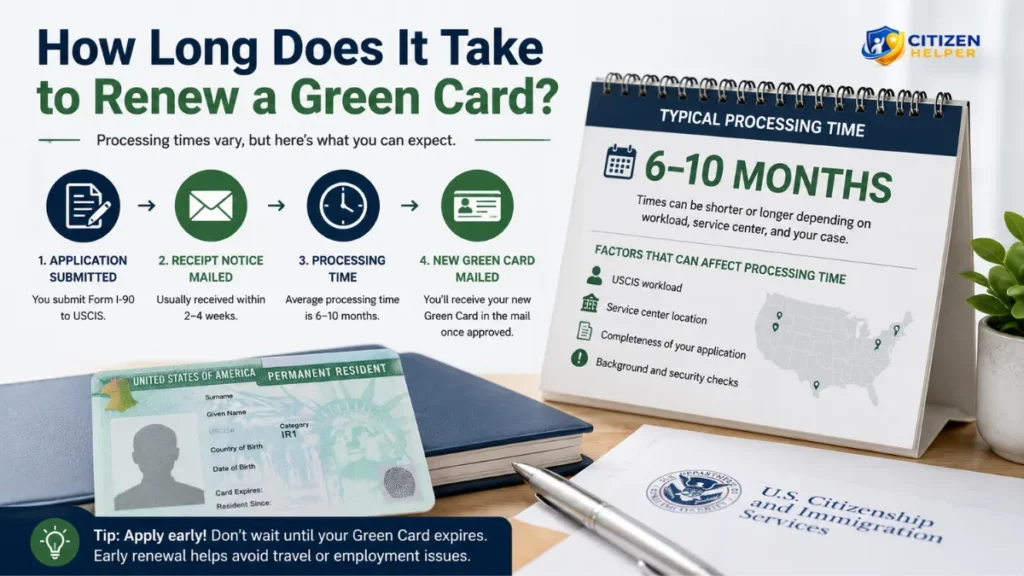
One of the most common questions applicants ask is how long Green Card renewal takes.
The answer depends on USCIS processing times, which can change throughout the year.
Some applications are processed more quickly, while others may take longer due to higher application volumes or additional review.
Instead of relying on estimates from unofficial websites, always check the current USCIS processing times for the most accurate information.
Official Source: USCIS – Processing Times
Can You Travel While Your Green Card Renewal Is Pending?

Many permanent residents worry about traveling after submitting Form I-90.
Whether you can travel depends on your individual circumstances and the documents you have available.
Before making international travel plans, make sure you understand the documentation required to return to the United States.
In some situations, USCIS may issue documentation that helps demonstrate your lawful permanent resident status while your renewal application is pending.
Because travel requirements can vary, review the latest USCIS guidance before leaving the United States.
Official Source: USCIS – Green Card
What Happens After You Submit Form I-90?
After USCIS accepts your application, you can generally expect the following steps:
- USCIS receives your application.
- A receipt notice is issued.
- A biometrics appointment may be scheduled.
- USCIS reviews your application.
- Additional evidence may be requested if necessary.
- A final decision is made.
- Your new Green Card is mailed if the application is approved.
Keeping your mailing address updated with USCIS is important so you receive notices and your new card without delays.
Common Green Card Renewal Mistakes to Avoid
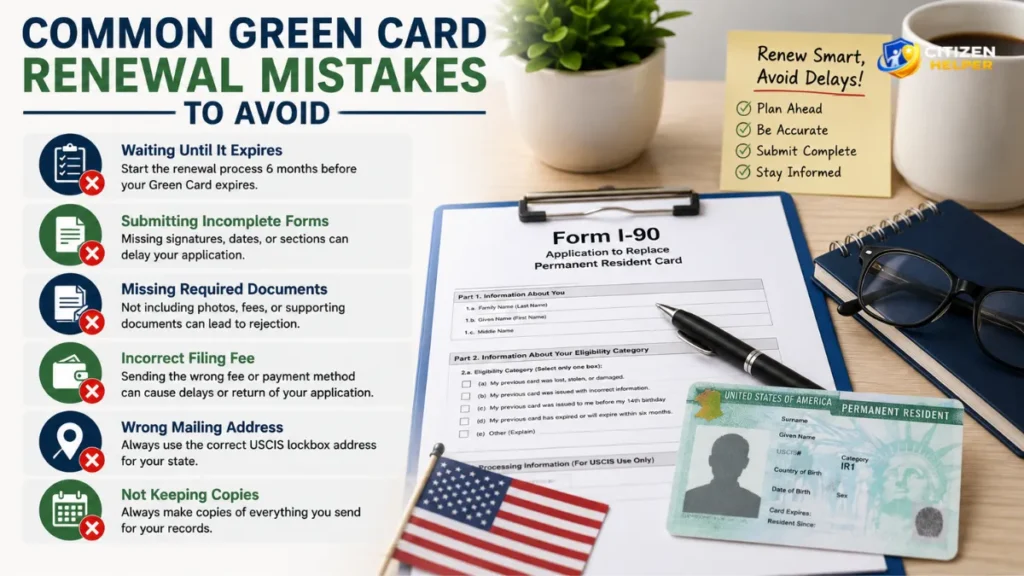
Avoiding common mistakes can help prevent unnecessary delays.
Some of the most frequent errors include:
- Waiting until the last minute to renew.
- Using an outdated version of Form I-90.
- Forgetting to sign the application when filing by mail.
- Uploading unclear or incomplete documents.
- Entering incorrect personal information.
- Failing to respond to a USCIS Request for Evidence (RFE).
- Missing a scheduled biometrics appointment.
- Forgetting to update your mailing address after moving.
Carefully reviewing your application before submission can help make the renewal process smoother.
Conclusion:
Understanding how to renew a Green Card can help you avoid unnecessary delays and maintain valid proof of your lawful permanent resident status. For most permanent residents with a 10-year Green Card, the process involves filing Form I-90, submitting the required documentation, attending a biometrics appointment if requested, and waiting for USCIS to process the application.
Although an expired Green Card generally does not affect your permanent resident status, renewing it before the expiration date can make travel, employment verification, and other everyday tasks much easier. Taking action early also reduces the likelihood of interruptions caused by processing delays.
Because immigration policies, filing fees, and processing times may change, always verify the latest requirements directly with USCIS before submitting your application.
Frequently Asked Questions (FAQ)
Do I lose my permanent resident status if my Green Card expires?
No. In most cases, the expiration of your Green Card does not mean you lose your lawful permanent resident status. However, an expired card is no longer valid proof of your status, which can create problems when traveling, starting a new job, or completing identity verification.
Can I renew my Green Card before it expires?
Yes. USCIS generally recommends renewing a 10-year Green Card if it will expire within the next six months. Renewing early helps reduce the risk of delays and ensures you continue to have valid proof of your permanent resident status.
Can I renew my Green Card online?
Many applicants can renew their Green Card online by submitting Form I-90 through a USCIS online account. Others may need to file by mail depending on their situation.
What documents do I need to renew my Green Card?
The required documents depend on your reason for renewing. Common supporting documents include:
1. A copy of your current Green Card.
2. Legal name change documents, if applicable.
3. Identification documents requested by USCIS.
4. Additional evidence related to your specific situation.
Always review the latest Form I-90 instructions before submitting your application.
Can I work while my Green Card renewal is pending?
Generally, lawful permanent residents remain authorized to work in the United States even while a Green Card renewal application is pending. However, employers may require valid documentation to complete employment verification.
Can I check the status of my Green Card renewal?
Yes. You can track your application by using your USCIS online account or the USCIS Case Status tool after receiving your receipt notice.
What if my Green Card is lost or stolen?
If your Green Card has been lost, stolen, destroyed, or significantly damaged, you should generally file Form I-90 to request a replacement card as soon as possible.
Do conditional Green Card holders use Form I-90?
No. Individuals with a 2-year conditional Green Card usually must file the appropriate petition to remove conditions on their residence instead of using Form I-90 to renew their card.